
• Home
  • About Jonathan
  • Essay
  • Fiction
    • Rant
  • Memoir
  • A House Divided, Full of Secrets: Kid Lit., Conspiracies and the Bohemian Club

Ghosts of Anti-Fascism Past

~ Essays. Memoirs. Rants.

Ghosts of Anti-Fascism Past

Author Archives: Jonathan Mozzochi

Antifa Spycraft

23 Tuesday Jan 2018

Posted by Jonathan Mozzochi in Essay, Memoir

≈ Leave a comment

Tags

alt-right, anarchism, anti-fascism, antifa, coalition for human dignity, communism, fascism, it’s going down, Nationalism, Racism, rose city Antifa, skinheads, socialism, spycraft, steve bannon

Antifa Emblem

I probably cut an odd figure in my Carhartt Washed-Duck Tool Pants, black Thrasher hoodie and industrial neoprene gloves. Waist-deep in a dumpster I am making a fashion statement of sorts, wading through the quotidian refuse of an office park: coffee grinds, fast food containers, styrofoam peanuts, cardboard boxes, used printer cartridges and, much to my chagrin, the occasional dirty diaper. It’s 1990 and my comrades and I are ‘dumpster diving’ out in the suburban sprawl of Portland, Oregon. But it is neither food nor salable commodities we seek. We are churning through garbage in search of the political droppings of a far right organization housed there. The take from this ‘trash cover’ (to use a term of the trade) could help neutralize a far-right group, or at least make less effective their attacks on vulnerable communities. After a few night’s worth of applied garbology–Disco! Reams of perforated computer paper reveal detailed membership lists. We don’t have time to do anything other than scan it–the headings confirm it is from our target–so we bag the loot and skidaddle.

Your trash, my treasure–asshole.

From there the black garbage bags are transported to a warehouse where the really difficult slog begins. We spread out a large tarpaulin and separate the wheat from the chaff. What we call raw, primary data–everything from membership rosters to post-it notes, utility bills to grocery lists–is sorted and prepped so as to be of some use. Then we feed the raw data into already existing databases and files, cross referencing it to identify matches and points for further analysis. In other words, manual data entry is how we transformed data into information (no shortcuts from analog to digital back then). If we do our opposition research well, that information can reach its final form: actionable intelligence. For instance, the computer printouts provide detailed information on the targeted organization’s supporters–donation amounts, addresses, phone numbers, occupations, etc. Some of those donors may not want their identities released to the public. We do. Likewise, the discovery of internal memoranda can provide a window into a group’s organizational capabilities, relations with other political formations or even internal dynamics, such as factional fights, that we can exploit. Finally, a report can be generated and the findings ready for dissemination. Then it’s back into the dumpsters and the process repeats itself. From data collection to information analysis to actionable intelligence.

Our fashion statement is also therefore a political statement.

In all of this our team of researchers were practicing a form of ‘para politics’, i.e., political conduct apart from voting or demonstrating, polling or political speech. There are other, less charitable meanings associated with this term, but I am employing it here in a relatively value neutral manner. This is, of course, the province of the Antifa. For our purposes here, let’s call it Antifa spycraft.

If my late-night shenanigans of decades past often yielded material for critical print, radio and television stories on the far right, they also often helped communities better protect themselves from attack. In this case, our information helped ‘out’ more than a few ‘down low’ bigoted businesses and politicians. Oh, and it was legal. In many locales, the laws around trash collection are often ambiguous. In this case, because the material we absconded with was in a dumpster, it was no longer private property. Likewise, depending on your locale, once your garbage can is out on a sidewalk or street, it may be free for anti-fascists–or fascists, for that matter–to rummage through. This low tech tactic of opposition research–today’s equivalent of hacking someone’s digital footprint–was a time-honored weapon in the Antifa arsenal. But not the only weapon.

If back in the day we had a ‘trash cover’ on an enemy political group, there was a good chance we also had an infiltrator attending meetings and other activists taking down license plates and shooting video and photos of their events. Much like the shitheads at Project Veritas and Brietbart News do now, but long before those clowns were selling their hack jobs to their paymasters, we pushed the limits of acceptable political engagement. Today, effective anti-fascists, especially those grouped around Rose City Antifa and It’s Going Down, as well as activists featured in Mark Bray’s Antifa: The Anti-Fascist Handbook understand this. It’s well past time to have a debate with those socialists and other radicals who don’t seem to get it.

That the political tradition and contemporary efforts of the Antifa are valuable, even essential, to the broader socialist struggle is not accepted by all comrades. In spite of an honorable and effective history, there are left radicals who not only dismiss this work, but denigrate those who practice it. Quite a few regard the most militant and therefore visible actions of the Antifa as anathema to our broader struggle. Many misguided socialists prefer to ignore this vital work or, when such intelligence is used by an Antifa fighting force, such as in Charlottesville, raise cries of ‘adventurism’, perhaps laced with a quote from Lenin on infantile disorders.

But if you ask this old ghost there is nothing more infantile than attacking the work of comrades you know next to nothing about; except, perhaps, doing so from a Marxist theoretical framework so sclerotic it can regurgitate that fatal stupidity all veteran anti-fascists are familiar with: “The enemy is not fascism as much as it is capitalism that exploits the working class according to democratic and civilized norms that would never be associated with the swastika or other fascist regalia.” (‘Antifa and the Perils of Adventurism” by Louis Proyect, August 15, 2017. My emphasis). Proyect, whose nom-de-chair is The Unrepentant Marxist, slanders antifa activists when he’s not busy digging himself out from under all the free dvds (he never tires of letting us know) tinseltown sends him for film reviews.

He goes lowest when addressing the street battles between anti-racists and neo-Nazis that took place in Charlotesville last year.

He writes, “Turning now to Charlottesville, it is obvious to me that if the protests had been disciplined and under the control of marshals such as was the norm during the Vietnam antiwar movement, there would have been much less of a chance that James Fields would have been able to drive his Dodge Challenger into a crowd, killing a young woman and injuring 19 others.”

Here Proyect is laying the death of Heather Heyer at the feet of the Antifa, instead of where it belongs, with the neo-Nazi who ran her over. Elsewhere he refers to Antifa activists as ‘boys’ engaging in ‘childish acting out’. And unruly boys need discipline, don’t they? Proyect apparently wants cops, in the form of movement ‘marshals’, to get them back in line, with a spanking, if necessary. This bit of scolding he digs up from his glory days in the abject failure that was the Vietnam antiwar movement. But the important lesson of Charlottesville is completely lost to Proyect, which is in the role the Antifa played in protecting religious pacifists from attack. Cornel West testified to this development, something that should be built upon. Leftists with integrity, who know when to shut the fuck up when they are out of their element of expertise, should support the Antifa, not hang them out to dry.

What Proyect does not understand is twofold: the nature of neo-fascism in the 21st Century and how a corresponding anti-fascism, to be effective, must be somewhat different from other forms of protest and organizing.

By definition Antifa organizing must contend with vigilante forms of attack–those that have their origins largely outside the state repressive aparatus. In other words, fighting racist assholes is not the same as going door-to-door collecting signatures for a ballot initiative or candidate, much less reviewing the latest art house cinema production.

The hinge that supports the door through which all revolutionary antifascists must pass–from a coherent definition of fascism to a retooling of anti-fascism–is intelligence, by which I mean spycraft. There is no substitute for knowing your enemy, preferably much better than they know themselves. No one else will do it. Cops reduce everything to their bailiwick: criminality. Reporters personalize the far right, always looking to sell a story. Academics do post-mortems with an eye towards predictability–usually unconnected with the flesh and blood Antifa struggle and therefore too little, too late. Liberals wring their hands about free speech and fumble about for that phantom limb within the democratic party that might deliver them from ‘hate’. Anti-fascists are the only political force intent on destroying both the conditions that continually regenerate fascism as well as the recurrence of the fascist plague itself.

This role can only be successfully carried out by anti-fascists who employ measures of antifa spycraft against our enemies. One cannot gain this critical advantage through anything other than counter-intelligence: no amount of long-form analyses of the falling rate of profit or the changing demographics of the working class will tell you this and it cannot be divined through oracles–whether in the form of tea leaves or data science. Anti-fascists must have the ability to infiltrate neo-fascists both to disrupt and neutralize their efforts and to protect communities they attack.

How to do this begins with a counterintuitive hidden in plain view. The state, law enforcement in particular, is governed by a set of regulations that are not the same as those that govern citizens and many others. People can engage in intelligence gathering in ways that are often (though not always) rendered problematic for a cop or official. Furthermore, the person of interest to an antifa spy is often not a public official but a private citizen, perhaps a public figure, in many ways more open to surveillance and their networks thereby to penetration. This also applies to the civic and political groups a far right activist works with. While it may be quite beyond the technical capability of an antifa activist to hack the confidential informant records of a local cop, it is certainly within their capability to wade through the trash of a local fascist.

Today, many Antifa groups continue in this same tradition with detailed, publicly available and actionable intelligence on far-right activists–mug shots, addresses, workplaces, quotations, etc. Furthermore, contrary to claims that it’s too expensive and/or complicated to practice spycraft (leave it to the professionals!?) amateur spies are essential to the Antifa. Another way to think about this is that the type of struggle the Antifa is engaged in will in large part determine its methods, much like clinic defense organizations have long utilized opposition researchers in their work defending clinics against the anti-abortion movement, especially when they cannot rely on the state to do so.

It should be obvious that fighting the far-right is not the same as fighing corporations or the state; and the Antifa is not synonymous with the Black Bloc, another elementary distinction that eludes Proyect, but will have to wait for another time.

To continue, a cop generally has to have ‘probable cause’ to search through someone’s garbage and will likely be required to leave a paper trail (digital footprint) of their activity. In other words, because of the oppositional nature of much of the far right–the fact that it occupies a contradictory relationship with the state, often outside of it and even opposed to it–forms of anti-fascist resistance can penetrate it by different means. Opportunities for disrupting the far right present themselves in ways that organizing a union drive at a multinational corporate factory do not, and, also, that creative intelligence work can provide the basis for work between communities that might not otherwise work together. This doesn’t, of course, mean that elements of the state don’t overlap with the far right (after all, Donald Trump is president) but that anti-fascists need to take the threat of their activism seriously.

In my experience the value of anti-fascist work was always best determined in close consultation with other radical groups and communities targeted by the far right. In “Death to the Klan” and Armed Antifascist Community Defense in the US (It’s Going Down, July 26, 2016) there is a useful review of such efforts in Portland, Oregon during the late 1980s and 1990s.

“…[groups] like the Red and Anarchist SkinHeads (RASH) and the SkinHeads Against Racial Prejudice (SHARPs) found themselves in frequent battles with neo-fascists converging on Portland. A group called Coalition for Human Dignity (CHD) activated not just to beat back the onslaught of skinheads, but to transform racial consciousness in Portland. They used the strategies developed by ARA [Anti Racist Action] to expose and shame skinheads wherever they showed their faces, getting them fired from their jobs and evicted from their apartments. However, when skinheads began to harass local members of the community, attacking their houses and cars, CHD devised a decentralized community self-defense strategy.”

In the same article an old Portland comrade of mine, M. Treloar, is interviewed by It’s Going Down activists and elaborates:

“There were several situations where our people who had concealed weapons were confronted by groups of boneheads and either pulled the weapon or made it clear that they were armed and the boneheads backed off…There is no doubt in my mind that in several instances they would have been attacked, since we had people who were taking down car license plate numbers, staking out houses or infiltrating gatherings.”

“The CHD mobilized to form a media defense position, which helped generate positive public opinion….What’s notable is again the people who attacked the boneheads after a certain point did very little time, and were generally hailed as heroes in the community…”

From very early on the work of the Coalition for Human Dignity in Portland, Oregon (I was a founding member) targeted the social base of neo-fascism: white nationalism and the Christian Right. This definition intentionally cut across class lines–rendering racist reaction as neither the exclusive rotted fruit of the ruling class (capitalism releasing fascist antibodies to protect itself) nor principally the unresolved grievances of a white working class left behind by captialist development (two fairly typical myopic explanations of the re-emergence of the far-right.)

Back then, much as today, the issues of choice for far-rightists were anti-black and anti-latino racism and homophobia. It should be noted that at this time (1980s-1990s) the two main political parties and all statist anti-hate groups (SPLC, ADL, etc.), scrupulously avoided homophobia as a political issue and did not include bigoted elements of the Christian right nor anti-immigrant groups within their definition of ‘hate groups’. It was radical LGBTQ and fight-the-right activists who pushed them to do so by being more effective than they ever could be. But, nonetheless, organizing in the early nineties had to contend with the routine dismissals of the Christian Right as backwoods hicks, neo-Nazis as cults and criminals and racist skinheads as yet another counter-cultural youth rebellion, all destined to pass–if they hadn’t already–into the dustbin of history. But they didn’t, and neither did we. So many premature obituaries of the Paleo-conservatives and the Christian Right have been issued and reissued since then that it is staggering to consider not only their continued relevance today but their central role in the Trump electoral victory, and how spectacularly wrong those analysts were about their political prospects.

Many months after Trump’s victory, in a series of articles for Catalyst, Jacobin and New Left Review one of the most astute Marxist analysts today, Mike Davis, finally got around to noting the confluence of white nationalism and the Christian Right in Trump’s victory.  That it took so long for the socialist left to make this observation is disturbing and highlights the fact that if anti-fascists lack the theoretical sophistication of New Left Review contributors, they more than make up for it by actually fighting fascism and capitalism, rather than just writing about it, after the fact.

On the other hand, if antifa groups want to have a say in how to oppose fascism, theoretical clarity is certainly important. The reason the best anti-fascist fighters have always come from socialist, anarchist and communist traditions is because they understood the first principle of anti-fascism: fascism is our mortal enemy, and must be fought.

Saying as much need not always involve alliances with liberals and conservatives that necessarily mean capitulation to those forces. If one has a decisive advantage in intelligence, it can be used to establish the political parameters of such alliances or agreements. If, however, antifa groups do not have an ‘intelligence capacity’ they will cede the right to effectively fight fascism, and thereby protect communities under attack, to others. That right, by the way, is earned; sometimes in a dumpster.
Share this:

  • Click to email a link to a friend (Opens in new window) Email
  • Click to share on X (Opens in new window) X
  • More
  • Click to share on Facebook (Opens in new window) Facebook
Like Loading...

Ghosts of Anti-Fascism Past

20 Friday Oct 2017

Posted by Jonathan Mozzochi in Essay

≈ Leave a comment

Tags

anti-fascism, antifa, fascism, Trump

I am half out of my chair, wagging a finger at a rumpled comrade across the conference table. He is mouthing yet another misbegotten argument. But, before I can lob a verbal hand grenade his way, my erstwhile rival employs a bit of misdirection, using a card trick to illustrate how ‘false populists’ dupe the unwitting into acting against their own interests. The slight of hand lards a meandering presentation, something about fighting extremism but accepting ‘real’ grievances, supporting tolerance and diversity but rejecting hate and privilege, and is taken by many in attendance to be the summit of human wisdom on the topic at hand, which is fascism. I want to throw something—or throw up. It is about 1995, somewhere in the United States (really anywhere will do) and a dear friend and mentor is quietly urging me to stop wagging my finger.

“Sit down!” He says.

“Fold your hands into your lap and let him speak…then pull it apart, piece by piece.”

Then, he whispers, “Omne trium perfectum. Tell them what you are going to tell them. Tell them. Tell them what you just told them.”

Huh.

Good advice when you are proposing ideas that break with accepted conventions; excellent advice if your emotions drive your intellect in the manner of a soap box orator. Throughout this gathering, held among fight-the-right activists from around the country, I try my best. But my best is not enough. My ideas don’t carry the day.

It is now some 20 years later and I’m not half out of my chair, nor am I standing on it. I’m throwing it—perhaps at you.

I am a ghost of anti-fascism past.

A restless spirit from history; a chair flying past your ear.

While I am not so arrogant to claim that if my ideas had carried the day then we wouldn’t be faced with a President Trump today, I am brash enough to state that the ideas which did carry the day during that gathering also failed to do as much.

Perhaps I can jog a memory that will cause you to shift uncomfortably in your chair. Am I mocking yet another premature obituary of the Christian right? Am I insisting that anti-fascists confront white nationalists on their own terrain? Am I noting how fascism can shape-shift and thereby ensure its enduring political relevance? Am I pounding my fist on the table, demanding foundations fund Antifa spy-craft instead of yet another conference on privilege? I hope the outline of my silhouette makes you a bit uneasy. But, behind every posthumous revenge lurks a pyrrhic victory. I am a ghost, after all, with nothing left of me but these words in the digital ether.

Don Hammerquist, in his valuable booklet Fascism & Anti-Fascism opens with the self-effacing statement:

“Feel free to shoot down any part of the argument, but remember that on the major points, validity isn’t ultimately a scholastic matter, but an issue that will be determined and ‘decided’ in struggle.” True enough. Feel free to attack what I write, too. However, keep in mind another dictum coined by C.L.R James on the same topic:

“A correct orientation does not mean victory. Incorrect orientations so glaringly false lead to certain defeat.” (The World Revolution 1917-1936, Chapter 12 “After Hitler, Our Turn”) The title of that chapter should be familiar to you, likewise the singular importance of its lesson.

With that in mind, here’s what I’m going to tell you, in three parts, naturally.

What you consider helpful in answering the age-old question ‘What is fascism?’ has probably been so inept as to invite that riposte rooted in mathematics: it is so bad it doesn’t even qualify as wrong. When trying to grasp the nature of fascism many radicals lean heavily on the tortured language of ‘populism’ and end up talking about choo-choo trains. Likewise, many socialists will suddenly morph into economic nationalists and start furiously digging analytical rabbit holes, reinforcing them with a maze of mirrors where we watch each other shadow box. It can be confusing. So, you probably don’t understand what fascism was, much less what it has become. Oh, I know. Who does? Even Nate Silver, that oracle of political prognostication, seemed shocked to find himself saying the words “white nationalism” on a podcast in the summer of 2016 when, had he understood the implications of what he was saying, it could have made a difference. But no matter, revolutionaries shouldn’t expect much from oracles. In any case, even back then it was clear that while the paleo-conservatives had successfully reinvented themselves as the alt-right through audacious counterintelligence initiatives such as the Acorn sting engineered by The Drudge Report, the salacious faux news of Brietbart, the white identitarian antics of Milos Yananoupoulis and the hacked Leninism of Steve Bannon, the progressive and socialist left were busy holding hands, examining and cross-examining their ‘privileges’ or feeling around for a phantom limb that had been amputated by the Democratic party. Meanwhile, much of the socialist left, including comrades at the International Socialist Organization (ISO) offered up wholly derivative, second rate accounts of fascism, forcing the tired bones of comrade Trotsky to carry their water, his petrified frame long ago having collapsed from the strain. But fascism is not a holdover from the past–a ‘basket of deplorables’ as some inept politician once remarked–nor ignorant hicks who clutch onto their God and guns because they fear being left behind. Fascism appears today as a tendency within our political and cultural age and offers itself as an exit strategy from the unsolvable contradictions of our present regimes of accumulation. It is thoroughly modern, or post-modern, if you insist. As white Christian nationalism it vies for supremacy within and between contemporary social classes throughout Europe and North America, where it has a political geography. That’s why Trump chose Pence as his running mate. It is real. It has always been with us. It is here, now and is both similar to, yet different from, ‘fascisms’ from previous eras. While this new fascism comes from the same family tree as its immediate predecessor, cold war fascism, and its antecedent, classical fascism, in important respects it differs from them, too. Getting that overlap and divergence correct is important. The Tea Party rebellion was the bridge between the end of cold war fascism and the beginning of 21st century fascism; of the transformation of the paleoconservative right—always the incubator of fascism in the United States—into the Alt-Right.

If you don’t know what fascism is, you will probably have a hard time fighting it effectively—even if you somehow arrive at the conclusion that it should be fought. Following the victory of Trump, liberals and progressives are leaping to join ‘the resistance’. But their methods follow their theory: fascism is something that comes from outside, not a tendency within our political culture. Their current obsession with Putin is a reflection of their diluted nationalism—what Albert Einstein called the “measles of humanity” that some Democrats offer as an alternative to the much more powerful Spanish Influenza on offer by Republicans. These “I’m With Her Anti-Fascists” who want Trump ridden out of town on a rail—preferably by the cowboys of the ‘Deep State’—should make any radical uncomfortable. But at least they recognize the existence of that political tendency, though their understanding of it is fatally flawed and their methods for confronting it a double-edged sword. On the other hand, for those of us from socialist, anarchist and communist traditions, it can be a bit disorienting to see an avowedly socialist journal such as Jacobin spend nearly seven years effectively arguing against the existence of, much less the need to fight, fascism. And that editorial line, that fighting the right amounts to nothing but the ‘anti-fascism of fools’ and support for ‘lesser evilism’, is pervasive amongst many radicals. With a redefinition of fascism along the lines I suggest, we might better retool our collective resistance to fascists and capitalists and carve out some space for emancipatory struggles. I am still waiting for long overdue mea culpas from socialists with integrity on this question.

Lastly, there can be no effective, comprehensive and permanent solution to the recurring problem of fascism without a revolutionary socialist project. The anti-fascist struggle is an indispensable crucible for revolutionary socialists, anarchists and communists–or should be. This understanding of fascism is informed by a theoretical framework rooted within a revolutionary left tradition—but one that is frequently overlooked, dismissed and denigrated by patrician socialists. A key insight into the nature of the kind of fascism we face today can be grasped by looking at the nuanced relationship that often exists between the far right and more traditionally conservative power centers. That relationship has long been a matter of fierce debate. What I will argue is that fascism has always been a constitutive part of capitalism, even when in opposition to it, but that that relationship is contested, a ‘semi-permeable membrane’ in the words of Leonard Zeskind. What all this means is that capitalist democracies will not and, more importantly, cannot decisively defeat fascism; they share too much in common with it. As revolutionary socialists, anarchists and communists we recognize this inescapable fact of our current predicament: Our mortal enemy is fascism. It cannot be decisively defeated without us and we should be preparing for the sacrifices necessary for the successful prosecution of that struggle. If need be, we will come back from the grave to kick its sorry ass back down the street.

In order to assert a new definition of fascism, theorize a contemporary movement against it and do so within the revolutionary socialist tradition (to restate what I am going to tell you) a note on who I am, is perhaps in order.

I’ve always been somewhat of a ‘bad school boy’—a peculiar revolutionary, perhaps even a walking contradiction: an insolent socialist who questions the centrality of workers to the democratic revolution; an anarchist in a suit who eschews affinity groups and consensus; a communist who refuses to join a communist party. But I wouldn’t have it any other way, for from each there is the possibility of a world outside the tyranny of the market, of work and of bosses, of violence, exploitation and domination. But, if our dreams and desires are dismissed as the daydreams of the naive and therefore nightmares for everyone else, (what used to be called ‘utopianism’, now ‘aspirationalism’ in current parlance) our future will be frozen within a capitalist democracy that will forever fail to be a democratic capitalism, thereby engendering the eternal return of fascist reaction. There the radical coreligionist dreams of a democratic socialism, an emancipatory anarchism and a communism of the commons will break our teeth and souls on the rocks of racism, nationalism and war. Now, facing a rising tide and ferocious surf of neofascism, it is imperative that we consider the following proposition at the heart of my dispatch from the past: Perhaps the unfinished Antifascist Revolution can bring together these warring siblings and deliver us from our current impasse.

That’s what the Antifa means to me.

What keeps me up at night, however, is quite different. In forthcoming dispatches I will expand upon the following themes.

  • The Sunkara Trap—There is little doubt that the most influential forum for socialist thought in the United States is the journal and blog called Jacobin. Founded in 2011 by its editor, Bhaskar Sunkara, Jacobin has played a foundational role in the welcome revival of socialist politics. So it should come as no surprise that within its pages, hidden in plain view, is the best articulated reason why the left shit the bed so completely in the run up to Donald Trump’s election to the U.S. presidency. Today Jacobin continues to refuse even the decency of a bedpan. Sunkara’s 2011 polemic, “A Thousand Platitudes: Liberal Hysteria and the Tea Party” argues that the best way for socialists to fight fascism is by channeling one’s inner Alexander Cockburn. That editorial line has been unceasing, sans any mea culpas, for going on seven years. It is disgraceful.
  • Leonard Zeskind’s Baloney—Wherein the most important anti-fascist thinker and activist in living memory gets awarded a genius grant from the MacArthur Foundation, then no one bothers to read his book Blood and Politics: The History of the White Nationalist Movement, much less follow the fervent, yet often funny, exhortations contained within it. Lenny’s singular contributions have largely been misunderstood and unheeded. I will endeavor to rescue what I consider to be his most important insights, even when I disagree with them. That he has managed to say more about white nationalism and fascism through a fanciful exploration of the invention of baloney is perhaps indicative of the low standards to which the question of fascism has been treated by the left.
  • The Political Geography of Fascism— A unique European and North American political phenomenon. Fascism has always had readily identifiable borders—physical, juridical and military and a white identity, and therefore racialized other, constructed around it.
  • Shibboleths—The central shibboleth for the anti-racist left is that ‘race is a social construct’. Once this is noted, get busy organizing a union. But, as Barbara Fields notes in Race Craft: The Soul of Inequality In American Life, it too often serves as a beginning and endpoint for discussion, thereby obscuring the endurance of racecraft, or how racism helps reproduce inequality. For liberals, the problem of racism and fascism is couched in the shibboleths of diversity, tolerance and being opposed to hate. Contemporary anti-fascism should demand more from its adherents.
  • A Definition, Not A Laundry List— From its earliest origins in the pitched street battles in Italy, fascism has had a seemingly contradictory history. Is it of the right or left? Is the most important question still whether fascism is a revolutionary or counterrevolutionary movement? What about fascism as a movement vs. fascism as a regime? Does fascism have a clear ideology, or is syncretism its hallmark? Is it a form of capitalist rule, or does it represent a movement outside of and opposed to capitalist rule? Is anti-Semitism a necessary ingredient in the fascist repertoire? Does fascism represent an intensification of racism and nationalism, or is it a different form of these ideologies? Does fascism only develop in opposition to an insurgent left? Indeed, the contributors to the Wikipedia entry on “Definitions of Fascism” seemingly throw up their hands: “What constitutes a definition of fascism and fascist governments is a highly disputed subject that has proven complicated and contentious. Historians, political scientists, and other scholars have engaged in long and furious debates concerning the exact nature of fascism and its core tenets.” (retrieved April 21, 2017). Any useful definition of fascism should identify the necessary ingredients that are required for a noxious stew to be called fascist, yet it must exclude those ingredients, or any combination thereof, that would make it something else.
  • The MARS Motor— Wherein the Cold War-era sociologist Donald I. Warren in his book The Radical Center: Middle Americans and the Politics of Alienation, coins the term “Middle American Radicals”. Warren sought to capture the post civil rights era development of a self-consciously white dispossessed majority that saw itself caught between a cosmopolitan elite above and the poor, swarthy masses below. Unwittingly, Warren identified the signature double movement—fighting above and below—that needs to be present for something to rise to the threshold of being called fascist. I call it the ‘MARS Motor’ and when it is engaged fascists are on the move. It is the missing ingredient in most definitions of fascism. For, even when there is racist nationalism, militant storm troopers on the street and anti-Semitism functioning as a catalyst; when seemingly everything necessary and essential for something to be called fascist appears to be present, that particular constellation of forces will not be sufficient for it to be called fascist. The motor must kick in, otherwise it is garden variety right wing reaction, or even a particularly aggressive form of neoliberalism. Warren’s unit of analysis also foregrounds the importance of social class to any cogent definition of fascism without reducing it to an epiphenomenon–the proverbial tail wagging the dog as with so much scholarship that employs categories such as ‘petis bourgeoisie’, ‘downwardly mobile white working class’, or ‘finance capital’.
  • Periodizing Fascism—Over the near century of its existence we can identify three major phases of fascist development–Classical, (1923–1945) Cold War (1945–1991) and 21st Century (2001—present). The gap between 1991 and 2001 is an interregnum. It would be useful to take a page from Regis Debray’s 2007 New Left Review article “Socialism: A Life Cycle” and map fascism along similar lines.
  • Positive Patriotism, Negative Nationalism—The ‘populism’ of the Pink Tide is not exportable to the capitalist core, where it must contend with a political geography of white nationalism. In other words, there is no positive patriotism possible here or in Europe without negative nationalism. Witness the limits of celebrity atheletes refusing to pledge allegience. Podemos and La France Insoumise, Laclau and Mouffe, Corbynites and Democratic Socialists of America all essentially trade the Internationale for the Tricolor with predictable results: fascism continues its long march through the institutions that constitute its natural habitat.
  • Fascism and the Zombie Horde—No, no, no. The zombies are us. They are always us. From George Romero’s Night of the Living Dead to the most complete expression of the zombie horror sub genre, World War Z, the zombies are us—its what happens to everyone who tries to exist outside of market relations—you die.
  • Populism Here, Populism There, Populism Everywhere—Toss that fetid word-salad into the garbage. Originally mixed by cold war-era sociologists and political scientists, the term ‘populism’ is what you get when you no longer believe in a subject called ‘the people’. It refers to everything, therefore can explain nothing and has its utility limited to telling us something about the political baggage of who is using the term rather than anything about any referent it claims to denote.
  • GOT Und Uber—How one cultural touchstone, the blood and soil soap opera, Game of Thrones and an economic one, the global ride share behemoth Uber, prefigure the rise of Donald Trump.

END

Share this:

  • Click to email a link to a friend (Opens in new window) Email
  • Click to share on X (Opens in new window) X
  • More
  • Click to share on Facebook (Opens in new window) Facebook
Like Loading...

Saints Without Miracles

01 Friday May 2015

Posted by Jonathan Mozzochi in Essay

≈ Leave a comment

Saints Without Miracles

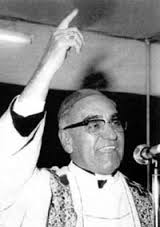
The late Catholic Archbishop Oscar Arnulfo Romero is rightly remembered as a courageous man of faith who broke with, then stood up to, the El Salvadoran elite.

Then he was murdered by them.

Roberto D’Aubuisson, the army major and oligarchy favorite known by the stomach-churning nickname “Blowtorch Bob” is said to have given the order for Romero’s March 24, 1980 assassination. Romero was shot to death as he was giving a sermon in a small chapel in San Salvador. Only days before his murder he had delivered a radio address beseeching Salvadoran soldiers to disobey immoral orders from their commanders—especially orders to kill civilians. That the Catholic Church hierarchy disregarded Romero’s pleas on behalf of the persecuted is well known.

Which brings to mind another courageous figure from El Salvador’s history who was cut down by his own: the communist poet Roque Dalton, whose assassination at the hands of fellow comrades took place forty years ago this month. Perhaps best known for the quote: “Poetry, like bread, is for everyone” Dalton was a larger than life poet/revolutionary who escaped a death sentence while in prison not once, but twice: the first time in the early 1960s when a coup d’etat freed him and the second time in 1965 when an earthquake destroyed the walls of his prison cell on the eve of his scheduled execution.

The legacies of Oscar Romero and Roque Dalton are linked by something other than mere geography. Their legacies are now contested by the very institutions that shaped  their respective histories–for better and for worse.

And, in their own ways, they are both saints.

Romero 2

In a sign that many regard as heralding a new, more progressive Catholic Church under Pope Francis, Romero is to be beatified this coming May 23, 2015. But beatification—an important step towards sainthood within the Catholic Church—comes at a price. In some respects this is the same church hierarchy that abandoned Romero and other priests and lay people to the tender mercies of dictatorship that now seeks to claim his legacy as its own.

The legacy of Romero has long served as a touchstone for conflicts between factions within the Catholic church—between it’s right wing (pro-free market traditionalists) and left wing (followers of Vatican II and Liberation Theology) and even it’s ‘North’ and ‘South’. The sainthood process of Archbishop Romero illuminates, and may sharpen, these conflicts. And there is no-one more at the center of this conflict than Pope Francis himself.

Romero was declared a “Servant of God” by Pope John Paul II as long ago as 1997, initiating the sainthood process. There was plenty of opposition to that step from right wing Catholics. Under Pope Francis a Vatican commission established that Romero died in odium fidei, or because of “hatred of the faith”, clearing the way for him to be declared a “martyr.” And there are plenty of right wing Catholics who are unhappy about that, too. But this latter distinction is important, because it means Romero didn’t die on behalf of the poor, or for any reason other than his Catholic faith. In other words, he died because he was a Catholic, rather than because he sided with the masses during the civil war, or because he delivered fiery sermons attacking the Salvadoran ruling elite. As with much in the Catholic Church this is a small, but important, distinction and one which represents an approach by Pope Francis which can be viewed as clever, or nauseating, depending upon your point of view. As when Pope Francis was asked about homosexuality and the Church and he responded, with clever ambiguity, “Who am I to judge?”

In my view, the Catholic Church’s beatification of Oscar Romero will most likely elevate, and bring low, his legacy.

These titles and definitions are linked to a process of institutional recognition that may eventually culminate in sainthood—the highest regard in which a deceased Catholic can be held. My admittedly limited understanding of this process is that for someone to be declared a Saint, two “miracles” have to be “proven”: One which occurred when the saintly prospect was alive and one posthumously. Apparently, the latter often involves someone praying to the prospective saint on behalf of a sick person who is then miraculously “cured”—magical steps that, it seems to me, cheapen the whole process; sort of a mirror image of the largely (and thankfully) disregarded Catholic practice of exorcism.

What all this means is that we don’t need a Catholic commission to find “proof” of Godly intercession to tell us what we already know: that Romero—call him what you like— played an important role in the struggle for freedom and equality and there is much to be learned from his example. And it is precisely this lesson that is problematic for the Catholic Church—in particular for Pope Francis himself.

I would argue that Pope Francis did not take that critical step towards the poor during the dirty wars in Argentina (1976-1983) when his fellow Argentinians were being hunted down and murdered by the dictatorship. When Romero was castigating his fellow ruling oligarchs for repressing preasants, what was Jorge Mario Bergoglio saying? Pope Francis claims that he protected some fellow Jesuit priests, but I think it’s clear from his own recollections of that time that he did not have his epiphany when it was needed most. And no brave actions against the dictatorship were forthcoming on his part. And I, for one, am still waiting for a fuller Mea Culpa from this Pope who, from the current relative safety of his Pontificate, now rails against the injustices suffered by the poor and downtrodden of this earth. Where were these impassioned homilies when they were needed?

But perhaps it will be the beatification of Romero that gives Pope Francis his opportunity to square the circular hole that is his past behavior during the Dirty War dictatorship with the square peg that is his contemporary denunciation of privilege and oppression in the new millennium.

The earthly ‘miracle’ of Archbishop Oscar Romero is that he set aside a life of immense privilege, stood up for the oppressed, made himself vulnerable and then paid the ultimate price for having done so.

This is something Pope Francis did not do.

If every person, from whatever background—religious or non-religious— would do as much, we would have paradise in the here and now, where it counts, rather than some imaginary beyond, where it doesn’t.

Romero had his epiphany following the murder of his friend, the radicalized parish priest Rutilio Grande. And while Romero probably wouldn’t have put it in the currency of Liberation Theology, he took that “preferential option for the poor” and stood up to torture, repression, poverty and inequality. And that’s why he was killed, not, in a narrow sense because he was Catholic, or because he professed his faith. Unless, of course, we equate the Catholic faith with standing up to oppression in the manner of Oscar Romero. In this respect the Catholic Hierarchy wants their cake and to eat it too—they want to take credit for Romero’s legacy of social justice, but without linking it to actual struggles for equality or their own complicity in the death of Romero and so many, many others.

And Catholics concerned with social justice should not allow this to happen.Roque Dalton

Roque Dalton’s murder by his own comrades in arms presents the left with its own ethical dilemma: Some who are reputed to have executed Dalton went on to play leading roles in the Farabundo Marti National Liberation Front (FMLN) umbrella guerrilla movement that now, as a political party, governs El Salvador. Dalton’s sons, Juan Jose and Jorge Dalton have both petitioned the left wing government of El Salvador to investigate the murder and bring to justice his killers, to no avail. 

The late Uruguayan writer Eduardo Galeano has this devastating three-sentence-long poem about Dalton’s murder which eloquently lays out the stakes:

The Unforgivable

The poet Roque Dalton wielded a defiant wit, he never learned to sup up or take orders, and he laughed and loved fearlessly.

On the eve of this day [May 10] in the year 1975, his fellow guerrillas in El Salvador shot him dead while he slept.

Criminals: rebels who kill to punish disagreement are no less criminal than generals who kill to perpetuate injustice.

(Retreived May 1, 2015 from wordswithoutborders.org).

Since the day I first read it in El Salvador in 1985 my favorite poem of Roque Dalton’s is Watchtower. (Please forgive my translation, it is largely from memory and what I have been able to scrape together from the Internet as I cannot find my copy of Datlon’s Clandestine Poems within which it appears.)

Watchtower

A religion that tells you there’s only pie-in-the-sky

and that all earthly life is lousy and vicious

and that you shouldn’t be too concerned

is the best guarantee that you will stumble at every step

and dash your teeth and soul

against absolutely earthly rocks

While it may seem counterintuitive, it is nonetheless true: the legacy of Archbishop Romero demands a reckoning from the Catholic Church that cannot be satisfied by his elevation to sainthood; it can only be given true meaning when his example transforms the Catholic Church and makes it a vessel for delivering us from oppression and opening the door towards justice and equality. Likewise, the assassination of Roque Dalton by his own comrades cannot be atoned for by placing his visage on a postage stamp or including his poems in the school curriculum; it can only be set to rest when his killers are brought to justice and when Dalton’s vision of a socialist future is won.

Jonathan Mozzochi

Share this:

  • Click to email a link to a friend (Opens in new window) Email
  • Click to share on X (Opens in new window) X
  • More
  • Click to share on Facebook (Opens in new window) Facebook
Like Loading...

The Real World

27 Monday Apr 2015

Posted by Jonathan Mozzochi in Book Review

≈ Leave a comment

Tags

Baseball, Elephant, Empire of Japan, Gus Van Sant, Misogyny, Nationalism, Natsuo Kirino, S.E. Hinton, The Outsiders

Real World

by Natsuo Kirino

Alfred A. Knopf 2008

208 pgs.

In a brief foreword to Real World the author, Natsuo Kirino, writes that for Japanese kids “…the school year begins in April and ends in March the following year.” In other words, excepting brief interregnums, it’s interminable. And as everyone knows, Japanese kids are expected to study way too much. Occasionally, student failure results in murder or, more often, suicide.

The tableau having been set—picture alienated students in uniform cramming in isolated cubicles—Kirino begins with the familiar trope of students collapsing under the weight of academic expectations that cannot be fulfilled. But what she does with this set piece is unexpected: She indicts modern Japanese society and, by extension American Imperialism, for a shared legacy of soul crushing militarism and misogyny. This novel is deeply political; although it seems no one has figured that out yet.

Kirino employs a first-person, present-tense voice through which we are brought directly into the headspace of five Japanese adolescents—four young women and one young man. As a literary device, attempting to convey the thought-world of teenagers (or anyone, for that matter) through the first person seems a risky conceit. But, S.E. Hinton did as much through her character Pony Boy in The Outsiders. Kirino does the same, adeptly and to devastating effect.

Matricide is at the center of Real World’s plot. The book opens with our first teenager, Toshiko, penciling in her eyebrows as she hears something “breaking” next door where a teenage boy lives with his parents. The loud sound, we find out later, is that of the mother being bludgeoned to death at the hands of the son. Toshiko refers to the boy as “Worm”, the nick-name that sticks throughout the remainder of the novel, even when we switch to his perspective, which reads somewhat like the boy’s one-sided response to an interrogation—the questions, while omitted in the text, are implicit. The remainder of the novel explores the deeply conflicted actions of the four women as they help, in various ways, the young man elude authorities until his inevitable demise.

While the novel is character—rather than plot—driven, it has no central protagonist. Instead, Kirino assembles a composite protagonist from four women, Toshiko, Kirarin, Tarauchi and Yuzan. Emotional attachment to Worm runs the gamut from erotic fascination to revulsion but always shot through with a certain matter-of-factness that suggests a certain shallowness. It is through the response these young women have to what Worm has done that Kirino’s political point comes into relief: modern Japanese nationalism, propped up on the twin pillars of militarism and misogyny, is destroying its youth, and thereby its future.

Worm’s murder of his mother sets in motion the plot of the novel. It is also through Worm that Kirino introduces the ghost of Japanese nationalism. Worm recalls watching a television program where, in revenge for something done “during the war” an “old Filipino woman” savagely attacks a Japanese soldier with a hammer and pointed stick. Worm identifies with the soldier.

The link between nationalism and misogyny becomes more explicit on page 113:

Worm: “I don’t need any women at all. I’ve been transformed. Maybe because I took a bath after we checked into this love hotel. As soon as my salt suit was washed away I completed my new personality. The soul of the former Japanese soldier.”

Elsewhere, Worm’s psychosis becomes more fully developed: “Now that I’d done my mother in, I had to mow down all the rest of the pornographic women in the world. Somebody’s got to give the order. I glanced around the room, looking for an officer. But no one was there.” (p. 114).

And finally: “The reality came to me—I’m alone on the front line, the only one still fighting the war. Before that old Filipino man and woman can torture me, I’ve got to escape into the jungle. And regroup for the next battle. My war has just begun. That’s the world I’m in—my world.” (p.115).

And the world of Worm—psychosis and all—is our world, too; the real world of men free to prey on young girls and a national culture that refuses to acknowledge, much less atone for, the Rape of Nanking and other atrocities. But in this Japan is not alone; the United States has its own national atrocities about which it has never come clean (slavery and segregation, the Vietnam War and other interventions in the so-called Third World, etc.). And Kirino is aware of the willful national amnesia the United States and Japan share. I don’t think it is by accident that she has Worm murder his mother with a baseball bat. While Sumo wrestling is Japan’s national sport, baseball—that most American of sports—is it’s most popular. As Worm swings the bat at his mother’s head, Kirino has him thinking, “Strike one…Foul ball…Clean hit…” deftly reminding us that the bat is not just a piece of wood, but a loaded cross-cultural symbol, as well.

Later, after Kirarin and Worm die in a car accident, Terauchi suffers the brunt of guilt for her involvement in the events leading up to the death of her friend. Terauchi considers her role so terrible as to be “…irreparable…a horribly frightening feeling that keeps building up inside you forever until your heart is devoured. People who carry around the burden of something that can’t be undone will one day be destroyed.” (p.150). She commits suicide. Through Terauchi, Kirino is clearly saying that a culture that cannot come to terms with its ghosts is doomed to be devoured by them.

Kirino is brilliant when rendering the alienation and terror of adolescent life through these harrowing internal monologues. In this her work suggests the dark cinematic lyricism of Gus Van Sant’s film Elephant (2003), itself a profound rumination on the 1999 Columbine high school massacre which shares a certain tone with Real World. Also, Real World clearly owes a debt to Tim Hunter’s 1986 film River’s Edge, a reinterpretation of an S.E. Hinton novel that explores some of the same territory Real World and Elephant do—the remarkably detached, almost sanguine, reaction to murder these kids display. All three efforts explore the normalization of dissociative behavior that hovers somewhere between the sociopathic and psychotic; that is between a coping mechanism grounded in reality and a complete break from that reality.

Kirino, Van Sant and Hunter all have their young people set adrift among failed institutions—most notably the family. But all of this takes place within a broader context of a deep cultural anxiety. In Hunter’s case our protagonists struggle (unsuccessfully) to find meaning in the cultural effluvia of America’s ‘defeat’ in the Vietnam War. Here, the importance of Dennis Hopper’s character (Feck) is noteworthy in establishing the film’s cultural context (he’s a Vietnam Vet obviously experiencing post traumatic stress disorder, newly added to the DSM III in 1980). With Kirino’s Japan it is the Lost Decade of the 1990s, together with the unresolved legacy of the Empire of Japan that provide context. Van Sant’s Elephant was made soon after the September 11, 2001 terrorist attacks that marked a turning point in the American cultural narrative, from self-sacrificing Cold War victors to “a reluctant, but necessary turn to the dark side”, as Dick Chaney succinctly captured it, best represented by the psychopath Chris Kyle of American Sniper fame.

It doesn’t do Kirino justice to describe her as merely a “feminist noir” writer, although she certainly is that. Aside from being a very well written and creative novel, the book also serves as an unexpected and welcome rejoinder to a growing Japanese World War II historical revisionism. It’s refreshing to see this done through what amounts to a Dystopian Bildungsroman novel leavened with social criticism.

Jonathan Mozzochi

Share this:

  • Click to email a link to a friend (Opens in new window) Email
  • Click to share on X (Opens in new window) X
  • More
  • Click to share on Facebook (Opens in new window) Facebook
Like Loading...

Unsettling Juxtaposition

23 Thursday Apr 2015

Posted by Jonathan Mozzochi in Snippets

≈ 1 Comment

Only two items are locked behind the counter at my local grocery store—cigarettes and baby formula.

Share this:

  • Click to email a link to a friend (Opens in new window) Email
  • Click to share on X (Opens in new window) X
  • More
  • Click to share on Facebook (Opens in new window) Facebook
Like Loading...

The Ferguson Frankenjury

30 Sunday Nov 2014

Posted by Jonathan Mozzochi in Essay

≈ Leave a comment

The Ferguson Frankenjury

“If it takes a riot for America to remember their names then that tells you more about the country than it does about the rioters.”
–Gary Younge, The Guardian.

First the killing.

After being shot six times by police officer Darren Wilson, Michael Brown’s presumably lifeless body (when did he actually die?) was left to lie in the street four hours before being perfunctorily gathered up, like so much trash in the ghetto, by authorities. This neglect is now a perverse emblem of the depth of contempt for black life that persists in America. As Gary Younge points out (The Guardian, October 10, 2014), this young man’s life and then bullet-ridden body were “dispensable, despised and discarded”, as with America’s promise of racial equality.

Then, as if to add insult to injury, there emerged a Kafkaesque grand jury process. Within days of the killing a grand jury had been assembled. But this cornerstone of our ‘Anglo-American’ system of justice was placed in the hands of a mad scientist, Fergson prosecutor Bob McCulloch, who would refuse to recuse himself and instead guide a deeply flawed, yet exquisitely effective, process to its forgone conclusion. McCulloch would, predictably, decline to recommend prosecuting Wilson, an event that occurs within our hallowed halls of justice about as often as a grand jury is all African-American–which is to say never.

In his Guardian article, Younge recalls another jury that deliberated over the fate of white men accused of killing a Black teenager. That jury, in 1955 Mississippi, took all of 67 minutes to acquit the killers of Emmitt Till. “If we hadn’t stopped to drink pop,” said one juror, “it wouldn’t have taken that long.” In that case, under Jim Crow segregation, the grand jury actually forwarded charges. The grand jury tasked with deciding whether to recommend criminal charges against Darren Wilson, the cop who shot Brown to death, took its sweet time–more than three months–to deliver a decision. “That’s a lot of pop,” quipped Younge.

When the Ferguson grand jury finally did deliver a decision it was that the preponderance of evidence did not, according to our citizen jurors, rise to the level of ‘probable cause’. In local parlance it was the equivalent of “fuck you”. The jury process was so rotten with foul illogic, so twisted in its legal sophistry as to have invited the opprobrium of none other than Supreme Court Justice Antonin Scalia, that standard bearer of Black liberation. According to Scalia, McCulloch’s handling of the grand jury flouted traditions that have stood for ‘hundreds of years’.

“It is the grand jury’s function not ‘to enquire … upon what foundation [the charge may be] denied,’ or otherwise to try the suspect’s defenses, but only to examine ‘upon what foundation [the charge] is made’ by the prosecutor…As a consequence, neither in this country nor in England has the suspect under investigation by the grand jury ever been thought to have a right to testify or to have exculpatory evidence presented.”

Which is exactly what McCulloch both did not do (forward a charge) and did do (had the suspect testify).

This was no ordinary grand jury; it was a Frankenjury.

The Ferguson Frankenjury process has been unusual in so many ways it is useful to list a few: the refusal of the prosecutor to recommend charges; the 3 1/2 month deliberation punctuated by seemingly mischievous and calculated leaks; the unprecedented 4 hours of testimony to the grand jury from the shooter, (this suggests a creepy parallel with the amount of time Mike Brown’s body was left–lifeless?–in the streets of Ferguson) the drawn out media circus; the interminable delays; the urban counterinsurgency strategy with its militarized ‘peace officers’ in the wings; the preemptive ‘state of emergency’ declared by a feckless Governor more than a week before a decision was announced, suggesting he wasn’t even in the loop; and, finally, the announcement itself coming at night and the smoking streets that followed–all of this so heart-wrenchingly familiar in its result yet novel in its process.

There is also the little matter of Wilson describing Brown as a “Demon” which, aside from being almost comical as a dehumanizing and racist trope, also serves as a defense. We were told again and again that all Wilson had to demonstrate for an effective defense was that he ‘felt’ fear of Michael Brown–whether that fear was rational or not being irrelevant. That this was something for a judge or jury to consider during a trial and not for a sitting grand jury weighing probable cause was almost completely lost amidst the blather.

Elsewhere in his article Younge uses the word ‘prevaricate’ (speak or act in an evasive way, quibble with the truth) where he means, I think, ‘procrastinate’, or delay. A common and forgivable error. But the members of the Ferguson Frankenjury, at least during their lengthy deliberations, had not spoken falsely–they said nothing at all–busy as they were drinking pop for three+ months. But there is something inherently deceitful about their delay, something dishonest in their act of ‘suspending judgment’ that suggests a neologism may be in order, so as to capture both the elements of delay and deceit so intrinsic to the process. 

When an institutional authority engages in a process of delay and equivocation, putting off and perverting justice, it can be henceforth be said to prevaricrastinate; or, if you prefer, procrastivaricate.

Ugly words for an ugly process.

My two Frankenwords are assembled from ‘prevaricate’ and ‘procrastinate’ and each has two word parts swiveling on a fulcrum of injustice: ‘Prevaricrastinate, meaning justice denied, then delayed; and, ‘procrastivaricate’, meaning justice delayed, then denied.

A perfect symmetry.

From my Oxford English Dictionary, Second Edition, 1989, we find the following nugget within the word usages for ‘prevaricate’:

Prevaricate: “…to betray the cause of a client by collusion with an opponent…To undertake a matter falsely and deceitfully in order to defeat the object professed to be promoted.” That, together with procrastinate, is exactly what Bob McCulloch engaged in: he betrayed the victims of this crime by colluding with the perpetrator, and our institutions either supported that decision or looked the other way.

(Elsewhere prevaricate can mean “to spread the legs apart, straddle…bent, knock-kneed…” but I won’t indulge in that tangent.)

Procrastinate, of course, means “…to put off till the morrow, to put off from day to day; to defer [action], to delay…play a waiting game, use delaying tactics.”  

Let’s dissect the Frankenword, ‘Prevaricrastinate’. First, there is the hacking apart of each word, ‘prevaricate’ and ‘procrastinate’, followed by the stitching together of the two words such that their combined meanings form a new one. When spoken, the word sounds difficult and uncomfortable; it registers a certain labored construction (unnatural grafting) and its enunciation proceeds as if one can hear the gears of justice grinding to a halt. Just as the word ends badly (‘crastinate’) as in a painful gastro-intestinal blockage–so too this jury’s work will come to an ugly end.

‘Procrastivaricate’, on the other hand, with it’s ending ‘varicate’ sounds like ‘validate’ or ‘verification’. This suggests a drawn out process that, while painful, does eventually arrive at the truth–just as our Ferguson Frankenjury has dangled before us. But, as with the Ferguson grand jury’s final decision,’varicate’ is nonsensical in this context. It doesn’t mean anything at all; it just sounds as if it does. It is a word, but a medical term–‘varicies’, from ‘varicose’, as in ‘veins’. So in a poetic way this ending accurately represents the Ferguson Frankenjury process: A sclerotic system that has blockages preventing the free flow of blood (disinterested weighing of evidence) to the body politic (justice). In this ironic sense, it works

Younge’s parallel between the absence of justice in the Till and Brown killings is instructive. If under Jim Crow the racist murderers of Emmitt Till were acquitted, but did at least face charges, whereas the killer of Michael Brown won’t even face a manslaughter or ‘failure to aid’ charge, then what has changed?

Nothing. The process has mutated; but the result remains the same.

Jonathan Mozzochi
November, 2014

Share this:

  • Click to email a link to a friend (Opens in new window) Email
  • Click to share on X (Opens in new window) X
  • More
  • Click to share on Facebook (Opens in new window) Facebook
Like Loading...

“They Bring That Desert Stuff To Our World”–Bill Maher and Islamophobia

09 Sunday Nov 2014

Posted by Jonathan Mozzochi in Essay, Rant

≈ Leave a comment

“They Bring That Desert Stuff To Our World”
Bill Maher and Islamophobia

In case you missed it, Bill Maher has been at it again with religion. Which is nothing new–after all he did make a movie called Religulous. But he is not just grinding his religion axe, which I have been known to swing; he’s been dragging Muslims through the mud in a way that is, well, getting unseemly and personal. In the process he’s managed to exhibit the same loathsome character traits he assigns the religious “whackos” he is so fond of excoriating. At one point in this ongoing, disgraceful rehashing of the ‘Clash of Civilizations’ thesis Maher, exasperated at all the ‘hate’ he’s stirred up, suggested he might shut up on the topic.

Please do. It’s getting to the point I want to throw a shoe at you.

Maher and his sidekicks Sam Harris and Richard Dawkins–those instant atheists ever at the ready to demolish whatever straw man caricature of organized religion is offered up for sacrifice–are playing an odious game. It is really difficult to watch the three of them play shills to political forces eager to have an expanded war in the Middle East. They serve at the pleasure of war mongers, all sniggling aside, as their signature adulation of a virtuous ‘West’ is counterposed to a malevolent ‘Orient’. This reeks of intellectual dishonesty and a noxious repackaging of neo-colonialism and xenophobia, albeit with all the trappings of postmodern irony on offer for a forthcoming retreat behind plausible deniability–”we were just joking.” And while it’s painfully familiar, it still sucks because, well, he’s kind of one of us, like Christopher Hitchens. Or Alexander Cockburn.

Such an old ploy, this brutal cleaving of the world into two irreducible and distinct, warring civilizations. Their framework for discussion (if one can call it that) studiously ignores what most liberals and anyone who can legitimately be called a leftist knows to be necessary when addressing this subject: power relations between peoples within and among nation states. As in what forces are arrayed against the democratic aspirations of Muslims? Ah. But therein lies the rub. Maher doesn’t have this problem, as by definition a ‘Muslim’ is anti-democratic. So no need to discuss what role the 21s Century Leviathan plays in this drama. How about in Egypt? Was that a Coup d’etat, Bill? Or perhaps a conscientious, independent, and benevolent military gracefully sidelining a nasty, backwards, Islamic dictatorship intent on murdering those precious standard bearers of Western culture, the cartoonists behind Southpark? How is it that Maher can be a trenchant critic of American influence both at home and abroad but shit the bed when it comes to Islam and Muslims? Answer: He succumbs to classic Islamophobia. But this is nothing new for him in kind; only perhaps in degree. Which raises the question as to how this jackass can pass himself off as a leftist.

But before we get to that, let’s get a working definition for the inelegant but necessary term ‘Islamophobia’. How about unfounded hostility towards and fear of Muslims. Unfounded is the operative term here; and in Bill Maher’s case that will be abundantly clear–no mean Muslims at his door calling for his head.

What would we look for among Maher’s comments that might conform to the defining elements of Islamophobia? How about the following definitive exchange between Maher and Anderson Cooper. In it, Maher manages to hit on all cylinders when responding to a characteristically sophomoric question from Cooper, who has never encountered an unstated assumption he could articulate nor one he would shy away from to please a guest: “Why is Islam the one religion about which so many in America–and the West–censor themselves…? Is it just fear?”

Maher responds: “Absolutely. Because they’re violent. Because they threaten us. And they are threatening. They bring that desert stuff to our world …We don’t threaten each other, we sue each other. That’s the sign of civilized people. And they don’t … People who want to gloss over the difference between western culture and Islamic culture and forget about the fact that the Islamic culture is 600 years younger and that they are going through the equivalent of what the west went through with our middle ages, our dark ages when religion had way too much power … do so at their peril.”

Elsewhere Maher has added:

“New Rule: Although America likes to think it’s number one, we have to admit we’re behind the developing world in at least one thing. Their religious whackos are a lot more whacko than ours! [Laughter]…Our culture isn’t just different than one that makes death threats to cartoonists. It’s better. [Applause]” –Real Time with Bill Maher 2011.
Let’s unpack that load.

Islam is archaic and backwards (‘desert stuff’, ‘dark ages’). Check.

‘Islamic Culture’ is inferior to ‘Western Culture’. Check.

Muslims lag behind more advanced peoples (600 years!). Check.

Islam is uncivilized (lacking the signs of ‘civilized people’). Check.

Muslims are inherently violent (we sue, they fight). Check.

Islam is a religion of violence and supports terrorism (Fatwas against cartoonists). Check.

Elsewhere Maher and his cohorts Harris and Dawkins peddle other stereotypes.

Muslims reject democratic values (otherwise they would have democratic states! Ignore Indonesia. Ignore Egypt before the Coup. etc.). Check.

Islam does not share common values with other major faiths (Even the Pope won’t send his “Swiss Guards” to hunt apostates down). Check.

Islam is monolithic and cannot adapt to new realities. Check.

What’s perhaps more chilling than Maher’s ranting is the disposition of his audience. Was there no one in his studio audience with a conscience? Couldn’t someone even cough to signal opposition?

Maher at once cuts too broad a swath with his biting humor and yet displays an obsession with the flesh and blood particulars of his subject matter that is worrisome: he’s always returning to graphic images of heads being lopped off, suicide bombers and all the rest. Maher would be better off examining the tomfoolery of religion across cultural boundaries than allowing his pathology full bloom in regards Islam.

It’s indicative of his neo-liberal moorings, laden with a culturally permissive patina, that Maher doesn’t bother with the messy notion of a North-South split. That would involve too much heavy lifting and unpacking of his heroic notion of the ‘West’ and the so very unheroic effects of Western imperialism in the third world. Such a different perspective wouldn’t help him render an ‘other’ so different from ‘us’–a rhetorical operation absolutely necessary for demonization–which is what Maher is doing.

All of this reminds me of another American popular culture expression of Islamophobia, the 2007 film 300, described as a ‘porno-military fantasy’ by one reviewer and as a film that trafficked in neo-fascist aesthetics by myself where “so completely is the ‘other’ rendered different that it is difficult to conceive of them as human.”

Coming from national security state war boosters this kind of jingoism is not surprising; but it shouldn’t be welcomed within the liberal left, where Maher moors his ship of fools. I am at a loss as to how any decent person would ever forgive or forget these transgressions. They are despicable.

What’s at play here is a familiar Western superiority complex that needs dismantling. I’m particularly fond of a quote by the late Uruguayan novelist Eduardo Galeano from his book Open Veins of Latin America: “Underdevelopment isn’t a stage of development, but its consequence.” Just that one sentence explodes Maher and company’s narrow, moralistic and ahistorical stance. As in who carved out all those ridiculous state borders from the Ottoman Empire and what effect has that had on the subsequent development of civic society there? How about all those so-called ‘Banana Republics’?

Must we continue with the likes of Ben Affleck as the standard bearer of reason in opposition to Maher and company? Meh. What Affleck lacks in erudition he makes up for in enthusiasm; but sometimes you’ve got to be more than just right, sometimes you need to drop the etiquette and just slap the smile off his face.

Besides, if you must divide the world into the West vs. Islam, secular rationalism vs. religious superstition, how about this: The thoroughly religious injunction against financial interest and debt at the center of Islamic economics is far more rational than the fairy tale of Adam Smith’s ‘Invisible Hand’ or Alan Greenspan’s modern rendition spun from algorithms. How difficult would it be to make that argument for a more just and equitable world?

Although after having suffered through the ignorant ramblings of these Three Wizened Blowhards (Maher, Harris and Dawkins) you wouldn’t think so, I still maintain it is possible to be an atheist without being an asshole.

Jonathan Mozzochi
November, 2014

Share this:

  • Click to email a link to a friend (Opens in new window) Email
  • Click to share on X (Opens in new window) X
  • More
  • Click to share on Facebook (Opens in new window) Facebook
Like Loading...

Capital in the Twenty-First Century–Eternal Inequality?

08 Saturday Nov 2014

Posted by Jonathan Mozzochi in Essay

≈ 2 Comments

Jonathan Mozzochi's avatarGhosts of Anti-Fascism Past

Capital in the Twenty-First Century–Eternal Inequality?

No, I have not read all 577 pages of Thomas Piketty’s Capital in the Twenty-First Century. I don’t think I have the wherewithal to hike through such a dense scholarly forest. Besides, there are also seventy-eight pages of notes inconveniently placed at the end of the book–rather than at the bottom of each page–that drive me bat shit. So I’ll leave it to the saintly patient among us to assemble a more complete assessment. Here I’ll sketch out my preliminary thoughts.

I’ve read more about Thomas Piketty and his economic laws and formula for inequality ‘r>g’ (now immortalized on a t-shirt by Stephen Colbert) than I have read pages of his book. But after having read a hundred or so pages, Capital in the Twenty-First Century now occupies pride of place on my desk where it conceals a good number of bills I would…

View original post 1,786 more words

Share this:

  • Click to email a link to a friend (Opens in new window) Email
  • Click to share on X (Opens in new window) X
  • More
  • Click to share on Facebook (Opens in new window) Facebook
Like Loading...

Capital in the Twenty-First Century–Eternal Inequality?

08 Saturday Nov 2014

Posted by Jonathan Mozzochi in Essay

≈ 1 Comment

Tags

capitalism, economics, inequality, r>g, Thomas Piketty

Capital in the Twenty-First Century–Eternal Inequality?

No, I have not read all 577 pages of Thomas Piketty’s Capital in the Twenty-First Century. I don’t think I have the wherewithal to hike through such a dense scholarly forest. Besides, there are also seventy-eight pages of notes inconveniently placed at the end of the book–rather than at the bottom of each page–that drive me bat shit. So I’ll leave it to the saintly patient among us to assemble a more complete assessment. Here I’ll sketch out my preliminary thoughts.

I’ve read more about Thomas Piketty and his economic laws and formula for inequality ‘r>g’ (now immortalized on a t-shirt by Stephen Colbert) than I have read pages of his book. But after having read a hundred or so pages, Capital in the Twenty-First Century now occupies pride of place on my desk where it conceals a good number of bills I would rather not pay. So here’s my two-cents worth, which is all I have left after r>g.

Capital in the Twenty-First Century is primarily a study of economics, a discipline I generally hold in low regard, as phrenology or public relations. Despite this built-in handicap, Piketty has succeeded in producing a work of singular importance for anyone concerned with social equality and economic justice. What allows him to do so, unlike so many others before him, is two-fold: a multi-disciplinary approach to the problematic relationship between capitalism and social inequality; and a mastery of a mountain of data sets.

Piketty argues that a systematic rendering of the dynamics of inequality require the scholarly tools of the historian and the sociologist as much as, if not more than, the economist, in order to adequately explain what is at the core of this system of production, exchange and consumption that we all live with. Piketty also owes a great debt to a number of talented colleagues and to relatively recent technological advances (the internet, relational databases) that help with the heavy lifting necessary to manage mountains of data. Such talented coworkers and new widgets allowed for Piketty et. al. to slowly, over 15 years, sort through economic data spread out over a great deal of time (as much as 300 years) and across many different societies (at least 20 countries) and transform it into useful information and from there into a theory. Piketty even goes so far as to argue that his theory rests on laws. That’s pretty audacious, and just the sort of thing, when put forward by economists, I usually find so aggressively stupid–the kind of stuff that ‘naturalizes’ inequality and injustice, where the rich are rich because they work real hard and deserve what they get and, conversely, the poor deserve their lot. But Piketty is grinding a different axe here and although I am skeptical that he has uncovered any hidden ‘laws’ regarding the functioning of capitalism or economics more generally, he has valuable insights.

Captial in the Twenty-First Century provides a much needed re-periodization of the history of global capitalism that reminds us (as if we needed reminding) that as a system it is both unstable and unsustainable. As a political economy it involves a deeply contradictory relationship to democracy. Except for war, depression and revolution, social inequality increases both over time and across nations: regardless of where or when you live, the global rate of return on capital (r) tends to increase at a rate higher than that of the economy in general (g), the result being that the rich get richer and the poor get poorer. It’s a fairly straightforward equation, but it has far-reaching, profound implications. Piketty’s prescription to solve this problem is not, as revolutionary ideas go, audacious, but it is absolutely inconceivable within the thought world of elite opinion: a global tax on wealth and income. Even Piketty has described this modest proposal as ‘utopian’.

What Piketty and his colleagues effectively demonstrate is that instead of a steady forward march and upward trajectory, where the benefits of capitalist development steadily lift all boats, or trickle down onto the heads of the masses–choose your inept metaphor–the prevalence and persistence of inequality is a key feature of this economic system. The kicker here is that the rate of accumulation of wealth and income by the few is only interrupted when gross economic output (GDP at the national level) exceeds the rate of return on capital. The tendency towards increased inequality is mitigated by technological innovation and the diffusion of education to the masses–but only so much, and such developments can be offset by novel forms of accumulation at the top. Apparently this leveling out hasn’t happened very often over the past 300 years and when it has–during and after world wars, depressions and revolution–it is a by-product of the instability the economic system has itself produced. In other words, only after economic and political convulsions is the process of upwards accumulation slowed or halted; then, after a time, inequality is reasserted. Another way to look at this is that these spasms of extreme violence, capital destruction, and habitat obliteration are this system’s way of regulating itself.
Yikes.

This brings to mind a clever rhetorical Q & A: Why does capitalism triumph over all attempts to thwart it? Because when faced with a crisis, capital turns to socialism to rescue it every time.

Elsewhere Piketty notes the recent emergence of ‘super managers’ pulling away from everyone else and that we are returning to a form of ‘patrimonial capitalism’ that resembles the ‘Gilded Age’ that preceded the Great Depression.

It doesn’t take a Paul Krugman to see that.

But I am also ambivalent about Piketty and his tome. The author self-consciously adopts the accoutrements of radicalism without any of the elements of risk (imprisonment, exile, execution) that have commonly been associated with such ideas–sort of squatting on the shoulders of giants. Piketty’s radicalism is that of a ‘rock star’, the perfect emblem for the Society of the Spectacle (another apt French phrase). If I write dismissively of the hype surrounding Piketty it’s only to highlight an intellectual marketplace that functions to domesticate all manner of dissent and opposition, what others have described as Capital’s ability to assimilate and thereby neutralize red, yellow and black cells. In the process what is so obviously a scholarly work of some importance is being systematically sucked dry of any saliency by a commentariat enthralled with the image of scholarly rebellion but largely incapable of grappling with the most potent ideas at the center of this work. And that includes the gushing praise heaped by the likes of Paul Krugman as well as the absurd red-baiting coughed up by the Financial Times and other hack apologists for inequality.

It’s been inspiring to watch mainstream and especially libertarian economists go back on their heels in the face of a body of work that has exposed their epic failures: first, their inability to document and accept the instability that comes with inequality as an essential historical feature of global capitalism and, secondly, their failure to anticipate the obvious results this contradiction will produce (Crash of 2008). I delight in Piketty’s swipe at American orthodox economists as being numbers obsessed, a collection of blinkered bean counters and malignant technocrats consumed with more profit and novel ways of obtaining it. The essayist Thomas Frank in his review of Piketty’s book recounts an anecdote that neatly captures this point in a satirical manner reminiscent of a Family Guy cut-out skit: a group of American economists at an unnamed Mid-Western university took to sporting white lab coats so as to distinguish the ‘serious’ nature of their pursuits as distinct those of their colleagues in the ‘soft’ sciences of sociology, political science and anthropology. The hubris here tells us everything we need to know about the reining orthodoxy of that profession.

Piketty’s work neglects the role social forces (organized labor, civil rights movements, rural rebellions, etc) play in shaping income inequality–especially by reducing it. This reinforces a mechanistic view of economic forces as being somehow beyond our control, inexorable and inevitable–sort of like the orthodox historical materialism of another era. Piketty is a French structuralist, a school of thought that adds much to our understanding of the role social forces and institutions play in shaping our lives as much as it fails to apprehend human beings as subjects with conscious thought and agency. Such economic laws are said to exist outside us, perhaps above us, to be divined by econometricians with their modern alchemy of algorithms and spreadsheets, and salvation lies in uncovering the ‘laws’ that govern production, exchange and consumption. We need only understand them better and apply them more intelligently.

But the notion of perpetually increasing growth and profit is often presented as natural (immutable) or, worse still, moral (normative). But it is not any of those things (or shouldn’t be regarded as such) and our task is, again, to redistribute. There is no ‘law’–economic, political or moral–that can establish a fairer distribution of resources, income and wealth. Only struggle will achieve that. This is obvious to anyone who cares to look around at the abundance of natural resources that can sustain human life that are at our disposal. That those resources need be exploited by human intervention is a given, but that a market system based on greed and competition is the best way to achieve a sustainable distribution of those resources is an unsupported fairy tale: magical thinking without the sound moral teachings of a Gabriel Garcia Marquez novel to stoke our wonder and awe and help us engender change. There is really very little science here, just raw power.

Piketty distances his work from that point of view, arguing for interdisciplinary dependence and careful, sober fact-checking. Yet he reproduces that very dynamic elsewhere–at least more than he should–and it is this problem with his work that James K. Galbraith and Thomas Frank rightly point out.

Besides, no matter how many beans are counted, algorithms programmed or equations solved, I don’t consider economics a ‘science’ at all: at best it’s ‘mathematical sociology’, or ‘numerical anthropology’. We are, after all, still human and our ability to reflect on our world and change it means that efforts to quantify our activity should always be held up to rigorous examination and withering critique; that critical stance itself necessarily informed by how that bean counting, that widget, or innovative metric can help alleviate social inequality, how it serves the common good.

Given that Piketty and colleagues have been assembling, publishing and discussing their data for more than a decade and that the book was published last year in France (to mostly yawns) why the explosion in publicity over the past summer? It reminds me of the campaign orchestrated by Adbusters with the help of the PR firm ‘Workhorse’ around the Occupy Movement–some kind of prescient anticipation or luck combined with a ‘flash mob’ moment and technical prowess emerged to launch this book. I’m interested in seeing an analysis of the Harvard University Press public relations strategy on release of the book and other efforts, apparently wildly successful in a narrow economic sense, to sell the book and Piketty himself. My main concern, however, is what this book and the man who wrote it are saying about our world; how best do we evaluate the arguments put forth in the book and the discussion that has followed, and how it is useful (or not) in changing the world. At least it’s heft can be used against champions of the free market, or to help cover up those pesky bills I’d rather not pay.

Jonathan Mozzochi
November 2014

Share this:

  • Click to email a link to a friend (Opens in new window) Email
  • Click to share on X (Opens in new window) X
  • More
  • Click to share on Facebook (Opens in new window) Facebook
Like Loading...

The Three Montys

31 Thursday Jul 2014

Posted by Jonathan Mozzochi in Essay

≈ Leave a comment

[Essay]

From my jacket pocket I produce three playing cards: an Ace of Spades, a Two of Hearts and a Two of Diamonds. Three props for demonstrating a probability puzzle, the solution to which provides a window through which we may catch a glimpse–however fleeting–of the American soul. This of course begs the question: Does that soul has an afterlife? If so, where is it likely headed–heaven or hell? By reflecting on three separate but related cultural phenomena–what I call The Three Montys–we can perhaps hazard an answer these questions.

The first of my Three Montys is the classic short-con game, Three Card Monte. Played throughout the world on street corners and public busses, in alleyways and even dorm rooms, players come alive with the drama of a ‘game of chance’ or the prospect of a good hustle. The game goes by many names: ‘Find the Lady’ (when you are seeking to spot a Queen rather than an Ace as in my example), ‘Bola-bola’, ‘Thimble-rig’ or ‘shell game’–the latter substituting cups and a ball instead of cards. Regardless of what it’s called or how it’s played it always operates according to the same unwritten, but widely accepted, rules. We’ll get to those.

The second Monty is The Monty Hall Problem which derives it’s name from Monty Hall, the onetime host of the American television game show Let’s Make A Deal. Strictly speaking The Monty Hall Problem is not really a problem at all and shouldn’t be named after Monty Hall–but we will get to that, too.

The last Monty, The Full Monty, is my touchstone reference that contains within it the solution to the contradictions involved with the other two Montys.

So, in order, we have: Three Card Monte, The Monty Hall Problem and The Full Monty.

First, Three Card Monte.

You may have an image of a young man throwing dice against a wall, or leaning over a small fold-up table. You’re in the right territory. Three Card Monte involves three people, although the game relies on the illusion that only two are playing at any given time.

First there is the Con, or host of the game, who shuffles three playing cards and will lay them face down. Two of these cards are alike and undesirable. In my example above the Two of Diamonds and Two of Hearts, both red cards of low value, are to be avoided while the Ace of Spades, the only black card among the three and of the highest value, is the card a player wants to pick. When the shuffling is finished, the Con invites players to guess where the Ace of Spades lies among the three downturned cards, and wager a bet that they know where it is hidden.

The second person in this game is the Shill, a seemingly disinterested player, who often appears hapless unable to guess where the one card of value keeps getting on to.

The last person is the Mark, who doesn’t understand that the Shill is not an independent player, but rather an assistant to the Con. The Shill’s staged play is designed to lure a player with money–the Mark–into the game and secure large bets. If done correctly, the Mark will become convinced that they can better ascertain where the Con is hiding the desired card than the Shill and thereby gain an advantage. The Mark will believe they are competing against the Shill, all the while there is no real chance of winning at all. Another variation has the Shill convince the Mark that they can team up against the Con when in fact the opposite will occur. The Shill should lose as many rounds as it takes to get the Mark to place a bet–preferably a large one–that can be won by the Con, who will judge as to how long the Mark can be kept in the game and how much money can be obtained. In fact, although money will pass between the Shill and the Con, no money is actually exchanged. There is only the appearance that it has done so, all for the benefit of the Mark.

The Con and Shill use misdirection (“look at the birdy”), charm (“you have beautiful hair”), distraction (the Shill bumps the Mark at an appropriate time) and outright deception (palming the correct card instead of actually placing it among the three so that there is no way the Mark can correctly guess where the desired card is placed, as it is not there) to alternately allow or disallow the Mark to win a round of betting. As in all ‘con games’ the Con and Shill gain the confidence of the Mark, (hence a ‘con game’) encouraging higher bets by intentionally losing, thereby building up the Mark’s confidence and wagers, until the Con lowers the boom and takes a large bet, or all the Mark’s money and the Con and Shill suddenly have to leave (bus to catch!). In fact the name of the game–Three Card Monte–references not only the fact that there are three cards but, ironically, that there are three players, not two, as an uninitiated player would think.

In this formulation the game is fixed through cheating in order to secure an outcome favorable to the Con and Shill. It’s a game that only works if the Mark doesn’t understand the difference between how the game appears to function and how it actually functions. It is no surprise that in most locales it is illegal.

Perhaps it is also no surprise that some casino poker rooms employ Shills, although if asked, they generally must identify themselves as such. The continuity in terminology is suggestive here, but in a casino Shills are not ‘cheating’, per se, but engaged in a type of team play that has a hidden benefactor–usually the House (casino). A casino Shill works for the House as a ‘street’ Shill works for the Con, but with an important difference. Casino Shills are hired to stimulate more frequent play and larger bets because the House is making a small percentage–what’s called ‘the rake’–off each round of betting. The more rounds and higher the bets, the more the House makes. The fact that Shills are allowed to play in casinos, but must identify themselves as such if asked, signals that the House is in a position of power; poker is the one game in a casino that is not, strictly speaking, a con game. The House can afford to identify Shills because Casino games rely on something other than cheating to secure a favorable outcome. And it’s that ‘something other’ that concerns us here.

The Monty Hall Problem

Monty Hall was the avuncular host of Let’s Make A Deal, a television game show that aired in its original form from 1963 into the mid-1970s. It has since inspired various sequels and imitations, such as The New Let’s Make A Deal which currently airs on CBS. The 1963 pilot featured well-behaved, buttoned-down studio audience members chosen by Hall to become contestants who would compete, most often against each other, for the opportunity to “buy, sell or trade” their way up to a “Big Deal” held at the end of each episode. Sometimes contestants seemed to compete against themselves–wringing their hands and furrowing their brows as they wrestled with their better natures trying to decide whether to keep whatever prize they had won from Hall or risk it all for something of greater value.

By 1970, the dress and mores of so-called ‘middle America’ had begun to morph under the sustained influences of the 60’s counterculture and Monty Hall’s “Marketplace of America” began to traffic in new cultural references–in one episode Monty suggests divorce to a female contestant, something inconceivable in1963. By the early 1970s contestants had started to dress up in costumes–Raggedy Ann, a sailor, a scarecrow, a police officer, etc.–to get Hall’s attention and make the hallowed transition from passive (if boisterous) audience member to contestant and therein (hopefully) to big winner.

The props included the perfect embodiment of commodity fetishism–the iconic “Instant Cash Machine”–that prefigured our now ubiquitous ATMs (can you even remember what that acronym stands for?) together with a constant flow of booby prizes that amused and entertained: behind curtain #2 is…a camel! Or lion cub or bargain item of little value. Contestants were from all-American locales such as Simi Valley, California or Elgin, Illinois and competed against one another to guess the “West Coast Suggested Manufacturer’s Retail Price” for a can of Hilton’s Oyster Stew or a pair of Mother Goose women’s shoes. A contestant who wins some money at the cash machine may be called back as a “Trader” and given the opportunity to risk what they had won up to that point for something of greater value; but they would always compete against another trader.

Let’s Make A Deal pioneered now-standard game show set-pieces such as estimating a “manufacturer’s retail price” and progressive risk-taking through ‘trading up’. Such elements would later define such game shows as The Price Is Right. Let’s Make A Deal was also an early and successful example of advertising through product placement, as brand name items–often furniture, household appliances, and leisure culture staples such as sailboats and cruises–were featured prominently, over and over again, on the program’s stage, in the audience, even emerging from Monty Hall’s pockets. The pace of Let’s Make A Deal, rapid fire and intense with it’s carnival atmosphere helped suppress critical thinking in exchange for immediate gratification; the relaxation or abandonment of skepticism in order to ‘scratch that itch’. All of this reflected the post World War II American explosion in domestic consumption and change in America’s self-identity from a nation of people(s) into a nation of consumers. With this development also coincided the notion that rights such as ‘liberty’ and ‘freedom’ were inherently bound up with one’s ability to exercise ‘choice’ in the marketplace. Freedom, even democracy, became inseparable from the marketplace whereas prior to this historical juncture capital was more often considered in competition with democracy and freedom. The show is also an excellent example of commodity fetishism: how the magic of the marketplace (where products are conjured up from seemingly nowhere, or everywhere) obscures the true character of human relations that make possible the production, exchange, and consumption of those products.

In some respects the original Let’s Make A Deal resembled a televised casino game; the program took off in popularity about the same time the city of Las Vegas was being established as the world’s epicenter for so-called ‘games of chance’. In its own way Let’s Make A Deal reflected a marriage between two innovations that were coming into their own in the post WWII era: mass marketing and the cult of the consumer, on the one hand, and novel ways of using probabilistic sophistry to part people from their money, on the other.

All casinos have ‘bells and whistles’ that come with their games. The most impressive ones can count on a battery of field-tested social-psychological accoutrements designed not so much to obscure or deceive or misdirect the Mark as to lard their experience with critical thinking suppression devices–alcohol and other drugs, sensual pleasures, entertainment and toys. In other words, what happens around casino games is of at least as much importance as what goes on inside the games. Besides, casino games share much in common with Three Card Monte, but much more with Let’s Make A Deal.

A Letter to The American Statistician

As a game show Let’s Make A Deal was innovative, but in at least one respect it was ground breaking. It wasn’t until 1975, 12 years after the show’s debut–that someone noticed what that something was. Let’s Make A Deal did not become ‘The Monty Hall Problem’ until 1975 when Steve Selvin, a professor at Berkeley published two letters in The American Statistician. (Vol. 29, No.s 1 and 3). In Silven’s first letter he cleverly reworks (without attribution) the Three Prisoners Dilemma, a well-known probability paradox that itself is indebted to Bertand’s Box, which dates back to 1889. Selvin changes the format of Let’s Make A Deal to illustrate how veridical probability paradoxes work–they produce results that appear absurd but can be mathematically demonstrated to be true. Through his letter Selvin was trying to show his readers that Let’s Make A Deal helps us understand how probability paradoxes work.

I’m trying to show that Let’s Make A Deal and it’s association with probability paradoxes can help us understand how our economy and politics work.

Instead of using The Three Prisoner Dilemma format whereby one prisoner is to be pardoned and two others executed, Selvin substitutes a hypothetical contestant on Let’s Make A Deal who faces a similar choice, though without the added stress of potential execution: three boxes, one containing the keys to a 1975 Lincoln Continental, the other two, nothing.
Silven’s hypothetical contestant chooses a box, let’s say ‘Box B’. The host (Monty Hall) offers the contestant $100 for the box (this is a nod to the format of the show, but superfluous to his reconstruction of the paradox). The contestant says, “no.” Hall then offers $200 in exchange for the box–telling the contestant to remember that the probability of ‘his’ box being the correct 1/3 while the probability of it being empty still 2/3. “Still want to keep it?” Asks Hall. How about $500?” The contestant still replies no!
Hall then says he’ll do the contestant a favor and open Box A, which is shown to be empty. He then tells the contestant his probability of picking the correct box is now 1 in 2, but offers him $1000 for his box. But the contestant says, “no”.
Silven then writes “WAIT!!! Is Monte right?”
Silven asks whether Monte has done the contestant a favor by opening one of the remaining boxes and whether his probability improved from 1/3 to 1/2. Again it appears as though the contestant’s probability of guessing the right box has improved from 1/3 to 1/2, but Silven will show it hasn’t. But his example doesn’t end there–there is a kicker. Silven offers up a role reversal wherein the contestant offers Monte a deal, saying he’ll “trade you my box B for the box C…”
Silven has Hall respond: “That’s weird!?”
But the contestant has done the math: Silven proceeds to consider the possible outcomes, after which two things are established: After Monty opens one of the empty boxes the contestant faces no improved probability of success, as it remains 1/3, even though it appears to have improved to 1/2. Furthermore, on the program Let’s Make A Deal there are always two contestants, and no box switching is allowed. Just because one of the boxes has been eliminated doesn’t change the fact that the hypothetical contestant chose his box when there where 3 boxes up for grabs. This the host tries to muddy by offering money, deliberately trying mislead the contestant that their odds had changed (an homage to the original Three Card Monte). What changes is if the contestant has the ability to stay or switch after the host has opened an empty box. While it doesn’t appear to improve the chances of success for the contestant, the option to switch improves their probability from 1/3 to 2/3. This is the counterintuitive, hidden play within The Monty Hall Problem that is so interesting.
That’s the original statement of the problem. It illustrates both the counterintuitive answer of either variation of the dilemma and as such is a better statement than practically any follow-up since then (and there have been hundreds, most of which do not grasp the nuances between the variations, including numerous iterations by The New York Times). Silven followed up with his second letter “The Monty Hall Problem” presumably because there was a great deal of criticism leveled at his conclusion that the contestant was correct in trying to switch. Silven restated his proposition, provided a mathematical proof to support it, then reprinted a section of a telling May 12, 1975 letter to him from Monty Hall:
“Although I am not a student of…[statistics], I do know that these figures can always be used to one’s advantage…The big hole in your argument…is that once the first box is seen to be empty, the contestant cannot exchange his box…after one is seen to be empty, his chances are no longer 50/50 but remain what they were in the first place, one out of three. It just seems to the contestant that one box having been eliminated, he stands a better chance. Not so. It was always two to one against him [1/3] And if you ever get on my show, the rules hold fast for you–no trading boxes after the selection.
–Monty”
Through his letter Monty Hall acknowledges both that the probability a contestant will choose the correct box does not change after the host (surprisingly) opens an empty box and that if he were to allow a contestant to switch choices after the fact (which he does not ever do) that would change their chances from 1/3 to 2/3.
Selvin’s second 1975 letter “On The Monty Hall Problem” is the first use of that term in print. It is amusing that Selvin’s first letter uses the ‘Monte’ spelling so closely associated with the low-brow con game, perhaps an unconscious nod to the unfairness at the heart of both Montys. In his second letter, Selvin uses the spelling “Monty”, perhaps because he had by that time received the letter from the game show host himself.

A second iteration of the paradox comes in 1990 with the publication of “Game Show Problem” by the celebrity intellectual and columnist Marilyn vos Savant in, of all places, Parade Magazine. Savant correctly interpreted the Monty Hall Problem as a probability puzzle with one solution: Switch. Savant published a letter by a reader from Maryland who is the first to structure the paradox using the now familiar two goats and one car formulation. Here the paradox is boiled down to “switch or stay”, and Savant correctly answers “Yes; you should switch.” But it doesn’t matter, as she reportedly received a mountain of angry letters denouncing her stupidity, many from PhDs.
Savant gladly reprinted some, including these gems:
“You’re in error, but Albert Einstein earned a dearer place in the hearts of people after he admitted his errors.–Frank Rose, Ph.D., University of Michigan.”
“Maybe women look at math problems differently than men.–Don Edwards, Sunriver Oregon”
“You are the goat!–Glenn Calkins Western State College”
And my favorite:
“You made a mistake, but look at the positive side. If all those Ph.D’s were wrong, the country would be in some very serious trouble.–Everett Harman, Ph.D., U.S. Army Research Institute”
Exactly.
Savant was correct and generally too polite in the face of unremitting, vicious criticism. Of course what is rarely discussed, and what Monty Hall referenced in his letter to Selvin, is that Let’s Make A Deal never allowed for a construction of the problem in the way it is now set up. In other words, the now familiar two-goats and a car construction of the so-called Monty Hall Problem, which the New York Times uses, is apocryphal. It does not come from Let’s Make A Deal, but directly from Selvin’s letter of 1975, which itself is a reworking of the Three Prisoner’s Dilemma (1959) which goes back to Betrand’s Box (1889).
It was only after Savant published her column and her letter-writer articulated the two goats and a car format together with the option to switch for the contestant that the Monty Hall Problem would achieve the status of a celebrity paradox, although in actuality since 1963–a span of over 51 years–the Monty Hall Problem has only ever been a reworking of a probability paradox that itself owed its origins to another dating back more than a century. It is somewhat ironic that in the almost 40 years since Selvin published his letter the very discussion of the meaning of The Monty Hall Problem, with it’s origin’s in Parade Magazine and later with the New York Times has also illustrated how marketing and probabilistic sophistry go so well together without explaining why the so-called ‘problem’, or the show itself, or any of it should matter at all.
Games of Chance
The term ‘game of chance’, by the way, seems calculated to obscure what these games really are: specialized con games that have supplanted their crude predecessors, such as Three Card Monte with its primitive accumulation and reliance on brute deception, with ever more sophisticated forms of probability schemes–innovative long cons. What do structured asset-backed securities such as collateralized debt obligations (CDO), predatory lending and other exotic financial products owe to these probability puzzles? Quite a bit, I suspect. What to someone else is a ‘game of chance’ seems more properly rendered ‘probabilistic sophistry’: a long con based on stable structures of aggregate accumulation. While that may be a mouthful, each word is important for understanding what is actually happening when you put your money into that slot machine, or are forced to purchase that insurance policy or ‘variable-rate mortgage.’ Stable, as in probability doesn’t change, whether the machine “paid” a jackpot yesterday or last year. Structured, as in an intelligently designed, closed system that God doesn’t care about and that misleads through appearance. Aggregate, as in large amounts of money collected over time, not one-time plays; and lastly, Accumulation rather than “pay out” as in the machine gathers your money. So another (more realistic) way to think about a slot machine that has a “97% pay out rate” is that it accumulates at a 3% rate while whoever plays it will play at a 3% rate of loss. And that’s if you never put back in your ‘winnings’, which you will. Over time, of course, which is all that matters to the casino, all players lose. Whether it’s poker, roulette or slot machines, all casino games work on this same principle. Unfortunately, more and more of our modern economy and political system appear to work like this as well.

Because The Monty Hall Problem is a pure example of this principle, understanding the mechanism at work within it helps illustrate what is actually happening, rather than the magical thinking involved with marketing that has rechristened all this business as ‘gaming’. Additionally, a re-examination of the game show and the probability puzzle it inspired helps us understand the profit motive at the center of the American Dream–or Nightmare, whichever you prefer.

But to really get a sense of why all of these variations on a theme are so difficult to understand–so counterintuitive and hard to grasp; why an explication of its play format can still elicit such passionate opposition, and how it suggests American political economy you need to see it, step by step, from the perspective of the uninitiated. Then, after your head cannot seem to wrap itself around this paradox, you can accompany me into its inner sanctum and see it from the only perspective from which it makes any sense: that of the House.

Let’s re-work Selvin’s Monty Hall scenario to better suit our purposes: As a thought experiment, let’s pretend we are a contestant, one of the uninitiated, and see how play proceeds.

Let’s Make A Deal — Two Goats and a Car

First, in this scenario we are the only contestant playing against the House–remember that in Monty’s actual version there are always two contestants, or ‘traders’, playing against each other who are never given the option to switch boxes. That was the point of Monty’s letter to Steve Selvin. But in our pure scenario it is just us against the House. For a high production value experience of the game go to the New York Times webpage at: http://www.nytimes.com/2008/04/08/science/08monty.html?_r=0 . Don’t press ‘How It Works’ yet.

We get to choose one of three doors behind which there are two goats and one car. In choosing a door there is a devious exploitation of bias set to work. It’s our door. We chose it. Once we’ve chosen a door, we are loathe to second guess ourselves. So we pick a door, which we really want to be the correct door, and wait expectantly for what comes next.

So we have our door, let’s say #1. Then the host ‘helps’ us by revealing one of the ‘goat’ doors, let’s say #2. Cool! That’s a prize I don’t want, and the host just eliminated it! It appears as though our odds were 1/3, but now they are 1/2. Then the host does us another favor! He says we can stay with our original choice or switch to the other door. Confident that nothing has occurred that would make us switch, as the odds, as it were, remain 50-50 you roll it over in your minds eye once, twice, –staying and switching are the same, because it’s still two doors, but somehow…

It doesn’t seem to make any difference, so we will stay. It’s the polite thing to do. And besides, the humiliation of switching away from the winning door and thereby losing when we were right (“you switched? Ouch!”) comes into play here. More reason to stay. It would be counterintuitive to think otherwise, and there doesn’t appear to be any compelling reason to switch. So we stay. When I play the game with the uninitiated I always frame the choice as 1) Stay or switch? 2) Does it matter? and, 3)Why or why not? Everyone says it doesn’t matter, so they stay as their probability of guessing the correct door appears to have improved from 1/3 to 1/2, and staying or switching doors doesn’t appear to impact that. Everyone I’ve ever had play the game who was uniformed about it stays. No one switches.

What we now know (all those Ph.Ds notwithstanding) is that in this format you should always switch. What appears to be an act of revealing a door in your favor also reinforces your desire to stay (because it appears as though the probability of choosing the correct door has improved) and to do otherwise would be, well, rude. I mean the guy did show you one of the doors! Switching strikes one as somehow a breach of trust with the avuncular host. The act of switching would somehow be going against both yourself and the host, who has done you a favor. Somewhere in your noggin is a well-intentioned but ignorant little fairy that does not help us here; it hurts us. All of this is compounded by that wholly irrational but nagging feeling that we are somehow better, more worthy people if we are right and somehow assholes if we are wrong.

The experience of choosing our door and staying with our initial choice involves the appearance of balance and fairness. There is so much that mitigates against the correct choice here that it begs the question as to whether there is something hard-wired into humans or perhaps culturally shaped (or both) that makes most people uniquely unsuited to ferret out this probability paradox. It is very difficult to grasp, much less explain, even after having it laid bare dozens of times. The game conceals a clear advantage for one choice of action (switching) and seems to promote the other (staying). Mathematically staying involves a 33% chance of guessing the car while switching will increase one’s probability to 66%. There is mathematical certainty in the advantage to switching, which the game, through probabilistic sophistry, suppresses.

Let’s Make A Deal–House Perspective

Now go back to the The New York Times web page The Monty Hall Problem http://www.nytimes.com/2008/04/08/science/08monty.html?_r=0 and play the game, but click on ‘How It Works’. Notice that it only makes sense when viewed from the perspective of the House, or dealer. It appears one way, but actually functions another.

With it’s roots in the Three Card Monte tradition of con games and it’s clever exploitation of probabilistic sophistry, did Let’s Make A Deal foreshadow the rise of casino culture economics and ever more sophisticated computer-based efforts to swindle people–and make them happy about being swindled?

But all of this is ‘free will’, is it not? It is not. And this is where I part ways with most social psychologists and economists. Free will and free choice presuppose a community that has relatively equal access to and acquisition of information and education; our society seems exquisitely constructed to prevent just that. Furthermore, our financial institutions increasingly utilize scams such as these to prey upon those of us with reduced access to information, education and just plain old credit.

But perhaps there is something of even greater importance that Let’s Make A Deal illuminates. Did the marriage between the suppression of critical thinking at the heart of modern marketing combined with new techniques of probability sophistry that Let’s Make A Deal pioneered foreshadow the development of our current casino economy? That would make the ‘Monty Hall Problem’ and Let’s Make A Deal both ingenious and insidious.

The Full Monty

There is a third Monty, of course, The Full Monty by which I mean ‘showing it all’. That is my Monty of choice. I suspect that this term has its roots in the Three Card Monte con game, although I have yet to see that documented. It is the perfect solution to both Three Card Monte and the so-called ‘Monty Hall Problem’. Both rely on concealment, as one doesn’t ‘see’ everything in either con game. But when you do The Full Monty, as with the film of the same name, you are stripping the problem down to its essence, forcing the House to show all. And that’s what both of these con games need–exposure, sunlight, understanding.

After all, sometimes our intuition is correct as when we get that feeling in our gut that ‘the game is fixed’, our horizons limited, our choices winnowed down, our effective parameters of action squeezed shut. Perhaps because there is no other game around, we play. Our political system, with its complete dominance by money, resembles a probability paradox. Our economy is now entirely dependent upon such games, a situation as unstable as it is unsustainable.

Am I suggesting a curtailment of free will? Yes, if you equate the rule of free markets with free will, or money with free speech. In my mind ‘free will’ or ‘free speech’ become moot points in a world where you have no real options other than the cheating version or the sophisticated bullshit version–both empty your pockets. My problem with these ‘problems’ is that within a world of increasing social inequality the last thing we need are more sophisticated scams that suck our wealth and income upwards; that said, I’d welcome one that did just the opposite! And if “money is the root of all evil” we have a provisional answer to the question I asked at the beginning of this essay.

Jonathan Mozzochi
August 1, 2014

Share this:

  • Click to email a link to a friend (Opens in new window) Email
  • Click to share on X (Opens in new window) X
  • More
  • Click to share on Facebook (Opens in new window) Facebook
Like Loading...
← Older posts
Newer posts →

Subscribe

  • Entries (RSS)
  • Comments (RSS)

Archives

  • February 2023
  • December 2021
  • August 2021
  • July 2021
  • May 2021
  • January 2021
  • November 2020
  • October 2020
  • September 2020
  • August 2020
  • July 2020
  • June 2020
  • May 2020
  • April 2020
  • November 2019
  • September 2019
  • August 2019
  • July 2019
  • June 2019
  • May 2019
  • March 2019
  • February 2019
  • January 2019
  • December 2018
  • November 2018
  • October 2018
  • September 2018
  • June 2018
  • March 2018
  • February 2018
  • January 2018
  • October 2017
  • May 2015
  • April 2015
  • November 2014
  • July 2014
  • December 2013
  • October 2013
  • August 2013
  • July 2013
  • June 2013

Categories

  • Book Review
  • Essay
  • Fiction
  • Memoir
  • Movie Review
  • Podcast Review
  • Portland Anti-Fascist Archives Project
  • Rant
  • Snippets

Meta

  • Create account
  • Log in

Blogs I Follow

  • Counting Crowds
  • Rain Coast Review
  • birchsays
  • BRAINCHILD
  • In Dianes Kitchen
  • Being Zab
  • chrislondon.org
  • Wandering Ambivert
  • The Decolonial Atlas
  • Site Title
  • HARD CRACKERS
  • R.J. Slater
  • ∞
  • strangeparadisehq.wordpress.com/
  • Work With Lapo
  • rajchandran2013
  • Table 41: A Novel by Joseph Suglia
  • Mark Bray
  • Selected Squibs, Scrips, and Essays by Joseph Suglia
  • Democracy & Good Governance

Blog at WordPress.com.

Counting Crowds

Blog of the Crowd Counting Consortium

Rain Coast Review

Thoughts on life... by Donald B. Wilson

birchsays

BRAINCHILD

gehadsjourney.wordpress.com

In Dianes Kitchen

Recipes showing step by step directions with pictures and a printable recipe card.

Being Zab

The Storyteller (Qissa-Go)

chrislondon.org

Wandering Ambivert

The Decolonial Atlas

Site Title

HARD CRACKERS

R.J. Slater

educator, writer, photographer

∞

strangeparadisehq.wordpress.com/

A hotchpotch of random stuff I'm working on... articles, songs, writing/YouTube projects

Work With Lapo

rajchandran2013

4 out of 5 dentists recommend this WordPress.com site

Table 41: A Novel by Joseph Suglia

Mark Bray

Historian. Organizer. Writer.

Selected Squibs, Scrips, and Essays by Joseph Suglia

The Web log of Dr. Joseph Suglia

Democracy & Good Governance

Building A Better World

  • Subscribe Subscribed
    • Ghosts of Anti-Fascism Past
    • Join 35 other subscribers
    • Already have a WordPress.com account? Log in now.
    • Ghosts of Anti-Fascism Past
    • Subscribe Subscribed
    • Sign up
    • Log in
    • Report this content
    • View site in Reader
    • Manage subscriptions
    • Collapse this bar
 

Loading Comments...
 

    %d