• Home
  • About Jonathan
  • Essay
  • Fiction
    • Rant
  • Memoir
  • A House Divided, Full of Secrets: Kid Lit., Conspiracies and the Bohemian Club

Ghosts of Anti-Fascism Past

~ Essays. Memoirs. Rants.

Ghosts of Anti-Fascism Past

Author Archives: Jonathan Mozzochi

The Internet Is Dead

14 Saturday Dec 2013

Posted by Jonathan Mozzochi in Essay

≈ Leave a comment

Tags

Alternating Current, Direct current, Edison, Google, Open source, Thomas Edison, United States, WikiLeaks

The Internet Is Dead

(Essay)

I’ve always wanted to write something so counterintuitive, something so ‘whacked‘ it probably shouldn’t even be set to print. Then I remember that nothing I write is set to print–writing is now just streams of light sent out using TCP/IP network protocols and reassembled elsewhere. Any apprehension I may have had about being ‘published‘ evaporates. There, I feel better. So here goes.

There is little doubt smart phones have made us more productive and efficient creatures. As entertainment and work aides our wonderfully pixelated digital devices are gently making us over into cyborgs, with few complaints and fewer protests. The burgeoning ‘social connectedness’ offered us through Facebook and Twitter, however, come at the expense of ‘social caregiving’: that all-so-important human warmth we all need to thrive cannot be provided by a cell phone, no matter how often you Skype your estranged loved one. It can only be facilitated, or impeded, by the device. Strange, how as screens proliferate and we become more ‘connected’ we are also more socially detached from one another. But that is the flexible ethical dimension inherent to all technology, none more so than ‘dual-use’ technology. And nothing is so emblematic of that dimension than the internet, originally a project of the Pentagon, or so the story goes.

A signature genius of the internet is its ability to reproduce the entirety of its network within any given node, sort of like a fractal in geometry or a rhizome in biology. A fractal is a ‘self-same’ pattern repeated at different scales, while a rhizome functions such that if any piece of a root system is cut from the whole, each piece may give rise to a new plant which will reproduce the organism from whence it came. Contrast this network model (can you imagine the hand wringing that must have gone on within the Pentagon over early versions of the internet?) with that of broadcast television, print media or radio–you can take out a station or tower and the whole network goes down. The internet is horizontal and reflexive; old media unidirectional and vertical. Any unit of the internet is self-sufficient and can exist independently, although full expression is only achieved through connection–being a part of the network. That’s the original genius of the internet preserved in such projects as Wikipedia, WikiLeaks and Open Source Software. It does not reside in Facebook, Google, Microsoft or Apple.

The freedom of the internet has been under constant attack since its inception. We have lost too many battles, perhaps the war. Metastasizing corporations have largely won out, with the Citizens United ruling enshrining the concept of a corporation with all the rights of a person, but none of the responsibilities. The hierarchy so anathema to the genius of the internet has triumphed through pricing people out of the market, political censorship, and monopoly of content. There is a certain poetic injustice in the iconic image of a slum dweller with nothing to eat, clutching a cell phone. The very spread of an inegalitarian internet and its offspring (cell phones) requires the immiseration of human beings.

Recently I picked up my 10-year-old from middle school. As we were making our way home with hundreds of other guardians and their charges, slowly snaking our way through mid-day traffic, I had Max note how many people were ‘dumb driving’ with their ‘smart phones’. The anecdotal evidence suggests that, at least in Marin County, California, we have reached the tipping point. The majority of drivers appeared to be ‘texting while driving’. The use of this technology is now impinging upon our ability to safely conduct our children to and from school.

There they were, heads down squinting into their screens, one hand up on the steering wheel, the other hunting and pecking, all the while operating a ‘loaded weapon’. Something has to give here–and it won’t be our screen time. Perhaps you sit up, excited and ask, does this behavior prefigure coming driverless cars? The Cult of Innovation says we will have such futuristic and cool stuff soon enough and that the rough edges of inequality will be smoothed over. I say we should be mindful not to drive right into such logical cul-de-sacs where we end up forgetting that all technological inventions and innovations are not just defined by their usefulness, but by an ethical dimension that is constantly in flux. When we uncritically celebrate an invention or innovation, an inventor or innovator, we become incapable of evaluating the role such technology plays in our lives. And that suits those among us who thrive on hierarchy, inequality, monopoly and violence.

The shorthand story of the rivalry between Thomas Edison and Nicolai Tesla is also instructive here. Edison, whose name is synonymous with American ingenuity, was also a ruthless businessman. He developed Direct Current (DC) electricity, but because of the nature of DC power a labor and capital intensive system of sub-stations had to be built every few hundred yards in order to deliver the electricity to paying customers. Moreover, DC, on it’s own, was more dangerous than AC. There was, of course, an alternative. Edison deliberately thwarted the development of Alternating Current (AC) so as to undermine his main business rival, Westinghouse and AC’s inventor, Nicolai Tesla. Tesla, as the story goes, tried to bring to market AC current but was met by an early negative publicity campaign where Edison arranged for the public electrocution of animals–a carnival show bait and switch melodrama–which he blamed on AC power. Aside from being an early example of public relations, Edison’s obsession with profit would extend the life of his ‘steampunk’ industrial substation network far beyond its usefulness, an effort to preserve profit that actually thwarted technological progress and extended and deepened inequality.

A contemporary example of corporate maldevelopment is the well-documented FUD (Fear, Uncertainty and Doubt) campaigns waged against Open Source Software, Wikipedia and Wikileaks. These ventures are collaborative, not-for-profit ventures that contain within them a more egalitarian, and dare I say so, efficient means of organizing information.

When most people think of Apple, Microsoft and Google, they think of 21st Century paragons of innovation. I think of what damage has come with that innovation, and what’s to come.

END

Share this:

  • Click to email a link to a friend (Opens in new window) Email
  • Click to share on X (Opens in new window) X
  • More
  • Click to share on Facebook (Opens in new window) Facebook
Like Loading...

History Through Horror: The Classical Eugenics Movement and Homo Sapiens 1900

12 Thursday Dec 2013

Posted by Jonathan Mozzochi in Essay

≈ Leave a comment

Tags

Charles Darwin, Darwin, Francis Galton, Frankenstein, Homo Sapiens, Human, Jean-Baptiste Lamarck

History Through Horror: The Classical Eugenics Movement and Homo Sapiens 1900 

By Jonathan Mozzochi

December, 2013

Contents

1. Introduction

2. ‘Reading’ Homo Sapiens 1900

3. Origins and Opposition

4. Trajectory 

–The Russian Version–Lenin’s Brain

–The German Version–Blood and Body

–The Swedish Version–‘Consensual’ Sterilization

–The American Version–Prefiguring the Nazi Holocaust

5. Decline 

6. Isms

7. Eugenics Residuals

–‘Human Directed Evolution’

–Kennewick Man

–‘Race’-Based Medicine

–Elasticity of ‘Race’

–Thoroughbreds and Prisons 

–Rand Paul 

–Michael Crichton

8. Conclusion

Introduction

Peter Cohen’s 2000 film Homo Sapiens 1900 explores the turn-of-the-century ‘eugenics’ movement, an effort by academics, business elites, civic groups and public officials to ‘racially cleanse’ populations through often coercive measures including, but not limited to: control of sexual reproduction (selective breeding), forced sterilization, and euthanasia programs. The movement is shown to have prefigured the European Holocaust and is effectively captured through the film-within-a-film iconic image of a physician who allows an ‘inferior’ baby to die so as to spare society the burden of its upkeep. The scene includes this chilling caption: “There are times when saving a life is a greater crime than taking one.”

A bit more horror show than documentary (think Nosferatu meets Ken Burns’ Civil War)Homo Sapiens 1900 shocks while it informs. In this respect the film adheres to the conventions of its genre; but the very novelty of its approach (history through horror) is also its achilles heel. While Homo Sapiens 1900 effectively conveys the monstrosity of the eugenics project and strikes the right tone in doing so (somber, melancholy, compassionate) it also prevents us from regarding it in a contemporary setting–there really is nothing to relate to here, but plenty to recoil from.

By shining light on the origins, trajectory and ‘decline’ of the classical eugenics movement, Homo Sapiens 1900 can help us expose an inchoate, if potentially far more powerful and destructive movement, all around us today. We need to ask: How did the eugenics movement become an accepted science of its time? How did it become embedded in ivory towers, from Cambridge to Berlin, Stockholm to Moscow? Under what conditions did the movement arise and eventually dissipate?  In what novel forms is the movement still with us?

The film asks and answers these questions; it’s our job to evaluate those efforts.

‘Reading’ Homo Sapiens 1900

Homo Sapiens 1900 unsettles through its film score (a piano accompaniment that is alternatively sparse, melancholy, dissonant, and strange) narration (think Rod Steiger of The Twilight Zone meets Walter Cronkite) and entirely black and white still photos and film from the era–many jarring and bizarre. The film’s motif, “The image of man fills us at times with compassion”, conveys a somber pessimism that envelopes us. Yet the overall effect is curiously reassuring as it distances us from its subject. This distancing makes it difficult to identify the persistence of old forms of eugenics; it makes it even more difficult to spot the emergence of any new forms.

Whenever we see a film that is set in the past we tend to project our values there–overlay the narrative, if you will–with our judgments and biases. What seems bizarre to us now may have been a normative idea of that time. For instance, recall those archetypal categories of physical anthropology, the ‘Great Races’? The Caucasoid, Negroid, Mongoloid and Australoid? How mundane does ‘race betterment’ sound next to ‘Mongoloid’? Unfortunately the context within which the eugenics movement flourished is not examined very well; academic and activist opposition to these ideas are only skirted and woefully undeveloped.

The ‘It’s Alive!’ scene from the 1931 film Frankenstein appears near the beginning of Homo Sapiens 1900: “Frankenstein: enlightened reason transformed into a nightmare. The scientist as the terrifying symbol of the utopian era,” a warning about the hubris of man’s attempts to control nature and perhaps cheat death. Cohen (the film maker) clearly regards the eugenics movement as a ‘road to hell paved with good intentions’ and the use of the Frankenstein clip is undoubtedly a convenient and effective framing device. It also, unfortunately, contributes to the film’s inability to grasp the particulars of each eugenics movement, none more so than the American experience. After all, Frankenstein is a morality tale about a heart-broken, rogue scientist while the eugenics movement featured powerful institutions laying the groundwork for genocide.

Origins & Opposition

The term ‘eugenics’ has its origins with Francis Galton (1822-1911), the British polymath who coined it as a means to redress the injustice of his observation that “‘inferior people’ procreate more rapidly.” The film’s narrator aptly summarizes Galton’s scientific racism: “the idea that life, society, [and] the family can be cultivated like a garden, in which the weeds must be distinguished from the useful plants, is something Galton wants to develop into a science. He calls his idea ‘eugenics’: the control of natural selection.”

As used here at the film’s outset ‘natural selection’ and ‘homo sapiens’ reference Charles Darwin’s signature theory of human evolution; indeed, they are inexplicable without it. But other than these instances, the film makes no mention of Darwin, and does not discuss the influence of his ideas on eugenics. This is a glaring omission–although in saying as much I feel a need to state clearly that I don’t consider Darwin’s ideas to be inherently racist, much less uniquely responsible for the eugenics movement. I can’t help think the film maker either intentionally omitted such background for reasons of economy (which is unfortunate) or, perhaps  internal censorship, (which is regrettable). Perhaps Cohen didn’t think the material was relevant? Perhaps he was fearful that his art would be subject to misinterpretation and/or willful misuse and abuse by fundamentalists of all stripes?

In any case, our narrator locates the philosophical roots of the eugenics movement in Enlightenment Europe, particularly in ideas popularized by Kant and Rousseau that human beings are the only self-reflective creature able to intentionally alter its environment and, reflexively, itself. The idea of improving, or perfecting, ‘races’ through scientific intervention, followed. This notion was given new meaning when harnessed to advances in biology, in particular the study of heredity. The movement found ample echoes in the ‘high arts’, in particular sculpture, painting, poetry and literature. “The concept of degeneration now has an optimistic antithesis: biology as the redeemer of the western world” the narrator intones.

There were two main schools of thought regarding heredity: Mendelism, so-called by the followers of Gregor Mendel (1822-1884) the founder of the science of genetics, which held that subjective characteristics (e.g., beauty) are not subject to generational alteration through human intervention and that the environment does not directly shape heredity and, Lamarckism, named for the followers of Jean-Baptiste Lamarck, (1744-1829) who held that one could intervene in heredity to alter traits, including subjective traits (e.g., intelligence). Both schools of thought are examined through debate carried on during the 5th International Conference on Hereditary Research held in Berlin in 1927.  While the Mendelists were proven right, there were many variations of eugenics followers, from nudists to communists, and some were Mendelists while others took a more Lamarckian approach to the matter.  The film does a good job of illustrating the cultural milieu within which this debate took place, but does not effectively show how racism could remain potent after one version of the hereditary debate was vanquished: i.e., the elimination of Lamarkism as a viable model for the interpretation of heredity did not eliminate a racist interpretation of Mendelism. The very notion of effecting heredity–from any direction, if you will–can be harnessed to the forever plastic idea of ‘race’. This insight suggests a permanency to such ideas, i.e., so long as discrete ‘races’ persist, notions of ‘improving’ them using ‘science’ will naturally follow.

The film does not discuss these points.

Practitioners of eugenics used two approaches to better a ‘race’: so-called ‘positive eugenics’ or directed breeding, the encouragement of the ‘best’ people to reproduce; and, ‘negative eugenics’, the culling of the herd or pruning of the stock, discouraging ‘inferior’ races from breeding. Attempts to employ these approaches culminated in the euthanasia of babies, the ‘mercy killing’ of the genetically unfit and, of course, the Holocaust, which can be understood at least in part as an effort to apply ‘negative eugenics’ on a global scale.

Weren’t there academics and activists opposed to the hogwash of utopian racialism that eugenics represented? There were, but they are practically invisible in this film. Raymond Pearl, an American scientist in attendance for the 5th International Heredity Conference makes an appearance to deny that “there is any evidence supporting eugenics”; but his is a lonely voice in the film–and conspicuously American. Likewise, academia in general, and physical and cultural anthropologists, sociologists, and biologists in particular, are made out to have been largely united in support of eugenics.

Where is the opposition? Nowhere. This omission serves the artifice of horror at the expense of history. It is enough to note that the ‘father of American anthropology’, Franz Boas (1858-1942) was also “one of the most prominent opponents of the then popular ideologies of scientific racism…” (Wikipedia, Franz Boas) and that Boas often feuded with Madison Grant (1865-1937) “the prophet of scientific racism”(Jonathan Spiro, in Patterns of Prejudice, 2002). Grant was also a close friend of President Theodore Roosevelt and a ‘grandfather’ of the modern environmental movement. Together with co-founding the ‘Save the Redwoods League’ and supporting innovative wildlife management techniques and conservation efforts, Grant also took an active role in shaping anti-immigration policies and anti-miscegenation laws.

This the film leaves on the cutting room floor?

Trajectory 

Homo Sapiens 1900 examines four varieties of the eugenics movement: the American, Swedish, German and Russian. Each is contextualized within a broader trend of ‘utopian movements’ prevalent during that time period–the two most influential being communism and fascism. Eugenics became popular because utopian, or well-meaning but misguided efforts to improve society were susceptible to the elegant lie of progress through racial science, or so the film argues. Racialist ideas combined with advances in science were supercharged by utopian ideas. Such efforts reached a tipping point of influence when harnessed to a powerful state, where “the nation ranks higher than the individual.”

The Russian Version–Lenin’s Brain

In newly triumphant revolutionary Russia (1917), the death of Lenin (1924) occasioned the establishment of a eugenics institute dedicated to studying ‘genius’. Lenin’s brain, together with that of other scientists, artists, dictators and democrats were preserved in a glass display case in the hopes of discerning the biological foundations of intelligence.

Homo Sapiens 1900 also explores the ‘utopianism’ at the center of the Russian Revolution noting that at least one Soviet scientist considered eugenics the “religion of the future and it awaits its prophets.” Herman Joseph Muller, an American geneticist and radical, is also an anti-racist who believes that the correct application of eugenics will breed a new generation of geniuses in the mold of Marx and Lenin. Conversely, he just as strongly argues that the incorrect application of its principles will produce monsters in the mold of Al Capone and Billy Sunday. Lost, of course, is the notion that eugenics itself is nonsense. In the Soviet version, however “ideas of degeneracy and decay play a subordinate role” to breakthroughs in the biological sciences, however poorly they are understood.

In any case, the movement is eventually demolished by Joseph Stalin (in his own inimitable fashion) when he brands “eugenics, genetics and fascism” as one and the same–throwing out the baby with the bathwater, as it were. The famines already experienced by the Soviet masses, and those to come, were informed by this decision. Some of the most frightening film clips are those from (presumably) Soviet propaganda films that feature lines of industrial workers pounding hammer to anvil in unison, to the following narration: “Higher capacity–physical and intellectual– leads to increased productivity. The scientific organization of labor will harmonize man and machine.” The ‘young state’ tries to apply the faulty principles of Lamarckism–with updated twists from the Soviet scientist Trofim Lysenko,  to poultry and cattle and then to breeding people, but (thankfully) doesn’t get very far. The upshot here is that the Soviet version of eugenics was tolerated by, and ultimately destroyed by, Stalin.

The German Version–Blood and Body

The German version features the physician Alfred Plutz advocating the euthanasia of babies with morphine and the coinage of the term ‘race hygiene’. Early ideas of selectively breeding humans and of the supremacy of biology are central here and the movement infiltrates and conquers German academia with its racial anthropology and notions of ‘blood purity‘. While the film doesn’t reference the back-to-nature, youth movement of the Wondervogel directly, it’s influence is everywhere in the art selected to represent the budding German eugenics movement. The nudism and anti-modern elements of the movement are an interesting contrast to the Russian version of ‘the new socialist man.’ In Germany, protecting the body demands strict guidelines against ‘racial mixing‘ which is believed will lead to degeneration and doom. The role of anti-Semitism in all this is curiously unexplored. Unsurprisingly, Hitler’s National Socialist Party is the first to adopt a policy on ‘race hygiene‘ into its platform. By the early 1930s, eugenics is official state policy.

We know the rest of that story.

The Swedish Version–‘Consensual’ Sterilization

The Swedish variety is fascinating and not as well known. As in the German and American varieties, a pioneering scientist, Herman Lundborg, visits prisons, parishes and ‘mad houses‘ to measure and evaluate inferior peoples. The film presents Swedish society in the 1920s and 1930s as “a progressive social welfare state within which ethnic conflict is virtually unknown.” How that was achieved, we are not told. But, the eugenics movement is again ‘supercharged’ as “the nation ranks higher than the individual” and race hygiene merges with the welfare state. Sterilization laws are passed “unanimously” by parliament (although not until the 1930s) and in a twist perhaps unique to Sweden and the Swedes, “the sterilization law is not compulsory. The Swedish variety is democratic. Opposition shall be overcome through persuasion.” The “passion for social justice” at the center of the Swedish ethos hangs on, if in attenuated form.

In all, Swedish eugenics policies are perhaps less monstrous than those of other states but they last–get this–well into the 1970s.

The American Version–Prefiguring the Nazi Holocaust

The American version, we are told, “gains support through an aggressive campaign against blacks and immigrants” and that “nowhere else is it so strong”. The movement is anchored in granges, eccentric scholars and then-novel forms of mass entertainment (silent movies). Again, all of this is true, but not the whole picture.

How about who funded the movement? What institutional connections did it have?

Charles Davenport, a renowned Harvard Zoologist is an early figure who set up a ‘eugenics record office’ on Long Island where field workers collected ‘eugenics data’ in mental wards, prisons and hospitals on millions of index cards (this nicely prefigures IBM’s complicity in the Holocaust.) Davenport also exemplifies that peculiar American trait of entrepreneurship, in this case wedding the profit motive to ‘racial science’, of singular importance to the spread of the nascent American eugenics movement. Of course that is my observation, not Cohens’.

In America the world’s first sterilization laws were passed early (1907) and broadly (20 states). The American Eugenics Society would hold competitions at fairs where medical measurements are taken of participants who are then judged on ‘intelligence’ and ‘pedigree’. This nicely illustrates the movement’s street credibility, it’s resonance within American culture at large, together with the movement’s fixation on measurement, rank and classification–the trappings of modern scientific inquiry.

There is no better example of the movement’s self-assurance than The Black Stork (1917; re-released in 1924 as Are You Fit to Marry?) which sought to answer the touchstone moral question of whether to allow an ‘inferior’ baby to grow up an outcast, condemned to a life of misery for itself and (by implication) others. The film resolves the question through the application of eugenic infanticide (‘compassionate murder’) which is at the centerpiece of this silent eugenics propaganda film. The film is a re-enactment of a very public effort to apply the then novel philosophy of eugenics to an (incorrectly diagnosed) syphilitic boy. The Black Stork features the real-life doctor in whose care the child was entrusted, Dr. Harry J. Haiselden who plays the fictional Dr. Dickey. 

Whereas in reality the child is condemned to death, in the film the doctor is prevented from applying his theory of eugenics and the child grows up to be a “shunned monstrosity” (Wikipedia ‘The Black Stork’). Haiselden intended the film as a “date night movie for couples” who would be spurred to consider ‘race betterment’ when starting a family. Homo Sapiens 1900 introduces us to an emblematic controversy of American eugenics, but without any historical context. The defense attorney Clarence Darrow weighed in on the issue at the time–in support of Haiselden–which would have been interesting to know; instead, we are treated to a compelling, if narrow, horror show ‘set piece.’

The film cherry-picks old, turn of the century images of eugenics meetings at grange halls but fails to identify the fertile soil of white supremacy and anti-black racism that American society provided for newfangled ideas of ‘racial hygiene’. The influence of business elites on funding and directing the movement was not insubstantial, although almost entirely missing in the film. It is one thing to say Charles Davenport founded a eugenics laboratory on Long Island; it’s quite another to learn that the Carnegie Institution funded it or that, according to Edwin Black’s The Horrifying American Roots of Nazi Eugenics, the movement “would have been so much bizarre parlor talk had it not been for extensive financing by corporate philanthropies, specifically the Carnegie Institution, the Rockefeller Foundation and the Harriman railroad fortune…in league with some of America’s most respected scientists hailing from such prestigious universities as Stanford, Yale, Harvard, and Princeton.”

And this: “Stanford president David Starr Jordan originated the notion of “race and blood” in his 1902 racial epistle “Blood of a Nation,” in which the university scholar declared that human qualities and conditions such as talent and poverty were passed through the blood.”

Or this: “The Harriman railroad fortune paid local charities, such as the New York Bureau of Industries and Immigration, to seek out Jewish, Italian and other immigrants in New York and other crowded cities and subject them to deportation, trumped up confinement or forced sterilization.”

There is an almost complete absence of anything regarding the economics of the movement, in particular any demographic data about its adherents or much about the institutions that funded its efforts. The eugenics movement appears–as Frankenstein–then after a struggle, is dispensed with.

Throughout all this I think Cohen overstates the ideological aspect of the movement–the utopianism–at the expense of other features.There are implications for this overstatement. For instance, the utopian drive to improve humanity that eugenics promised suggests that in a more staid and calm environment such ideas would not have taken off. That the eugenics movement wouldn’t have had the impact it did–that it wouldn’t have led to the Holocaust without a ‘utopian’ aspect–is a perfectly reasonable argument to make. But other wellsprings of horror contributed to the spread and popularity of eugenics ideas. Unfortunately the strangeness of the pictorial and filmic images reinforces the horror show aspect of the endeavor, making it difficult to link these images with pre-existing structures of racial stratification and gender inequality, in particular. Family structures, for instance, could drive, or mitigate against, eugenics. And what about religion? Christianity in particular?

Decline

Homo Sapiens 1900 suggests the American eugenics movement reached its full expression in sterilization laws, but went no further; that the less utopian American system rejected the movement quicker; and, that utopian overreach was limited by American democracy, and the damage, while reprehensible, contained. In contrast to the American experience, the effects on Swedish society were longer lasting because of that society’s melding of the ‘welfare state’ to eugenics; its (utopian) ‘passion for social justice’ perverted by a nightmare of false perfectionism. The German variety devolved into targeted genocide and the Soviet version occupational extermination, with good measures of ethnic cleansing to round out whatever 5-year-plan was underway at the time–both societies under the heel of full-blown utopian/totalitarian dictatorships.

Homo Sapiens 1900 contains an implicit argument about the decline of eugenics. Cohen argues that the movement was extinguished primarily through exposure to the light of modern genetics, which set in relief the ‘backward’ nature of eugenics. Add to this the growing involvement of America in the Allied effort during WWII and its implied ‘multi-racialism’ and the disturbing example of Nazi extermination policies, all combined to illustrate the movement’s ultimate, nefarious ends.

But I think something else is in play here. America dispensed with its eugenics movement when it did and how it did not because it rejected the ideas of eugenics per se, nor because it suddenly had to fight a war against the Nazis (both of which the film argues) but because it had other eugenics measures already in place–such as anti-miscegenation and hypo-descent laws, state enforced segregation of schools, housing and work, etc. Besides, I’ll bet more than a few white Americans considered eugenics ‘pointy-headed’ nonsense.

“We already cull our herd quite well, thank you very much,” I can hear them grousing.

An American version of eugenics had already been in place for generations: It was called slavery, and later, segregation (de jure and de facto). A brutal racial caste system predated the classical eugenics movement in America; therefore, there was not a great need for ‘racial hygiene’, as most of those functions were already legally and extra-legally in place. What this film fails to convey is the deep racial inequality that served as the cradle within which eugenics thrived, but ultimately, was undone by–it’s horizon limited by its redundancy.

Additionally, as the film notes took place in Germany, unanticipated institutional pressures may come to bear on any social movement. When Heinrich Himmler’s SS was criticized for the ‘positive eugenics’ effort to establish what were taken to be ‘human breeding farms’, the romantic love at the center of the bourgeois family appeared to be threatened. The film notes that this German program was phased out, while negative eugenics programs continued full steam ahead–you didn’t need breeding farms to kill undesirables. But this interplay of interests is not discussed with regard the American setting, with its deeply conservative Christianity and preformationist ideas (‘homunculus’ anyone?) that likely served as a backstop for certain eugenics efforts. This opposition to ‘positive eugenics’ says nothing about ‘negative eugenics’ programs, which were already an integral part of the American social landscape.

Isms

Arguing that the different versions of the eugenics movement were primarily expressions of the totalitarian ‘isms’ of that era, most conspicuously communism and fascism, Homo Sapiens 1900 poses American democracy as the ‘best of the rest.’ While conceding that eugenics found expression in American society–indeed, the film’s understandable pessimism is rooted in the observation that eugenics ideas were able to find fertile soil in all types of ‘civilized’ nations–it also argues that the movement dissipated quickest in America because there was no totalitarian dictatorship or welfare state to nourish it. Gains in science, especially genetics, were most pronounced in America where eugenics was eventually exposed as a ‘backwards’ science that could not withstand the light of day.

But this is misleading as the ‘utopianism’ so evident in Sweden, Germany and the Soviet Union also had an unexplored doppelganger in the nascent American empire which had already identified itself as the actually existing liberation of humanity; a utopia ready for export. While the Soviet and Nazi versions of utopia strived to create a ‘new man’, the American version offered itself as a ready-made, actually existing ‘new man’. And this utopia had the power, and riches, to export it. It also, apparently, didn’t need eugenics in that particular form, to do so. In any case, it doesn’t matter that the American version was perhaps less utopian and less totalitarian, or coddling, than other societies; what mattered is that the American version already had those structures of oppression in place. That’s why the movement expired quicker there. The film’s narrative here occludes concepts such as ‘Manifest Destiny’ and American empire building as meaningful to explaining the eugenics movement in the United States–and that’s unfortunate.

How is it that segregation in the United States is never mentioned in this film? What else is neglected during this time? How were issues of reproductive rights–birth control and abortion–woven into this movement? Where these issues intersect with racism and racial science–the film never says.

American anti-miscegenation and hypo-descent laws helped provide the stock for the stew within which ‘racial hygiene’ ideas were slowly cooked, and made to taste delicious. The Ku Klux Klan would make a massive public appearance soon after the nadir of American eugenics, further altering the American political landscape on issues of ‘race’. I can only imagine how ideas of heredity and genetics played out in that context.

There is no mention of this in Homo Sapiens 1900.

What’s needed is a follow up effort to answer some of these questions.

Eugenics Residuals

There is a disconnect between our received notions of race, racial categories, and racism and all those advances in biotechnology with their specificity,  scientific method and peer review processes. The certainty of our advances in knowledge concerning genes, chromosomes, DNA, genetic engineering, etc., is only matched by the sheer complexity such knowledge has uncovered, and continues to uncover. I’m reminded of the overused, yet still pertinent expression that there are more connections in our brains than stars in the universe. We are infinitely complex, a creature at once unsolvable and uncontrollable. And that’s good. With sufficient concentration of power, however, perhaps exercised through new biotechnology, we could become something else: Frankenstein’s monster, perhaps.

Human Directed Evolution (HDE)

If it is in American foreign policy that “the advisory imagination can roam–run riot, even–with a liberty impossible at home” (Perry Anderson, New Left Review, ‘American Foreign Policy and Its Thinkers’, No. 83, Sept./Oct. 2013) it should come as no surprise that it is in the elite policy journal, Foreign Affairs, published by the Council on Foreign Relations, that the subject of eugenics can be broached. The biotechnologist Craig Venter of ‘mapping the human genome’ fame is now creating ‘synthetic life’, we are told, while biologists and geneticists are discussing ‘human directed evolution’. Let’s abbreviate that term ‘HDE’. (Laurie Garrett and Ron Noble, Foreign Affairs, “Biology’s Brave New World” Nov.Dec. 2013). That quote is correct–‘human directed evolution.’ How far is that from Galton’s shorthand definition of eugenics as ‘the control of natural selection’?

Venter is recorded gushing, “What we have done so far is going to blow your freakin’ mind” a comment that registers all the solemnity and pathos of a professional wrestling match. Venter’s ‘game-changing experiment’, as the authors describes it, unpacks as utopian overreach; perhaps shot through with a cult of innovation and an attendant celebrity worship. In keeping with the sports metaphors, I find such ‘cheerleading’ repugnant. The Foreign Affairs article, enmeshed as it is within the antiseptic confines of ‘national security’ considerations, fails to apprehend its subject matter, as worrisome a state of affairs as must have confronted Franz Boaz in his time.

Of course the prior eugenics movement had its cult of innovative scientists and utopian dreamers. Left to their own devices–and they often were–their programs paved the way for genocide. Do our contemporary paragons of innovation resemble so many oracles sifting through the entrails of a genetically modified cow so as to divine the next spasm of wealth creation and how to capture its inevitable flow upward? Will there be horrific unintended consequences as a result of their actions? Is there a new road to hell being paved?

History will tell.

What’s certain is that such scientific innovations as genetic engineering are taking place within a world of globalized consumer capitalism, in many places uprooting traditional forms of social cohesion and deepening social inequality. By harnessing a profit motive to poorly understood scientific innovations controlled by immensely powerful corporations, all within a context of deep racial and economic inequality, we could be witnessing the reemergence of a frightening, new eugenics movement.

Let’s take a moment to pause, and reflect upon the elements of the horror show that  is Homo Sapiens 1900. 

What of Homo Sapiens 2013?

Kennewick Man

In 1996 an ancient skeleton was unearthed along the banks of the Columbia River on the border of Oregon and Washington. A paleoanthropologist, Dr. James Chatters, did the heavy lifting on the remains, sorting some 350 bones and subjecting them to a battery of tests demanded by his discipline. Dr. Chatters then commissioned a reconstruction of the skeleton’s skull, by then dubbed ‘Kennewick Man’ for a nearby city, and the resulting visage bore a startling resemblance to the actor Patrick Stewart. Together with Dr. Chatters’ comment that he thought the skeleton most likely of ‘Caucasoid’ descent, Kennewick Man attracted the attention of a racialist pagan group, The Asatru Alliance. The ‘look’ of the skeleton suggested white people populated North America first, and were therefore America’s true indigenous peoples.

During this time I operated a small not-for-profit human rights organization in nearby Portland, Oregon called the Coalition for Human Dignity. Kennewick Man came to represent a stand-in for white America’s struggles with declining demography, Indians (the Umatilla Tribe claimed the skeleton as their descendent) and science.  Throughout the years, the skeleton has continued to carry with it an undeniably ideological component, perhaps ignited by scientists who still cannot agree as to its ultimate origins and inflamed by racists. DNA testing, furthermore, has not set the origin story of Kennewick Man definitively to rest.

As an example of the far-right using our plastic notions of race for their purposes and thereby extending this enduring controversy is a March 19, 2012 article on the website of the white supremacist Council of Conservative Citizens, the modern heirs to the white citizens councils of the Jim Crow era. An article entitled “Kennewick Man Revisited: The Cover-Up of Kennewick Man” by Kyle Bristow includes this gem in its second sentence: “An archeologist [Chatters] who studied the dimensions of the skull concluded that the skeleton belonged to a long dead Caucasoid–white–male…” Here the author sloppily conflates ‘Caucasoid’ with ‘white’–the first an anthropological term of dubious scientific value but undeniable contemporary resonance, the second a proxy for the author’s ‘race’–and we are left with the lurid and the absurd, as in that Patrick Stewart reconstruction.

It is but a small jump from racialist ideas about our origins to ‘race based medicine’ and ‘positive eugenics’.

Race-Based Medicine

An insidious example of contemporary eugenics residual appears in the discipline of Pharmacogenomics, a term that blends pharmacology and genomics and seeks to ‘personalize medicine’ by tailoring drugs to a person’s unique genetic makeup. That sounds promising. But there is evidence that the discipline involves ‘race-based medicine’, especially when advertising is involved. Wikipedia defines ‘race-based medicine’ as “the term for medicines that are targeted at specific ethnic clusters which are shown to have a propensity for a certain disorder.”

BiDil, a medication to treat congestive heart failure, was first licensed to be used with patients who ‘self-identified’ as black in the mid-2000s (so much for ‘ethnic clusters’ as the ‘science’ behind the treatment). Of course the first round of trials (experiments) would be targeted at African-Americans–did you think it could be otherwise? After the initial trials the drug was approved by the FDA, but the marketing of Bidil showed itself to be more ‘utopian’ than practical. According to Wikipedia: “This peculiar trial and licensing procedure has prompted suggestions that the licensing was in fact used as a race-based advertising scheme…Critics are concerned that the trend of research on race-specific pharmaceutical treatments will result in inequitable access to pharmaceutical innovation and smaller minority groups may be ignored.”

Subsequent studies of the drug confirmed its effectiveness among some people, but what ‘people’ is the unanswered question. The problem here lies in the relationship between one’s ‘genome’ and one’s ‘self-identified’ racial classification, and how companies should be allowed to market such products. The two concepts–‘race’ and a person’s ‘genomic map’–having multiple, overlapping and exclusive, realms. This is no problem for Henry I. Miller whose September 10, 2013 article “Race, Medicine and Political Correctness” published in the conservative Hoover Institution journal Defining Ideas comes to the winning conclusion that the solution to the problem is simple: “follow the data”. To which I would respond: Who’s following the people following the data? After deregulating, defunding and ultimately destroying agencies that would be best positioned to offer sound answers to such questions, Miller and his ilk suggest that ‘the market’ will do it. Everything else is ‘political correctness’. The subheading to this article is instructive and contains within itself the absurdity of the author’s argument: “If a drug works better for black people than whites, shouldn’t we say so to save lives?” But that is precisely what the study did not establish–only that the drug worked better for some people with particular genetic markers or genomic maps. If Miller had any ethical or intellectual ground to stand on, that is exactly what he shouldn’t say.

For Miller the lesson here is that ‘science’ is being distorted by ‘political correctness’. That’s an inelegant lie, betrayed by the articles subheading. What is actually happening is that the carnivorous jello that is ‘race’ has been opportunistically attached to a medical innovation that is itself poorly understood. The results, predictably, have a disproportionate impact on people of color.

All of this ignores the obvious: that the profit motive, when left to its own devices, will ‘find a way’ to exploit, and thereby distort, any treatment. Where ‘race’ is brought into it, or its proxies such as ‘ethnic clusters’, the plasticity of options are endless with medical treatments that resemble ‘race-based’ alcoholic beverages, video games, clothing and cars. Of course quite apart from the efficacy of any treatment is the question of access to it, a subject relegated to the mysteries of our free market system.

Elasticity of ‘Race’

Leonard Zeskind, President of the Institute for Research and Education on Human Rights (IREHR), an anti-racist think tank, is fond of explaining the persistence, elasticity and absurdity of the concept of ‘race’ in America through an anecdote on the Mexican American War (1846-1848). One faction of American elites was pro-war and wanted to intervene in Mexico–they were the interventionists. The anti-war or anti-interventionist side opposed the war, but on the grounds that they didn’t want their ‘blood’ mixing with that of an inferior people. The pro-war side defended its position by arguing invasion did not necessarily mean ‘race mixing’–they were just as anti-miscegenation as their loyal opponents. Both sides believed Mexicans were inferior and that white people were innately superior. This narrow ideological spectrum constituted what was acceptable debate; anything outside of it was anathema. Invade or don’t invade, pro-war or anti-war–everyone was a white supremacist.

While that spectrum of debate appears quite narrow today, it was normative then; what’s normative now may appear bizarre in the future.

Thoroughbreds & Prisons

For another contemporary eugenics residual take thoroughbred horse racing–elitist, hereditary, and ‘scientific’, served up in a casino-driven, cult of the celebrity economy. Here the full weight and precision of the science of genetic breeding is joined with the profit motive in a conspicuous display of ‘sport.’ What a thrill the owner must feel sipping Mint Juleps, his horse galloping to riches while his human offspring are granted legacies at elite universities–a sort of eugenics for the hereditary rich masquerading as a meritocracy of the intelligent. These healthy specimens–the progeny of the well-to-do and the horses–will likely receive all the benefits of our modern commercialized health care system, especially its budding ‘race based’ gene therapies, so redolent of ‘positive eugenics’. On the flip-side we can identify ‘negative eugenics’ within the American penal system and its roughly 2 million imprisoned people (African-Americans criminally–pardon the pun–overrepresented) built over three decades of racialized drug laws (sentencing guidelines for crack cocaine vs. powder, anyone?).

I was not charitable in my description of thoroughbred horse racing above, but as it’s most conspicuous home is Kentucky–home of the Derby and Rand Paul, who has his own version of eugenics he’s fighting against–I’m going to return to it.

Rand Paul

Libertarian standard bearer Rand Paul read from a standard Christian Right anti-eugenics script when, according to the Associated Press (October 28, 2013) he claimed, “In your lifetime, much of your potential — or lack thereof — can be known simply by swabbing the inside of your cheek…Are we prepared to select out the imperfect among us?” For Rand Paul, contemporary eugenics is primarily about reproductive rights–and his desire to eliminate them–and not about equality or how race, class and gender interact with science. However, when the larger academic culture insists, as the writer of this article does, that “All the [eugenics] programs were abandoned by the 1970s after scientists discredited the idea” then we can understand why Rand Paul comes to the conclusions he does without agreeing with those conclusions. Paul’s statement predictably upholds the absurdity of the promise of eugenics even while it condemns it. This is, no doubt, because he has a deeply flawed understanding of ‘race’, and probably genetics.

Michael Crichton

Let’s ask a novelist to weigh in on the subject.

The late Michael Crichton: “The theory of eugenics postulated a crisis of the gene pool leading to the deterioration of the human race. The best human beings were not breeding as rapidly as the inferior ones — the foreigners, immigrants, Jews, degenerates, the unfit, and the ‘feeble minded.’ Francis Galton, a respected British scientist, first speculated about this area, but his ideas were taken far beyond anything he intended.”

While I certainly share Crichton’s outrage at such ideas–who doesn’t– his understanding of eugenics is appalling, and betrays the anti-science, conservative populism at the core of his understanding of the world. The term ‘eugenics’ was coined in 1883 by Galton, but the concept of ‘genetics’ didn’t enter the vernacular until 1905. Therefore there was no ‘crisis of the gene pool’ that kickstarted the eugenics movement, as the concept of a ‘gene pool’ didn’t exist then. Once discovered, the concept took decades after that to propagate throughout the field. Furthermore, the notion that Francis Galton’s ideas were “taken far beyond anything he intended” while true in the sense that anyone dead cannot be held responsible for the posthumous reworking of their cogitations, is cringe worthy for its denial of a more relevant detail of Galton’s work: his scientific racism, so central to the eugenics movement.

Conclusion

A horror-show eugenics most certainly was, but by exaggerating the bizarre aspects of its appeal Homo Sapiens 1900 simultaneously quarantines these ideas into the past and impedes us from considering them in the here and now. We are introduced to many of the primary practitioners of eugenics and the broad outlines of the movement, but other than a lone American at an international conference on heredity (Raymond Pearl) and, perversely, Joseph Stalin, there is virtually no opposition to eugenics shown in the film. Eugenics rises up from its coffin, we scream, the damage is done (to others), then it is vanquished, consigned to the dustbin of history along with all the other ‘utopian movements’ of that time period.

‘Civilization’ marches on.

A contemporary warning, while poetic and moving, comes at the end of the film but fails to convey the resonance contemporary eugenics ideas carry today: “Underneath the streets of the city lie the graveyards of civilization, the biological remnants of heredity…Today we know how heredity works. Research on human genetic makeup is in the vanguard of modern science…As political and social utopian theories lose ground, the biological ideal acquires a new lease on life. Visions on genetics and its social implications occasionally assume utopian proportions.”

Occasionally? That is not very comforting.

From Craig Venter’s mapping of the human genome to the elitism of thoroughbred horse racing, through Michael Crichton’s science-phobic moralism, onwards to Rand Paul’s lamenting the reemergence of ‘eugenics’, to geneticists contemplating HDE, it is, indeed, a brave new world.

Modern economic theory will stress that the inelegant inefficiency of ‘race’ will be ameliorated through the mysteries of competition: the stinkweed of selfishness and personal gain–greed–blossoming into the flower of the common good. Or overall good. Or mostly good. Or better than anyone else’s good. Or, perhaps, just as good as it gets.

In light of modern genomics, what data would one pick to categorize people? Would we still use language? Geography? Phenotypes–skin pigmentation, shape of the nose, eyelids? Genotypes? Genetic maps combined with some of the previous categories? To speak of ‘race’ or ‘racial categories’ in the same sentence as ‘genes’ or ‘genetic expressions’ is to enter into a hell of epistemological confusion characterized by a high degree of absurdity, tragedy and, of course, farce.

The very endeavor is absurd, as there are as many ways to allocate traits, characteristics, qualities, aptitudes, and talents as there are to invent a race. Is it better to speak of population groups here? Yes, but we really run into the same problem, especially if that term is just a proxy for ‘race’ and ‘races’.

The notion of ‘race hygiene’ is preposterous given the incredible heterogeneity of our species and the world within which it exists; but the persistence of these ideas, particularly efforts to map and thereby ‘direct’ elements of the human genome seem to transcend the era within which the classical eugenics movement thrived. Or, alternatively, perhaps that era has persisted in a new form; either way the likelihood of a resurgence of eugenics is real.

The image of man does, indeed, fill us with compassion.

END

Share this:

  • Click to email a link to a friend (Opens in new window) Email
  • Click to share on X (Opens in new window) X
  • More
  • Click to share on Facebook (Opens in new window) Facebook
Like Loading...

Out of Prison, Into Debt: Bank Robbers and Bootstraps

28 Monday Oct 2013

Posted by Jonathan Mozzochi in Essay

≈ 1 Comment

Jonathan Mozzochi's avatarGhosts of Anti-Fascism Past

A Museum to Money

A cheerful young docent began our tour of the Wells Fargo Museum in downtown San Francisco with a ‘Q&A’: How many pioneers can that stagecoach, around which we sit, hold? Ten? Fifteen? The answer ended up being a seemingly impossible number (thirty-something I recall) and our cheerful guide continued loading our fifth-graders from Marin County onto the wagon, one by one, until collectively they resembled a terrifying creature with multiple protruding heads and limbs, rolling and writhing about in search of gold and prey.

At least that’s how I imagine many Native Americans, on first encounter, must have viewed them.

The museum was everything you might expect from a tourist trap devoted to a bank: a dumbed-down chronology of technological innovation and capital accumulation scrubbed of offending data, social conflict, or critical consciousness but with nods to major historical periods (the depression) and the bank’s prescient…

View original post 1,729 more words

Share this:

  • Click to email a link to a friend (Opens in new window) Email
  • Click to share on X (Opens in new window) X
  • More
  • Click to share on Facebook (Opens in new window) Facebook
Like Loading...

Out of Prison, Into Debt: Bank Robbers and Bootstraps

27 Sunday Oct 2013

Posted by Jonathan Mozzochi in Essay

≈ 1 Comment

Tags

African American, American Legislative Exchange Council, Black Bart, Frank Rich, Henry Wells, peace dividend, Pursuit of Happyness, Rand Paul, San Francisco, Wall Street, Wells Fargo, Will Smith, William Fargo

A Museum to Money

A cheerful young docent began our tour of the Wells Fargo Museum in downtown San Francisco with a ‘Q&A’: How many pioneers can that stagecoach, around which we sit, hold? Ten? Fifteen? The answer ended up being a seemingly impossible number (thirty-something I recall) and our cheerful guide continued loading our fifth-graders from Marin County onto the wagon, one by one, until collectively they resembled a terrifying creature with multiple protruding heads and limbs, rolling and writhing about in search of gold and prey.

At least that’s how I imagine many Native Americans, on first encounter, must have viewed them.

The museum was everything you might expect from a tourist trap devoted to a bank: a dumbed-down chronology of technological innovation and capital accumulation scrubbed of offending data, social conflict, or critical consciousness but with nods to major historical periods (the depression) and the bank’s prescient track record (they saw it all coming and are a huge success!).

Those plucky pioneers faced tough conditions, the museum seemed to say, but with plenty of grit and innovation, a healthy protestant work ethic, an insatiable desire for riches and the welcome stability of a solid financial institution, they endured and prospered.

Meh.

I got a bit chippy with the docent when the kids were lined up for their turn to fondle gold nuggets and coins. This was structured as the high point of the tour–a creepy sensual indulgence in commodity fetishism. The kids, pupils dilated, perfectly represented the ‘idolatry of wealth’ the museum embodied. The docent gave me a bemused look when I refused to fondle her wares. But there are always cracks, however small, in any edifice built by humans; the Wells Fargo Museum being no exception.

On the museum’s second floor there was a cardboard standup replica of Black Bart, a notorious and apparently somewhat successful, stagecoach robber. He was appropriately menacing, all dressed in black and despite a nearby wall that featured “Robbers and Heroes” (a clumsy dichotomy, that one), the kids, grinning and pantomiming gun play, had their pictures taken with the Robber.

No one posed with the oversized oil portraits of William Fargo and Henry Wells that adorned the entrance to the museum.

I wonder why?

Is it because Black Bart was eventually caught and the bank now enjoys a certain satisfaction in his display, the children sharing in his capture and demise? Contemporary thieves pose no threat to our modern titans of finance, who are, after all, modern Robber-Barons. This is no doubt part of the answer, but not all of it.

I tend to look for the awkward non-sequitur in installations such as these; that little something that might reveal an unintended truth. Such a moment came as a creaky service cart, not unlike that used to haul dishes in a restaurant, was wheeled out. On the cart was propped a framed portrait of a black man, ‘William Robison, Stagecoach Driver’ together with a page-length biography of the gentleman. The display appeared as an afterthought; perhaps someone’s hasty attempt to redress a grievance.

I wonder what grievance that could have been?

The display was cringe-worthy and appalling.

Consider that for a black man in mid-19th century America to be a stage coach driver for Wells Fargo would be the career choice of someone with a death wish.  He’s the guy the robbers have to go through to get the loot, probably the most dangerous job in that entire industry, the one you are most likely to be killed performing. So the black guy, probably reeling from the suppression of the revolution that was Reconstruction following the Civil War, can go to work for white bankers. For Wells and Fargo–Bill and Hank.

Our kids enjoy posing with the (white) Robber who, in order to get his loot, must shoot the (black) stagecoach driver who works for Wells and Fargo (who, incidentally, probably wouldn’t loan a black person a dime). That sounds like an apt metaphor for our racialized political economy. People can sacrifice themselves for the good of a bank and are memorialized with a shitty little cart.

The physical placement of a picture of an African American man on a cart also suggests black people are an aside for Wells Fargo, an after-thought, to be wheeled out when needed and stored in a dark closet, when not.

There was one other awkward and offensive little cart that featured a similar framed picture of a white female Wells Fargo employee, but the display was softened by its implicit inclusion in a larger exhibit mounted on a wall featuring more contemporary, and presumably more powerful, female Wells Fargo employees.

I’d almost feel better knowing the field trip was funded by the bank, rather than public funds. Both options are repugnant.

How about a ‘Banks and People’ installation where students can learn about the social, economic and political effects of financial institutions, especially when they go awry? Was it really necessary for my child to visit this place? Is this a part of a new program, ‘No Child Left Out of Debt’?

The Pursuit of Happyness

If the Wells Fargo Museum is designed to obscure the role banks play in the reproduction of social inequality, the 2008 film The Pursuit of Happyness, starring Will Smith, reproduces a subtle and cruel irony about that inequality: the very institution that in the real world destroys men such as Will Smith’s character is the same institution that the film-makers offer for salvation.

The Pursuit of Happyness chronicles the heart-wrenching ‘true story’ of an African American man and his young son struggling to survive in 1980s San Francisco. While watching The Pursuit of Happyness I wept as the protagonist and his young son are slowly reduced to indebtedness, abject poverty, and homelessness. Although the film is well acted and watchable, the narrative lessons implicit in its story make it loathsome–as mendacious and despicable a cinematic rendering of the African American experience I can recall, all the more so because it is really, really, painful to watch.

Our hero’s salvation comes at a price, namely his community. Note that the money Will Smith’s character loans an investment banker (to Smith a truly precious $5.00, but nothing to the banker) is magnanimously and ceremoniously paid back at the end of the film; but the money Smith loans an African-American ‘friend’ is not. Note how the illusion of a meritocracy is upheld in this film; how the bureaucratic reality of high finance is softened with a nod to affirmative action, as when Will Smith’s boss says that ‘usually’ the highest score on a test wins the job, but not always. We don’t actually know what Will Smith’s test score ends up being, but we can entertain a warm and fuzzy feeling imagining Wall Street as flexible and dynamic enough to reward such heroic effort as a way to humanize their warped meritocracy.

Smith’s wife leaves both he and his child; a reversal of the oft cited absence of African-American males in the lives of their offspring. The domestic implosion that follows soon after is brutally and effectively portrayed.

While the film’s setting is 1980s urban San Francisco and we get the obligatory portrait of Ronald Reagan, drugs are strangely absent, as is the AIDS crisis.

The precipitating event that launches our character’s descent into hell is an IRS seizure of his last few dollars. This is a nod to the libertarian populism at the center of the film’s message: those plucky ‘up by your bootstraps’ exhortations so essential to Rand Paul’s right wing torch and pitchfork appeal. Paul’s attacks on Wall Street are geared towards ‘liberating’ financial services so they can feed unhindered, not restrain their rapaciousness or much less ameliorate their harsh social effects.

The film unconsciously displays the social Darwinism that underpins the competition Smith has sacrificed everything to win, without following up to show what it has wrought: the dozens of ‘losers’ who have for months given free labor to the company, only to be left with nothing.

Only one survives–and thrives. Plucky pioneers, plucky black guys.

I was recently with my 10-year-old in the the Richmond District of San Francisco, near Ocean Beach, where the Golden Gate Park meets the Pacific Ocean. I pointed out that San Francisco’s public bus benches are exquisitely constructed so as to make sleeping on them impossible, whereas in the film father and son often found welcome, if temporary, refuge on benches that at the time would accommodate them.

Kinder and gentler.

That is the most disturbing aspect of the film; how our society treats children. Banks, as top-notch predators within our winner-take-all economic system, help tear asunder our modern families, making them disposable: easy to assemble and just as easy to disassemble. Financial institutions and other corporations, having created the conditions which hurl children to the mercy of the streets, are only too happy to perform the largely empty task of charity and take over the role of government in providing for the social good.

Except they don’t.

The proximate causes of this catastrophe are those grand bi-partisan experiments with ‘welfare reform’ and ‘workfare’ undertaken in the 1990s together with numerous illegal and unjust wars and a frenzied scrapping of that post cold war ‘peace dividend’. After having eviscerated our ability to care for the young and old, infirm and differently abled, war veterans and everyone else, we have shunted this responsibility to the very institutions that caused it in the first place.

I’ll tell you how that happens: it happens when we allow depraved charlatans such as Rand Paul to pose as populist reformers, or radicals, when in fact they are blood sucking freaks. Even the normally reliable Frank Rich with the New York Times Magazine, (“It’s Hard to Hate Rand Paul”, September 22, 2013) gives this American neo-fascist a pass because he now supports overturning mandatory minimum sentencing. You remember this almost three decade-long experiment in mass incarceration that doubled the number of imprisoned Americans from about 1 million to 2 million through racist policing, ‘three strikes’ legislation, draconian drug sentencing guidelines and a frightening increase in the privatizing of prison services?

Why would Rand Paul be opposed to that, you ask?

Because the American Legislative Exchange Council (ALEC), a sort of right wing sewer where libertarian lobbyists and ‘free market’ policy experts coagulate, have figured out a way to make more money releasing prisoners than they can make putting more in.  In her article “US criminal justice system: Turning a profit on prison reform?” Charlotte Silver argues that some corporations are hoping to changes sentencing laws so as to make money off newly released prisoners:

“In competition with private prisons are other industries which are coming up with solutions to reduce incarceration costs that will benefit them. For instance, a 2007 brief by ALEC recommended releasing people early from prison with conditional release bonds, similar to bail bonds, effectively setting up bonding companies as private parole agencies.”

The report suggests, in other words, that there are plenty of other people happy to step in and make money off of an inevitable “reform”.

Newly released parents can come out of prison in debt, perhaps to the same company they will then have to work for.

End.

Share this:

  • Click to email a link to a friend (Opens in new window) Email
  • Click to share on X (Opens in new window) X
  • More
  • Click to share on Facebook (Opens in new window) Facebook
Like Loading...

All Atwitter Over The ‘Barefoot Pope’

29 Thursday Aug 2013

Posted by Jonathan Mozzochi in Essay

≈ 2 Comments

Tags

adolfo perez esquivel, archbishop desmond tutu, bishop desmond tutu, christian leadership conference, latin american liberation theology, representative john lewis

Pope Francis

Pope Francis

Introduction

I am not a believer in Catholicism; I’m not even Christian. Nor am I in any sense religious. But I have always been interested in, and strive to be open to, those who are. In my youthful days as a rabble-rouser I learned to hold in high regard the great currents of social change rooted in religious traditions–Latin American liberation theology such as that practiced by Paulo Freire, Adolfo Perez Esquivel and Leonardo Boff; Christian anti-Apartheid activism in South Africa, in particular that practiced by Archbishop Desmond Tutu, Rev. Allan Boesak and Rev. Dr. Colin Jones; the social gospel and civil disobedience of the American civil rights movement; Buddhist and Islamic anti-colonialism, the Jewish anti-fascist tradition, and so on.

I still do.

In the 1980s I was fortunate to have first-hand experiences with Christian ‘base-communities’ in Nicaragua, El Salvador, Guatemala and Mexico. I joined a United States Delegation to Central America sponsored by Witness For Peace in 1985 (I was 19 years old then) and later volunteered with Peace Brigades International in Guatemala. Both of these programs were (are) rooted in the social justice traditions of Christianity represented by the interdenominational journal Sojourners and the dissident National Catholic Reporter.

As a student radical during the 1980s I helped raise money and awareness to sponsor the Reverend Dr. Colin Jones, then an assistant to Bishop Desmond Tutu of South Africa and the Anglican church, for a post in Portland, Oregon. In this endeavor I was influenced by a New Zealand Church of Christ pastor, Jim Stuart, who helped guide my understanding of faith and social justice.

In the 1990s I would have the opportunity to meet with such American civil rights champions as Rev. Joseph Lowery of the Southern Christian Leadership Conference, Presidential Medal of Freedom honoree Rev. C.T. Vivian, and the legendary Georgia Representative John Lewis.

I evaluate any religious tradition by its dogma (what it asserts, or says) and acts (what it actually does), the two together forming what liberation theologians refer to as ‘praxis’, the ongoing reflective process of combining theory and practice. What the praxis is of a given religion in relation to social inequality–and secular ideologies should be subjected to this same rigorous treatment—-constitutes my litmus test.

To this end I offer my impressions of the unfolding Papacy of Pope Francis.

All Atwitter Over The ‘Barefoot Pope’

The earthly ascension of Jorge Mario Bergoglio, now known as Pope Francis, to lead the Catholic Church has been heralded as both ground-breaking and a significant rupture with the past. He is the first non-European pope in 1300 years, the first pope from the Americas (Argentina) and the first pope who hails from the Society of Jesus (the Jesuits). Even his chosen name, ‘Pope Francis’, in honor of Saint Francis of Assisi, the much beloved spiritual icon for the poor and dispossessed, is unorthodox.

Within days of his election, the Argentinian iconoclast initiated his first Twitter account: @Pontifex.

The very act of electing Pope Francis while the outgoing head of the church, Pope Benedict, was not yet dead, was also out of the ordinary–the office has not changed hands from one living pope to another in six hundred years. Reflecting the world’s most entrenched and enduring patriarchal institution, a sitting pope is always ‘Supreme Pontiff of the Universal Church’ for life. He never resigns, nor is ever removed, for any reason, while living. That pope Benedict resigned and has been supplanted while still in earthly form undoubtedly reflects an institution attempting to contain, and thereby ameliorate, what are several, often interlocking, scandals.

Any early assessment of Pope Francis must take into account these trends.

Schisms and Scandals

First, there are the persistent and very widespread incidents of child sexual abuse that have been alternately ignored, tolerated, occasionally encouraged and often covered up. Secrecy has been at the core of this drama and will remain at the forefront of Vatican troubles. Criminal convictions of church officials and accompanying secret settlements intended to silence victims appear to continue apace with no sign of a break with church dogma or practice in the offing. Without a change in the culture and practices of the church–in particular some rather 19th century views on gender–we are likely to see recurrences.

The so-called ‘Vatileaks scandal’ that erupted in 2012 has centered on Vatican financial and moral corruption. Then Pope Benedict’s butler compiled and later released secret accounts of a ‘gay lobby’ active within the Vatican hierarchy together with other salacious material. Some of those reputedly gay church officials were being blackmailed for financial gain; there was rampant embezzlement and corruption ‘discovered’ within the Vatican Bank as well. All this was taking place within a Vatican culture of other-wordly exceptionalism anchored within the real-world of all-too human desires and failings.

It seems disingenuous not to refer to the church’s policies of priestly celibacy and opposition to birth control and abortion in this regard; but we rarely hear these items linked in reporting or analysis.

Three longer-term trends bode ill for the Vatican.

Protestant Evangelicals–pentecostalists in particular–have been outflanking the Catholic church in Latin America for decades through an aggressive theology of ‘prosperity through piety’ (The Economist August 3, 2013) and partnerships with the region’s most repressive political movements and governments. (I will not cite The Economist for that second point; that’s my own).

Free Market Capitalism (Neo-Liberalism)–free-wheeling consumer capitalism undermines the church through its emphasis on faithless individualism and acquisitiveness. While such ideology obviously does not prohibit the coexistence of Catholicism and capitalism–they often go quite well together–they remain in competition with one another in a ruthless, winner-take-all system.

South/North. A continuing rift between the church of the South (third world) and the church of the North (first world) perhaps goes to the heart of the identity of the Catholic church. Much has been made of cultural splits, especially along gender lines, but the deeper, more significant divide is around issues of inequality.

So this pope has a great deal on his plate.

We might speak of two contradictory currents within the Catholic Church: that of the followers of St. Francis of Assisi (but not necessarily Pope Francis) and the Saint’s commitment to the poor; and, those who uphold a dictatorship of privilege, deception and inequality.

Much of the sparkle, excitement and easily digestible ‘talking points’ reflected in mainstream press coverage of Pope Francis reflect the tension between these two currents; if only unconsciously.

Pope Francis and his Social Manifesto.

On his trip to Brazil Pope Francis issued his first social manifesto, telling politicians that more was needed to be done to wipe out social inequalities and a “culture of selfishness and individualism.” (Catholic News Service, July 25, 2013). “No one can remain insensitive to the inequalities that persist in the world” he said, and “no amount of peace-building will be able to last, nor will harmony and happiness be attained in a society that ignores, pushes to the margins or excludes a part of itself.” (Vatican Radio, July 25, 2013).

During a mass in Brazil he urged Catholics to “resist the ‘ephemeral idols’ of money, power, success and pleasure.” (The Guardian, July 25, 2013). Earlier in his papacy Pope Francis used the terms “savage capitalism” and the “dictatorship of the economy.” (Reuters, May 21, 2013). His visit to Brazil came on the heels of massive, populist protests throughout the country, many centered in Brazils ‘favelas’, or slums, and aimed at opposing lavish funding for the upcoming Olympics and Soccer World Cup, as well as pricing for public transportation, among other pocket-book issues. Pope Francis’ tour also included a stop in a ‘pacified’ favela.

In Italy the new pope highlighted the plight of refugees who died fleeing poverty.

An Al Jazeera column described him as a “humble son of a railwayman.” His populist bonafides are reinforced when we consider that he was not on anyone’s short list to be elected pope prior to the cardinal conclave this past March.

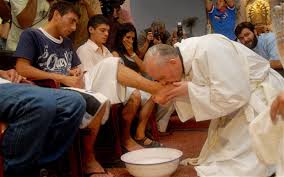
We continue to be transfixed by media reports of Pope Francis washing the feet of the downtrodden all the while scolding political and economic elites for their callousness.

Finally, this pope has refused to be housed in that cradle of opulence known as the apostolic apartments within Vatican City and has chosen more modest accommodations nearby; he eschews the fashionista trappings of his predecessors, preferring simple robes to lavish vestments, and is an outspoken proponent of public transportation–no pope-mobile here.

The Vatican Press Corps was all atwitter as the new Pope inaugurated an open-ended, free-wheeling chat session aboard his private jet en route to the Vatican, fresh from his wildly successful World Youth Day in Brazil. Previous popes had been exclusive and restrained with the press, hastily announcing press conferences that were scripted with pre-planned questions and short, controlled exchanges. This Pope fielded twenty-one questions over a period of more than one hour and addressed, at least in part, and in some respects ‘off the cuff’, the most serious issues facing the church.

The most covered segment of his chat concerned his response to a question about the ‘gay lobby’ within the Vatican and the church’s policy on homosexuality. His response is deliciously clever, and worth quoting in full, so I’m going to reprint conservative New York Times columnist Ross Douthat’s summary of the exchange (July 30, 2013); Douthat in turn relies on a transcript from the Catholic News Service (July 29, 2013).

“… Pope Francis said it was important to ‘distinguish between a person who is gay and someone who makes a gay lobby,’ he said. ‘A gay lobby isn’t good.’

‘A gay person who is seeking God, who is of good will — well, who am I to judge him?’ the pope said. ‘The Catechism of the Catholic Church explains this very well. It says one must not marginalize these persons, they must be integrated into society. The problem isn’t this (homosexual) orientation — we must be like brothers and sisters. The problem is something else, the problem is lobbying either for this orientation or a political lobby or a Masonic lobby.’

Three items jump out here.

First, the pope’s “…who am I to judge…” response suggests an opening on the subject; but it is an opening that can be slammed shut by the simple answer “Well, you’re the Pope!” According to church dogma, in the final instance, the Pope is perhaps the only one who can judge.

So he invites an opening by saying, in effect, “gay Catholics are fine, so long as they don’t organize for their rights.” Pope Francis also suggests an acceptance of gays and lesbians seeking salvation in the Catholic church, but says nothing about gay people seeking it elsewhere, or not at all. An economical position, if there ever was one.

Second, the distinction between ‘sinful’ acts and ‘the sinner’ smacks of a familiar, and disingenuous, parsing of language meant to deflect charges of homophobia and, at a deeper level, misogyny.

Third, by closing his remarks on this subject with a reference to a ‘Masonic lobby’, Pope Francis gives an undeniable shout-out to the reactionary wing of the Catholic church, Masons being a familiar bogeyman of the Catholic right.

Is Pope Francis signaling that he is navigating a treacherous path between reform and reaction?

The Dirty War

This triangulating, or balancing act, may be the most salient character trait of this pope. His legacy could be undermined by the historical pope Francis–the actual past of the flesh and blood Jorge Mario Bergoglio–and what he did, or did not do, during a blood-stained period of his country’s history.

I don’t know if Pope Francis has something to confess regarding his time as a Catholic cleric and leader of Argentina’s Jesuits during the military dictatorship (1976-1983), but the terms ‘collude’ and ‘collaborate’ offer up a rich catalog of sins–of omission, of commission, from ignorance, in word, and in deed, such that I have to wonder: did Pope Francis do all he could to protect human life during those terrible years? Is there, or should there be, a ‘mea culpa’ forthcoming? What was it like meeting with officials of the dictatorship knowing the counterinsurgency war underway against ‘subversives’ was devolving into a murderous urban pacification program so despicable as to force us to rewrite our vocabulary of repression?

Any list of the morbid neologisms contributed to the world by the Argentinian dictatorship would include, but not be limited to, the following:

  • ‘Los Desaparecidos’ (The Disappeared)–Victims of the dictatorship made to vanish through anonymous torture and murder. The term is a nod to Hitler’s ‘Nacht und Nebel’, (‘Night and Fog’) policy of vanishing all human resistance to the Nazi regime, even down to the sites of graves of its victims.
  • ‘Operacion Condor’ (Operation Condor)–a regional strategy of repression aimed at the left, pursued by southern cone nations with help from the United States, that culminated in tens of thousands dead in half a dozen South American countries.
  • ‘La Guerra Sucia’ (The Dirty War)–self-named by the dictatorial generals who led it. A war of urban counterinsurgency warfare that left perhaps 30,000 dead; the term was echoed by Vice President Dick Cheney when he referenced torture and assassination as the necessary ‘dark side’ of U.S. foreign policy.
  • ‘La Parilla’, (BBQ Grill)–“By gruesome analogy, the metal frame used in the torture was given the same name because of its appearance and because the victim was placed on top of it like the meat on a barbecue. The parrilla is both the metal frame and the method of torture that uses it.” (Wikipedia “Parrilla-torture”)
  • ‘Escuadrones de la Muerte’ (death squads), secret, state-sponsored groups of assassins who target ‘subversives’ for elimination.
  • “Secuestro Bebes”: (Baby Kidnapping)–The pregnant kidnapping/murder/adoption program where female prisoners were forced to bring pregnancies to term, the mothers subsequently murdered and, with the collusion of elements of the Catholic church, the babies bundled off to be adopted by elite military families–a secret ‘baby rat line’.

I have not found a word or phrase that quite captures the horror of that last contribution, “secuestro bebes” is my own rendering.

Even with the successful conviction of the Argentinian dictator Jorge Rafael Videla in 2011 the implications of this policy continue to be debated, as does the role of the Catholic church. The Grandmothers of the Plaza de Mayo have discovered the identities of at least 100 of the stolen babies; there remain hundreds more as yet unidentified.

I have not read a definitive account of the role of the Catholic church in this diabolical program. It seems likely there was an organic connection between this policy of selective murder of pregnant subversives (who were, in the eyes of certain Catholic priests, presumed guilty of crimes punishable by death) and the sparing of their offspring. In other words, this policy has a distinctly religious, and in this context, Catholic, character. It’s hard to imagine such a policy in another situation of state-sponsored eliminationism–in Nazi Germany, for instance. In fact, given the church’s positions on abortion and birth control, it’s possible the policy is uniquely Catholic.

There are many forms of collaboration, and this word, when unpacked, can carry with it a truck-load of negative connotations. As some Christians often refer to levels of sin, we can think of degrees of collusion, or collaboration. It is important to know who Jorge Mario Bergoglio was then, and what he did or didn’t do during the executions, disappearances, illegal adoptions, torture sessions and murders.

What’s Next

The two general issues this Pope seeks to ameliorate are the charges from Argentina (that originate from the left) of his collaboration with the dictatorship; and, the more general issue of clerical pedophilia. Some of the reporting on these issues has been largely supportive of these efforts, e.g., The Economist, no friend of the poor, is only too happy to bury the first and perhaps display a certain deference to power through its omission of the second (August 3, 2013).

So is this pope different?

Yes and no.

My sense is that Pope Francis may be able to use a more populist theology of the poor to overcome the various scandals that have rocked the Vatican of late, and that progressives should be both encouraged by and wary of this.

Will Pope Francis seize the opportunity for an historic dialogue on issues of economic inequality in the Americas? Any discussion between Pope Francis and President Obama in this regard would have to take into account the region’s left-of-center governments–from Cuba through Venezuela, Bolivia, Brazil, Equador, Argentina, and Chile. The very fact that the Pope is so engaged on issues of economic inequality suggests that the fulcrum of debate could move more to the left. The very act of having the discussion seems promising.

Anyone for a Third Vatican Council?

END

Share this:

  • Click to email a link to a friend (Opens in new window) Email
  • Click to share on X (Opens in new window) X
  • More
  • Click to share on Facebook (Opens in new window) Facebook
Like Loading...

America’s Playground

17 Saturday Aug 2013

Posted by Jonathan Mozzochi in Rant

≈ Leave a comment

Tags

California, de facto segregation, Eastern Europe, Lake Tahoe, Latinos, Mexico, Plymouth Rock, population reduction, segregation in schools, South Lake Tahoe California, United States

America’s Playground

August 2013 (Rant)

One crisp winter morning, after Santa Claus left his presents under the tree, the Pillars of the Community announce another miracle: the sudden appearance of some one-thousand Eastern European student worker bees.

Bright-eyed and bushy-tailed, some of the Polish girls were hot.

South Lake Tahoe, California, with 22,000 residents, 30% of whom are Latinos, faced a demographic conundrum. While almost completely invisible (except in transit to work at the Casinos, restaurants and ski resorts) Latinos were becoming, well, more visible. Sometime in the mid-1990s the Pillars of the Community had a meeting about this, although the issue was subsumed within a more general topic, such as ‘labor force needs’, or ‘gangs’ or some such nonsense. As with most cities in America, there is a nagging pattern of de facto segregation in schools, work and housing, but this is not the South, nor the 1950s.

The lake had a dwindling population–no doubt because every year fewer workers could afford to live there. Those who could not afford to live in town, but must work there, are reduced to a brutal mountain-pass commute in order to make a living. Rising property values, single and multi-family structures undergoing full-scale conversions into time-share and vacation rentals–all help this trend toward population reduction.

The rich with their second or third vacation homes must like that.

A powerful, abiding myth helps to both bind together and segregate these communities. The myth rests on a lie that needs constant tending, feeding and massaging. How to break free? Cut it off at the knees with a simple, pointed question–the kind of question that poses its answer in the asking.

Why does Lake Tahoe import a thousand student workers from Eastern Europe every year, and not from somewhere nearby?

The answer is in the asking: Because they are from Eastern Europe; they are white, temporary workers with limited rights; and, what is more important, they are not black or brown. Added bonus: they are mostly women.

Americans won’t work those jobs because they are too busy spreading their generosity around the world, so the reasoning goes. With the continued expansion of global markets it appears as though labor is traipsing around the globe, as capital does, free to find its natural station in life, at times beyond national borders.

Opportunity is available to all!

But these kids are the poisoned fruit of globalization, because labor is not free to go wherever it wants. It is free to go where capital wants, and allows it to go, and under conditions it controls; and then no farther.

A labor force imported from overseas: one-thousand students a year in a city of 22,000 people. This importation carries a trace amount of cultural diversity necessary to contribute to a menagerie effect in a hospitality resort setting, but without the racial diversity so problematic for Americans since, well, Plymouth Rock, I suppose.

The fundamental challenge: How to get more Mexican workers in town without…Mexico!

The Pillars decided they couldn’t have some pasty snow baller on a chair lift seeing one too many ‘tiendas’ around. What was needed is a kind of invisible worker who embodies all of the positive attributes ascribed Mexican ‘illegals’: they’re poor with a language barrier effectively preventing their easy assimilation and they have a precarious legal status, making them ripe for super exploitation in low-wage jobs; they’ll need low or no benefits and will be crowded into slum-like housing conditions with a virtually invisible social and cultural life.

Oh, and they aren’t black.

But they can’t have too many of their bad points: they’re illegal, brown (almost black) burdened with families that have to be housed somewhere; and, one must consider the flip-side of the language barrier, their tendency to nod in agreement with whatever is being said by terrifying tourists asking for directions, often unintentionally sending said tourists somewhere other than their desired destination. Doctrinaire libertarians could construe this unfortunate bi-cultural interaction as criminal–because it interferes with commerce—that flip-side of the language barrier. Well, there’s no other group that so embodies all those positive labor attributes without many of the negative attributes.

Eastern Europeans are Wetbacks, but not Mexicans. They’re White wetbacks.

Who doesn’t love student work visas? Good old state-subsidized overseas rites of passage. If the Pillars are fortunate, some of those Eastern European women can subsidize their income with sex work and/or marriage to local men.

The Tahoe Dream does need a few of the real Latinos in town to keep the beds made, the dishes washed, and the chairlifts and pleasure boats operating. There is also the undeniable attraction of the cocaine trade, while marijuana is handled by legions of slacker snowboarders tending dozens of indoor hydroponic grows that count for, well, a  truck-load of the area economy.

But the city fathers and their corporate masters need Mexicans for the other stuff–just not too many of them. At a conservative estimate, Latinos in South Lake Tahoe were approaching 30% of the overall population. Rut Row! That’s too many! An imported white worker solves this problem, because Lake Tahoe isn’t 1950s Selma, Alabama. You can’t have a police chief standing in the casino door of history spraying down people with hoses. But you can raise rents, prevent multi-family housing from being built, convert a bunch of modest working-class homes and other inferior dwellings into vacation rentals and then ship in a bunch of white college kids from overseas.

Yes, I know, the market did all this. Adam Smith’s Invisible Claw reached out and scooped up all those overseas students then looked inward and squished some 30 small businesses in the downtown core to make room for a mega time share development; except the development ran smack into the global financial meltdown of 2008 and was transformed instead, into a giant hole.

Bad timing, that one.

But that’s just the market culling the herd. Everything is great. Play some Blackjack.

South Lake Tahoe congregants mostly appear prostrate before Mamon: An ironic contrast considering how this small city, seemingly so close to God at 6200 feet, could embrace such a crassly materialist ethos. Set as it is on a political fault line between a ruthlessly libertarian Northern Nevada, with it’s open defiance of any social protections whatsoever and a concomitant subservience to a casino/misogyny/real estate economy that produces the social dislocation and economic hardship that plutocrats feed off of; and that of Northern California, that bastion of pot-smoking, eco-socialism, the town could not be more unlike a ‘mountain hamlet’.

The congregation only ever gathers en-masse to celebrate their conspicuous and entitled indolence, itself consecrated through empty rituals performed for the pleasure of their god: The Eternal Real Estate King. The irony is the one we are all too familiar with: the lake is ‘saved’ just in time for the recreating pleasure of the elites who despoiled it in the first place. Here the term ‘manufactured crisis’ comes to mind. Deliberately screw something up, blame it on someone else, step in to fix it, and be the hero.

Rinse.

Repeat.

I shudder, recollecting the televised dog-and-pony show that is the Resort Sports Network, a cable television program that lodges itself within a host ‘recreational community’ and proceeds to infect the broader community with its endless amateur freak parade of blonde bobble heads going on ad nausea about their recreating, the station serving as the perfect travel agent for a trip to Hell, accommodating the legions of wasted youth busy flying down the slopes, their pointless lives dissolving in a cloud of bong smoke as the snowboard tracks they leave in the snow.

I guess there is something beautiful about tens of thousands of assholes in SUVs ascending a mountain to a lake in the sky, their orgies of consumption producing the toxic runoff that besots a lake so thoroughly that it continues to lose one foot of water clarity each year, as it has for the past 30 years. Upon arriving in Lake Tahoe these militant, class conscious tourists feel free to express the worst of their inclinations—their petty, degrading demands, public tantrums and obscene displays of wealth and bad taste offered up in grotesque fashion—all of which are suddenly unleashed upon resort workers who are virtually powerless to defend themselves. I am sure there is a beautiful aspect to this that I am missing. Perhaps the enriching multicultural experience of an English wanker stiffing you on a restaurant bill because he does not ‘believe’ in tipping is of some aesthetic value. Cheers, mate! You go ahead and fill in the beautiful stuff I have neglected to include.

As most everywhere, there are pockets of civility and organic community that have not succumbed to the grinding, seemingly inexorable forces of metastasizing corporate development. A small farmers market, erected on a tiny VFW parking lot every Tuesday in spring and summer; a smattering of cafes, coffee shops, taquerias, boutique restaurants and consignment stores; a women’s center and, until recently, a bookstore. As of 2010 the bookstore is gone, having been situated too close to a black hole otherwise known as Starbucks. There are ample parks and national forests, the lake (of course), a small public library and an ice skating rink, good public schooling, a Catholic Church that hasn’t, apparently, had a pedophile scandal, a Montessori school, etc. Increasingly these valuable public/private spaces are under assault.

And such amenities are under attack from unexpected quarters: The Legions of the Clean and Green. Uttering frightful incantations evoking mutually contradictory codes and regulations that magically apply to ‘scenic corridors,’ ‘Lake Zones’ and ‘accessory uses’ the eco-brats make way for the gigantism of corporate restaurant and retail chains with all the charm of concentration camps. Think Applebees, with all those pre-fabricated walls of ‘local’ deteriorata–the framed baseball team pictures, fire station benefits, etc., produced in a remote cubicle by a techno-serf thousands of miles away.

In the neighborhood!

On the one side: weak, disorganized and distracted citizens so rooted in the grass as to be incapable of even the empty, peripatetic ritual of a street demonstration. On the other side: Free market environmentalists skilled in the Byzantine arts of deception called ‘best management practices’, ‘green spaces’ or ‘historical preservation’ administered by federally sponsored, quasi-governmental juggernauts incapable of hearing anyone other than $500.00 per-hour consultants who speak in the murky idiom insisted upon by their resident priests of preservation.

One of my favorite schadenfreude-laced memories involves a public meeting held at the local middle school following the Angora Fire of 2007. The fire, the origins of which were probably accidental, began at the south end of town and obliterated some 200+ structures, including many homes and businesses. This public meeting, held while the fire was still active, featured  then executive director of the Tahoe Regional Planning Authority (TRPA), John Singlaub (no relation to the Iran-Contra scumbag of the same name) the very embodiment of the Clean and Green/Metastasizing Corporate Development wing of the Lake Tahoe Pillars of the Community.

One middle-aged home owner who had just lost his domicile to the raging fire began blasting the TRPA for not having allowed him to clear some trees near his home prior to the fire, a problem often associated with the agency. Some of these complaints are undoubtedly self-serving, made by people who want to cash in on environmental destruction, but others are legitimate. The speaker was clearly upset–just alternately fuming and despondent–and in need of comfort. So Singlaub stepped up to the microphone and, if I remember correctly, interrupted the guy, called him a liar, belittled his loss, and defended his massive federal agency by hacking away at a guy who just lost his home.

Masterful.

Meanwhile, a murmur spread through the crowd and a lynch mob began to form. Local police and sheriffs had to surround the stage where Singlaub was in order to protect him from what could have been exciting vigilante violence.

On the other hand, there are plenty of voracious corporate types–free market zealots–who salivate at the notion of paving over Lake Tahoe (and its workers) to make way for a gigantic theme park or some other such monstrosity. In cases such as these, the zealot doth protest too much, methinks.

I fondly recall misbehaving at Harveys Casino with the voice of Bill Cosby rising above machine and man alike with its reassuring, familiar tone and cadence. Cosby, itinerant peddler of parental advice and trusted icon of pop child psychology, the supplicating genius behind the Fat Albert Show and the later, thoroughly domesticated Cosby Show, prodding the listener in that snide and snarky manner common with advertising that playfully preys on your insecurities: ‘Whatcha doin’ there? Got some bonus points yet? No? You haven’t signed up for Reel Rewards? You haven’t yet? What’s that? Wazza matter? You mean you don’t like FREE? You don’t like getting something for free? Ha! Ha! I knew ya did! Get on over to the VIP booth and get some FREE coupons! Sign up for Reel Rewards. Ya like free, don’t cha?’ Cosby’s disembodied voice, ubiquitous visage emblazoned on thousands of poker chips, and marquee name collectively eating away at what had long been rumored to be a gambling debt owed Harveys Casino.

However much money Cosby may have owed Harvey’s Casino was more than compensated for with that routine.

A history illiterate but acutely image conscious public relations engine churns out myths of pulp fiction; the halcyon days of the gold rush of yesteryear gently giving way to the gold mines of today, the casinos. Mark Twain is exhumed and repackaged as a grandfatherly icon of Leisure Culture, his trademark white linen suit and panama hat re-contextualized as ‘leisure wear’. I can picture him screaming, turning over in his grave, straining to throw a molotov cocktail at a casino, time share, vacation rental or Hummer.

Oh…that’s my fantasy. I’d like to think I would be by his side as we stormed the ramparts of…well, you get it.

Seeing Mark Twain, who was a brilliant satirist and anti-imperialist conjured up by some artless twit–sometimes a pair of twits in two different lakeside locations during the same day–always made me want to start burning tourist brochures.

Here’s a better allusion. Is the effect produced by the four high-rise casinos that dominate the main drag of South Lake Tahoe that of a ‘Donner Party Drive’? Is this an unintended homage to those misguided pioneers of an earlier century? Ah, the parallel is delicious and devastating.

Picture a family on their way to visit their precious childhood heroes Hoss, Lil’ Joe, Ben and the other white settlers at the Ponderosa Ranch theme park of Bonanza fame. Their SUV stalls in the Canyon of Casinos. Overstaying their welcome, they are forced to resort to cannibalism in order to survive. ‘Stay too long in this theme park, and you will eat your young’, they should have been warned.

This imagery sparks a memory from the early 2000s when I was managing a restaurant in South Lake Tahoe. I had been away from the restaurant for a few hours and when I returned at 11pm or so I discovered some ‘parents’ had left their two young children at a table and proceeded to go to the casinos. They told the server they would be back in awhile. The waiter demurred and kept an eye on the kids. That was five hours ago.

I called Child Protective Services.

Lake Tahoe, as most American cities, is a cultural desert whose only sources of water are crass American white settler mythology and vacuous civic boosterism fermenting within a repressive laboratory of corporate casino, hospitality and leisure culture.

If you are looking for the corpse of the American dream, you can find it in a casino that was built next to a pristine lake at 6200 feet elevation in the mountains. I’ve been to the mountain top and…there’s a casino.

Spend your last dime to feel that momentary warmth, that space-cadet glow. The rush of the endorphins, the clanging of coins, the blinkering of multi-colored lights, the swell of breasts and the smell of money—a timeless synesthesia where you are only vaguely aware of your future slipping away into your past, a primordial, perpetual present.

The steady obliteration of civic life in America produces the effluvia upon which Casinos thrive, filling that hole in your heart while emptying out your wallet.

Earth Day is celebrated in a casino parking lot.

There is only one industry that really competes with the casinos. The competition between these two industries is a mutually beneficial, interdependent embrace built on decades of that all-too-human truism: ‘misery loves company’.

The drug trade is where everything comes together: It is arguably the only remaining vestige of democracy left in a place like Lake Tahoe, or anywhere else, for that matter. There are no longer public squares or areas to congregate freely without consuming something in a conspicuous manner, which means you need ample ducats.  Civic traditions are limited to gargantuan, environmentally devastating orgies of consumption: The Fourth of July, New Years (when the town’s population swells to something on the order of 100,000), Labor Day (that’s just brutally ironic), Cinco de Mayo, and Saint Patrick’s Day, all of which amount to all-day, city-wide drunk-fests, the latter two without even a feint to Mexico or Mexicans, Ireland or the Irish.

Alternatively, and more disturbingly, one could consider the annual Renaissance Faire as a form of civic bonding. But this is another excuse for public drunkenness and loitering, but one that involves only white people inebriated on a bizarre, fabricated pastiche of swords and beer, heraldry and wenches, vassals and titles of nobility; peasants without peonage, parties without the plague.

Tribalism is what this place celebrates; the tribe of the white leisure class.

The town’s newspaper, The Lake Tahoe Tribune, has printed on its masthead, (without a trace of irony) “The Voice of America’s Playground”, neatly implying its residents are children. This fits seamlessly into the cult of the perpetual adolescent so essential for the reproduction of social inequality and a pervasive presentism. The town is a monument to a militantly ephemeral leisure culture. In a city with no history, on streets with meaningless names, next to a lake choking on its last dying effort to accommodate millions of tons of human pollution, the only quasi public places left where the life blood of democracy—the free association of opposites, especially rich and poor, black and white—only really occurs is around the drug trade.

No drugs, no democracy.

After all, most work is so poorly remunerated, so crushes the spirit, and leaves one so empty of meaning and humiliated as to demand a shot, a spliff, or a snort just to enable one to get up again the next morning–only to have to do it all over again.

The social stigma attached to drug use is conveniently bifurcated into ‘recreational,’  and ‘abusive’. Both are illegal, and begin classified in an identical fashion, then, through the magic of legal sophistry one becomes a substance that can send you to prison for 25-life (crack cocaine) while the other (powder cocaine) will get you a stint at a Betty Ford clinic, a job in entertainment, a rehab book contract or perhaps a vapid reality program.

While this may be depraved, it is not accidental.

The opportunity to rub shoulders with the other and rediscover, in a voyeuristic way, the polis, is real and serves a valuable public function. South Shore residents would like to emulate the peculiar social isolation that goes with having the power to live in your own gated community. And they will have it, just as soon as the ‘illegals’ have been relocated–far enough to be out of sight, but close enough to do the dirty work needed to clean up the playground.

There is one undeniable benefit of living in a casino town: it is thoroughly secular. No morally righteous arbiters of virtue–no Pat Robertson, Joe Lieberman or Osama Bin Laden, here. If they are in Lake Tahoe, they are passing through, incognito, throwing their money around like William Bennett, peddling their Little Book of Virtues to cover their roulette debt.

They are too busy cocooning with a one-arm-bandit or in awe of the lake’s crepuscular entertainment to organize politically.

END

pastedGraphic.pdf

Share this:

  • Click to email a link to a friend (Opens in new window) Email
  • Click to share on X (Opens in new window) X
  • More
  • Click to share on Facebook (Opens in new window) Facebook
Like Loading...

Racism and Rugby

09 Friday Aug 2013

Posted by Jonathan Mozzochi in Essay

≈ Leave a comment

Tags

Emmett Till, Google, Head coach, Highlander Board, Racism, Rugby, Rugby union, Varsity team

August 9, 2013

Racism and Rugby

An open letter to the Board of the Marin Highlanders RFC

After an exciting first year of rugby my 10-year-old is chomping at the bit to play again. While he loves sports–skateboarding, basketball and soccer, he really, really took to rugby. I was pleasantly surprised and up until recently knew very little about rugby. My son thrived I was, and remain, very happy for him. Throughout the 2012-2013 season I was favorably impressed by his team’s organization, discipline, teamwork and team spirit. My favorable impression was, in no small part, due to the coaching staff, led by Paul Cingolani. ‘Coach Paul’ inspired my son and gently helped him adjust to a large group of diverse kids and a strange new sport with seemingly arcane references–‘props’, ‘scrums’ and ‘rucks’ were new terms for us.

It was with great disappointment that I learned ‘Coach Paul’ would be leaving the Highlanders this coming season.

A July 22nd Board vote led to a public memo the next day from the President of Marin Highlanders RFC citing a decision to “terminate the services” of the varsity head coach, David Cingolani, Paul’s brother. A public meeting to inform interested parents as to the reasons behind this decision was scheduled.

The next day, the formation of a ‘North Bay Rugby Club’ was announced. Paul’s brother was listed as Director of Rugby and the new head coach of the varsity team. A long list of other coaches and parents, presumably in support of the move, was included with the announcement; Paul’s name was on the list.

My son was so taken with ‘Coach Paul’ that he took it upon himself to write him a letter expressing his thanks and admiration. I made many, many visits to practices and games. ‘Coach Paul’ always conducted himself with a coaching professionalism and regard for children that I think is unique, and laudable.

I think it is fair to say that many parents share this opinion of ‘Coach Paul’ and while I don’t know him socially, his reputation as a coach is untarnished.

I do not know, nor have I had any contact with, his brother.

This all feels like a family break-up; but if there is any chance of our leaving the Highlanders and joining ‘Coach Paul’ and the new league, that decision would face a daunting obstacle.

The Highlanders president announced the time and place of the Board meeting (August 5) and that the board would: explain why it terminated the head coach and why it had refrained from making any public statements; give a run down on the history, philosophy and principles of Highlander rugby; and, set out plans for the upcoming season.

I thought the order of events made sense and that clearly something had transpired that could well have legal implications. The Highlanders Board was behaving in a transparent, responsible fashion designed to protect a 33-year-old league with a solid, venerable reputation.

I didn’t attend the Board Meeting on August 5, but I have spoken with numerous parents who did. Also, the Board issued a “Rugby Parent/Coach Meeting Summary” of the meeting from which we can distill the following points:

The Board set out a “clear chronology of recent events” involving the former varsity head coach that included complaints of “verbal abuse, intimidation, and humiliation of players and condoning of alcohol consumption by the team.”

That wording is from the written summary of the meeting. Some parents and coaches, however, made it clear that there were verifiable instances of racial abuse, racist taunts and a frat culture (drinking, hazing) tolerated, condoned and perhaps encouraged by the varsity coach. There were numerous personal, written testimonies to this effect.

Are these complaints justified?

Were the testimonies read to the Board accurate and truthful?

The evidence strongly suggests that they are. These complaints, as documented and recounted at the very public Highlander Board meeting, demonstrate a long-established pattern of abuse. It appears as though this was tolerated, for many years. It is less clear why (a winning record trumps civility? The threat of social ostracism? Scholarships would be jeopardized?). The accusations have an aura of authenticity; some of them were made by people who themselves were enmeshed within what sounds like a culture of conflict avoidance, of looking the other way.

Everything I have heard from the meeting strongly suggests that the Board has taken the correct course of action. It is equally clear that more should have been done by the Board, earlier, and that still more needs to be done.

The Highlander Board wrote that an honorable sports program should “transcend the cult of an individual coach.” It should also transcend the ‘cult of the perpetual adolescent’. In other words, when our children are found to be drinking or doing drugs, hazing other kids, and hurling racist insults, this is regrettable behavior that requires intervention. When adults engage in racist, bigoted behavior it is deeply disturbing–more than just regrettable–and requires active opposition.

The Highlander Board should consider adopting a stronger policy on bigoted behavior when it occurs on the part of players and/or coaches. The day my son witnesses, or, god forbid, is involved with racist abuse is the day that program becomes dangerous for my child. I feel fortunate he is only ten, and thus far mostly shielded from it.

It appears as though the Highlander Board has limited this issue to a problem centered on the varsity head coach. Or does it have deeper roots?

If this behavior has been as egregious as claimed, as persistent over time as the Board itself has alleged, (seven years?) then what is the proximate cause of the failure to intervene sooner?

If the Highlander Rugby RFC “expects all coaches to demonstrate civility, decency, maturity and respect in all coaching activities” how is it that this was allowed to go on as long as it did?

What are the safeguards you have in place to ensure it doesn’t happen again?

When responding to racism one should always make an assessment as to whether the behavior is organized or sporadic; whether the issue involves an organized hate group or perhaps is isolated to the malevolence of an individual–which can be bad enough–but not the same.

Lastly, racism in rugby is not new; do a google search on “racism and rugby” and you will find a university rugby team in the UK that was recently banned from competitions for 18 months after players dressed up in Ku Klux Klan outfits at a party, among other despicable behavior.

Perhaps there is a need for a full-throated policy of zero tolerance of racism?

Do we need to “show racism the red card” as FIFA Soccer does?

The problem of organized hate groups and football hooligans in Europe is an ongoing, serious issue about which I have absolutely no sense of humor.

In the 1990s I was a contributor to a community-based manual called When Hate Groups Come to Town. One of my core areas of responsibility were youth-based hate groups. The first, most important lesson I would teach parents was that racist behavior needed to be stopped early; that interrupting and halting hate-based behavior helps prevent it from metastasizing into full-blown organized bigotry–a hate group.

If you think this kind of stuff doesn’t happen in Marin County, think again. It happens everywhere–from board rooms to break rooms, schools to prisons–and it must be stopped. Passivity in the face of racial hatred signals acquiescence. Emmett Till, Mathew Shephard and other civil rights martyrs were slain as a result of this.

As an aside: It has been my profoundly disturbing experience that different forms of bigotry tend to coagulate: racist taunts invite homophobic slurs; anti-gay violence is a close cousin to misogyny.

It might be a good idea for the Highlander Board to invest in an anti-racist/anti-bias curriculum for players and perhaps look into the availability of such resources in area schools and places of worship.

I applaud the efforts of the Marin Highlander Rugby Club to confront these issues and look forward to their continuing, pro-active response.

My son and I will miss ‘Coach Paul’. I hope that some form of reconciliation is not out of reach, but it should not be at the expense of the Highlander program and should be within the context of a meaningful accounting for what has happened and the initiation of a program that can help us stop it from happening again.

Regards,

Jonathan Mozzochi

37.774930 -122.419420

Share this:

  • Click to email a link to a friend (Opens in new window) Email
  • Click to share on X (Opens in new window) X
  • More
  • Click to share on Facebook (Opens in new window) Facebook
Like Loading...

War Crimes, Lady Liberty and Values Voters

05 Monday Aug 2013

Posted by Jonathan Mozzochi in Memoir

≈ Leave a comment

Tags

Abu Ghraib, Iraq, Iraq War, Michael Moore, Saddam Hussein, September 11 2001, United States, Winter Palace

War Crimes, Lady Liberty, and Values Voters 

2005 (re-edited August 2013)

When the muse of history looks back on the American invasion and occupation of Iraq, her countenance frozen in shock and awe at the sheer audacity of the lies, the tragicomic credulity of the American public and the utter absence of reason in any of it, she will write of the moment an American GI refused to drive a Hummer without armor as the beginning of the end of this sordid affair.

Ma History will note the courage another soldier displayed in choosing conscientious objection over a second tour of duty in Iraq. And then she will weep for the 100,000 bombed into oblivion because of an illegal, immoral and criminally stupid invasion of the land of Eden. She will not write of the 3,000 murdered in New York, Washington D.C., and Philadelphia some three years ago. Why? Because that act of monstrous evil had nothing at all to do with this carnage, and has its own, separate volume.

It’s also true enough what they say: power yields not to facts, nor reason, nor right, nor the public good. And while it remains to be seen whether ‘W’ will have to pay the piper for stuffing the square peg that is Saddam Hussein into the round hole that is the so-called ‘war on terror,’  for now might makes right.

But we will all pay for this one.

This is a morose habit of mine–watching the spectacle unfold with unbridled disgust and fury. The response I often receive is the cooing of the pendulum theory of history. You know, history repeats itself, endlessly swinging to and fro, in comforting, concentric circles. Somehow, I am supposed to take comfort in the idea that soon the pendulum will swing back.

Everything balances out.

But even if one were to accept this notion of plus ca change, it deliberately misrepresents the idea that while the pendulum does swing two and fro, it’s fulcrum may move to the right or to the left, leaving the path of the pendulum swinging over different terrain. Besides, the pendulum notion suggests another classical allusion that has also long since been shorn of any meaning through over- and mis-use: that of Lady Liberty holding the scales of justice, keeping in balance the counterweights of American jurisprudence: presumption of innocence, weighing of evidence, the dispensing of justice, and, of course, vengeance.

But I don’t take comfort in the pendulum swinging back because I no longer recognize the terrain over which the pendulum of history swings. That landscape has become increasingly barren and bereft of hope such that the part of history endlessly repeating itself seems to be the murderous and cruel part.

Lady liberty remains blind, but that just means she is unaware her scale is corrupted. She is now incapable of weighing in a fair manner the souls in the balance; her gaze is now permanently fixed on tabulating and re-tabulating the 3,000 or so Americans murdered on September 11, 2001. She considers the 100,000 (or so) dead in Iraq, [2005]–a result of the most egregious war crime one can commit, that of one sovereign nation invading another without just cause–to weigh less than those 3,000 lives lost in spectacular, jumbo jet-cum-missile fashion. If she was actually weighing anything of any consequence to humanity, if whatever she has been doing with those scales had anything at all to do with justice, the President of the United States would be tried as a war criminal. That’s the hard truth of the matter.

Some lives, then, are worth more than other lives. That principle is alive and well in American jurisprudence. You can see it at Abu Ghraib in the now infamous photo of the Iraqi prisoner standing on a crate, his arms out crucifixion style, hooked by wires at the fingertips to an electrical shock machine, his head covered by the capuche, or hood, so popular throughout Latin America for the past four decades. All this is instantly recognizable the world over as the dress code and pantomime of Imperial torturers.

The reverse is true as well: the United States policy of not allowing photographs of dead American soldiers, in or out of coffins, is to deny that American soldiers die at all, their lives so precious that we cannot even be allowed to see their lifeless bodies. So you can show an Iraqi being urinated on, hooked up to a torture machine, but you won’t show an American soldier in his coffin.

What do you glean from this?

This principle, that American lives are worth more than others, that we are an exceptional country, is a principle absolutely anathema to a functioning democracy. It is toxic to core values of justice and equality and it follows from a relativistic notion of ethics in the world: you know, we can do whatever the hell we want because they suck worse than we do.

America, love it or leave it.

But you can accept this from a realist (relativistic) manner; or you can continue drinking the Koolaid–actually believing in the content of the fabrication. Either way, we have become incapable of recognizing the unique humanity of other peoples.

I am not undergoing that classic American epiphany; the one where the man of conscience wakes up in the middle of the night with the terrible recognition that their government tells lies. I am no apostate from the American Dream; I never believed in it to begin with. I am a heretic. So I don’t experience that disorienting sensation of a fall from grace.

What gets me, what seems new this time around, is the utter oblivion that one is consigned to when you point out these seemingly irrefutable, common sense truths. That seems to be novel. That’s my epiphany. I mean, I never felt entirely in the wilderness in the 1980s and 1990s. But now? Trees are falling in the woods, I hear them, I even see them falling; but seemingly no-one else does. They didn’t fall, I guess. What’s left of the left is as irrelevant as it has ever been in the history of this nation. I know, there is Michael Moore with his jocular and populist anti-corporatism. But really, he is going to lead us in storming the Winter Palace? Will he provide the rope to the plutocrats with which they can hang themselves?

I don’t think so.

The pendulum pushers are those people who believe that when things get worse it just means they are about to get better. Meh. I’ve always thought this position, so popular among American progressives, reflects as much analytical subtlety and wisdom as the rallying cry of those German Communists who, just prior to Hitler being named Chancellor, took to the streets shouting “After Hitler, Our Turn!”

We know where they ended up.

Democrats may yet find a way back to power, but I am reminded of a mirthful query I occasionally toss up to my meat-eating compatriots: If, after decades of interbreeding and biological engineering the gene pool of the modern chicken is so fucked up that the fight or flight instinct has been bred out of the animal and it greets foxes with a merriment previously reserved for roosters; if, after so many generations of existence in a tiny cage it can no longer fly; if, after so many lives lived in complete darkness it can no longer see; and, if the thing increasingly eats its own young, then tell me, is that thing you eat, that thing you call a chicken, really a chicken? Or is it something else, something that requires a new name?

The battle cry for Democrats to ‘reconnect’ with values voters sounds like the feeble cackle of the modern ‘chicken’ embracing its natural predator.

A mobilized and active population will characterize the early phase of all fascist movements. Authoritarian regimes, Caudillo-style plutocracies, European monarchies and other dictatorships of all stripes do not, as a general rule, like excitable, mobilized populations. They may fight a war—as did Argentina against Britain, Iran against Iraq, etc., but these ventures are a sign of weakness, and it seems to me such activities usually  involve the undoing of such regimes. One has to consider how much worse racist attacks could have been in the United States post-September 11 with a mobilized population, rather than a nation of ‘reality television’-watching, McDonald’s eating, Hummer-driving, xenophobes.

I guess I should be thankful.

The current trend towards an electorate evenly divided and deeply polarized could very well portend the early stages of just such a population ‘waking up.’ Fascism, in its fetal stage, is dynamic and requires an active, autonomous, mobilized segment of society. It must have an alchemical, volatile mixture of ideas and activity on which to feed. The Republicans do not yet have a grip on such ideas, trapped as they are with the mutually exclusive goals of maintaining, extending and deepening their institutional power but also mobilizing a constituency that is increasingly hostile to such a project–their elitist leadership vs their base.

Ironically, it is within pluralist democracies that one will find the most fertile ground for the development of a full-blown fascist movement. This resolves the seeming conundrum of why Weimar Germany, the polestar of western, democratic societies of its time, would descend into fascist barbarism. The liberalism of the Republic provided the necessary, if not sufficient, groundwork for the incubation of the Nazi movement.

One could argue that there would be no need for fascism in America—liberal economic policies and an individualist moralism at home and abroad provide a modicum of stability; the siphoning off of profits from the third world channeled into stabilizing the social contract at home. While this may be true, it misses the point. It’s not whether America ‘needs’ fascism or not. The question is under what conditions does it becomes possible, plausible, likely or even inevitable?

How about under the current conditions within which we live? I think it is about time that progressives began to seriously ask the question: what is coming down the pike? If you think that we already live with a fascist government, then you and I have nothing to say to one another–because it isn’t. Assuming then, that whatever is coming is taking shape as I type, and it probably won’t be good, we should discuss how to stop it.

One could argue that the time to snuff out an incipient fascist movement is right then, in its infancy, right now. However, even this is probably too late. The better allegory is that of an abortion because in all likelihood fascism only becomes possible, its infant stage only realizable, after opposition movements have already been defeated. In other words, it wouldn’t be conceived at all if opposition had been strong enough to begin with. It’s necessary to turn the old (disastrous and wrong) leftist diagnosis of fascism on its head. Instead of fascism born as a reaction to the threat of progressive victory (the most common variant of this argument is that a segment of the ruling class will turn to fascists to protect itself against the threat of the left or, in its most infantile formulation, fascist movements are considered to be headless aggregates of disgruntled criminals fighting and dying for their capitalist masters, the latter secretly pulling the strings to achieve higher rates of profit) fascism is born in the ashes of the failed revolutions of the left.

In America, was the birth of fascism in the early 1970s when the civil rights movement and all the other progressive movements formed around it, lost? I know that’s counterintuitive, because most people, even progressives, are accustomed to speaking of the triumph of the civil rights movement. But I disagree. What, really has changed in Black America? When you break that down it all looks like the failure that it really is–most specifically for Black people, but also for most everyone else. No, the specter of American fascism feeds, and grows stronger, on the desiccated corpse of a union movement that today represents all of 13% of non-public workers. It grows stronger because the most promising civil rights and liberation leaders were assassinated in the 60s and 70s, the remainder of the movement jailed and beaten, commodified and gentrified into leisure rebellion and pseudo integration, into a retreat deep within the urban enclaves of crushing poverty, social Darwinist triage care, de facto disenfranchisement and a reactionary right wing business class.

The vultures of fascism are getting fat on the carrion. If anyone had bothered to hazard a passing glance at the mad copulating going on over the past 30 years between Christian conservatives, free market parasites, militia types and national security state operatives–a perverted union, the kind that can produce a fascist baby–if someone had seen this act of brutal, loveless fucking for what it was, then perhaps the parents could have been dispensed with. But alas, I fear we already have the prodigal son running around among us. And now he may be too strong to kill. Perhaps it’s time to run to the hills. I’ve heard Canada has mountains.

Fascism feeds on feeling states. It is always tribal and will concoct an imaginary heroic history from which to project an hallucinatory moving picture of the future. Fascism is the quintessential celluloid creation. This is why arguably the two most influential films in the history of cinema are both (proto)fascist films: Birth of a Nation and Triumph of the Will. Fascism in its movement stage seeks to supply an answer for that deep, collective yearning we all feel (some of us more than others) for community. In this age of digital anomie and multiple identities fascism supplies an answer to the question, ‘who am I?’ Fascism offers itself as profoundly solid and compact in contrast to rapid and inexplicable economic and cultural change (globalization, etc.) and demands that people be willing to fight for an alternative vision of the future. In fact, the very act of fighting is how the collective identity of a fascist movement is forged.

The esprit de corps of fascism is forged in the flames of war.

With the ‘War on Terror’ this country is now permanently at war. And now we have a demographic—the values voters—that wants a new beginning. These largely white voters constitute a self-aware group of people who want to be ‘born-again’ in the dung heap of its national mythology; a group of people whose own religious experience dovetails in a remarkable manner with that of classic fascist activists; a population that is ready to fight against the elites who have betrayed them (wait for this crop of ‘War on Terror’ veterans to come back home from Iraq, as my friend remarked, “they’ve already begun killing their wives”) and against the subversives (insert long list here) who assail the morality of their mission, subvert their manhood and impugn their honor.

The mark of an American fascist movement will be its ability to alchemically represent the battleground where racism and religion intersect. Pat Buchanan’s key supporters offer us a fabulous taxonomical specimen of this phenomenon (if only it were dead, stuffed and mounted on a wall by a political taxidermist). These voters, who make up the hard, fascist nut of the ‘values voters,’ but who are not synonymous with them, are ideologically defined. Don’t bother with the demographic profiling. It will tell you less than nothing–you will be misled.

Call them Middle American Radicals or ‘MARs’. What’s critical to the MARs is not their education, income level or propensity to watch Fox News. What is central to the concept of a MARs constituency is their worldview: the notion that post Civil Rights era white Americans are a dispossessed majority forced to contend for political power as a new white minority competing with other ethnic and religious groups within an increasingly balkanized set of American identities. And they are trapped between opposing groups: exploited from above by a deracinated, cosmopolitan, urban elite associated with the ‘blue states’ of the democratic west and east coasts and politicians such as John Kerry, they also consider themselves squeezed from below by poor people, minorities and especially immigrants of color. Anti-immigrant organizing is now their central issue. Corporate elites, by supporting programs such as outsourcing and immigration, conspire with the poor to undermine America’s unique place among nations: as that of God’s chosen vessel wherein all riches are divided among the chosen; or, in the secular, colloquial MARs version, the greatest ass-kickin’ country ever, dude!

Why did Kerry lose? Malaise. His ideas merely reflected Republican hegemony, rather than an alternative. Democrats were mobilized pretty narrowly to defeat Bush, rather than for anything. It’s as though the War in Iraq has somehow made the left within the democratic party irrelevant again, rather than insurgent force.

Where’s my peace dividend?

Where’s my peace movement?

“Oh no, we can’t win with those issues,” I am told. Much better to continue endlessly triangulating towards the goal of political power, sacrificing people and ideals along the way. As the sailboat shifts to and fro, tacking from left to right, plotting the most inefficient, confused and confusing course, everyone becomes too sick to guide the boat anywhere, and, most importantly, everyone on board fails to keep their eyes on the prize.

Perhaps you disagree?

Perhaps you really think that John Kerry’s duck hunting so as not to be pigeonholed as a girly-man was effective, but wasn’t taken far enough? Perhaps you think his manly threat to “hunt down, capture and kill the terrorists”, amounted to something other than a murderous mantra? Perhaps you think such xenophobic frothing at the mouth somehow subverted the deadly logic of Bush’s ‘War on Terror’. Perhaps you think Kerry’s “Reporting for Duty!” al la Gomer Pyle routine moved anyone but the hapless veterans busy trying to shore up his sinking swift boat routine. Maybe you flushed with pride when John Kerry adopted the schizophrenic position that [paraphrasing] “had he known then what he knows now he still would have voted for the war.” Maybe you believe all that, and you think Kerry lost the election because he failed to appeal to the faith-based constituency (I just made up that term, because I’m sure someone is going to use it as a weighty synonym for ‘values voter’). Maybe you think he lost because Johnny NASCAR and his big-hair Security Wife and linebacker kids didn’t feel safe enough with Kerry?

Nah.

Kerry lost because although people hated Bush in droves, Kerry failed to energize core Democrats, which would have required doing something other than betraying them, yet again. Kerry betrayed them when he took the nomination for president from the Democratic Party, simultaneously running away from Howard Dean’s mobilized anti-war constituency. Just as the Republicans were getting geared up to kick gays and lesbians off the steps of city hall in eleven states, the democrats demobilized around the War in Iraq. Go ahead. Tell me I’m wrong. But that seems to be the order of events.

To win, Kerry would have had to be for something. What he was for was not really clear, as various pundits have correctly argued. The election was his to win. The war was going badly, the economy sucked and all historical indicators favored a Democratic win. And while I think Kerry is a putz, I didn’t take him to the wall for being out of touch with values voters. Various pundits, including a gaggle cloistered around the Democratic Leadership Council argued for him to chase the proverbial, independent ‘undecided’ vote. Just weeks away from election day the Gallup Polling organization identified this august constituency as having become, for the first time in American election history, statistically immeasurable.

Nice going guys. Help the candidate tailor a message to a phantom voter that some wanker pollster identified in a focus group. Then off they go, looking for the phantom voter rumored to exist in habitat somewhere adjacent the yellow lines of some small town highway, right in the middle of the road then…Bam! Kerry gets run over by a confederate flag waving, white evangelical, in a NASCAR vehicle who never intended to vote for him anyhow. And the guy was dragging an authentic African-American values voter behind him–someone Kerry should have been courting. How long will the democrats be able to take for granted their base before the GOP or some other party cannibalizes the remains? Perhaps it’s already too late. Perhaps the feast has already begun.

By the way, the GOP didn’t have to suppress the African-American vote. The Democrats did that for them. The Democrats don’t just take for granted African Americans, they aggressively undermined their influence. Up until Barack Obama, there wasn’t a single Black Senator in the Senate. Forty-eight Democratic Senators and not one is black? That’s a stunning statistic. A real humdinger. I mean, the democrats were in danger of having the Republicans get a black senator before they did?

Super.

White people seem to be able to invent excuses not to vote for black people. My favorite anecdotal example was the white, normally Democrat-voting, gay guy—openly gay guy—who insisted on voting for the multi-millionaire Republican heiress, a first time congressional candidate with no public service experience whatsoever, as opposed to the eminently qualified and cool candidate, the black guy. That white gay guy supported the heiress right up to—and past—the point where the woman sent him a pre-recorded phone message accusing the black guy of supporting the homosexual agenda. Ugh. Oh, no that couldn’t possibly be about race…This explains why white people, as a matter of routine, vote against their own interests. Because they would rather be relatively poor among their ‘tribe’ than rich among the undeserving. One prejudice can undermine, or in this case, reinforce, another.

Only a few weeks before the presidential election I went to see Jesse Jackson preach some truth to power at a large African-American church in Kansas City, Missouri. A huge choir rocked the house with gospel singing, much crooning and crying, blues-based rock and roll, soul and R&B. There were 700 people there; ten of them white people. And me. There was no article in the local daily, the Kansas City Star, before or after the event. Not even a peep from the alternative weekly. White candidates like Kerry go to Black churches, at election time, but not white people. When Jerry Falwell dragged his meat sack to some mega-church in a Kansas suburb, the newspapers couldn’t give the huckster enough ink. Fifty people showed up.

That’s a heartland without a heart.

Sometimes I wonder about those clichés we like to use as metaphors on the road to ruin: Was the 2000 election, stolen by the Republicans with the complicity of the democrats themselves the canary in the coal mine? Was it the signal that democracy is dead, an elaborate game of three card monty, the rank vestiges of a revolution defeated 30 years ago? Are we the frog in the skillet, with the heat on low? Is there a scorpion on our back, and as we cross the river on our way out of Egypt? When it stings us, will we ask why? Will it respond that our deal was to get out of Egypt, but that no deal was cut about getting to the Promised Land?

I believe the time is past for dispassionate analyses of ‘the fascist aesthetic’ drawn, as blood from a dying patient, from sociological data present in the behavior of pedestrians at intersections or fashion models on cat walks. I think the time for post-modern identity politics that descend into lurid digressions on alienated otherness, is over. Or should be over.

Stick a fork in it, already.

To those who lost it all in the 1960s: You lost. Get over it, and try again. You didn’t lose because you were too radical; you lost because, well, revolutions always lose. What’s important is that you move the pendulum–the whole thing–off its fulcrum.  Two rather fanciful theorists of social movements–Daniel Foss and Ralph Larkin–once called this inevitable period of post revolutionary malaise the re-imposition of social reality with an accompanying state of quiescence.

Ouch.

Get up, dust yourself off, and do it again. Perhaps, this time, with a little more panache. Or at least get out of the way. What is important is that somehow we not allow the passivity and fuzzy logic endemic to the institutionalized Democratic Party chain all of our passions; all of the truths as we know them.

I want a prophet, someone to lead, not follow the shiny bauble of American myth-making. I want some new, American insurgents to give me hope.

Where are you?

END

Share this:

  • Click to email a link to a friend (Opens in new window) Email
  • Click to share on X (Opens in new window) X
  • More
  • Click to share on Facebook (Opens in new window) Facebook
Like Loading...

On Values Voters

05 Monday Aug 2013

Posted by Jonathan Mozzochi in Rant

≈ Leave a comment

Tags

Barbie, Heterosexuality, Homosexuality, Pat Buchanan, Roy Cohn, Same-sex marriage, San Francisco, United States


February 2005 (re-edited September 2013)

The fact that 11 American states passed initiatives opposed to Gay Marriage makes my stomach turn. It screws up into little knots and I want to throw up. The thought of 86% of the voters of any state (even Mississippi) voting to ‘defend heterosexual marriage’ makes me want to get on the first bus to Canada.

But I’m here for the duration.

When you think about it, the effort to legalize same-sex marriage is as much about freedom from violence as it is anything else. That’s just the bare minimum any human being can demand. Freedom from violence posits equal access to those institutions available to others. Even if those institutions are kinda screwed up. Furthermore, one could argue that insofar as same sex relationships are not legally recognized, there will be a persistent context for gays and lesbians to continue suffering high levels of vigilante violence and institutional discrimination. In other words, if the state doesn’t recognize the fundamental right of gays and lesbians to live openly and legally in love, why should some peckerhead?

So, even though the institution of marriage is screwy, and I respect the argument by some radical gay and lesbian activists that one should not be in the business of joining an institution that enshrines inequality, I have to respect the audacity of San Francisco et. al., in carrying out those very public ceremonies last summer. The power of the state is awesome, and having it on the side of gay and lesbian marriage—regardless of the baggage that goes with the institution of marriage—is a good thing. That said, I do not agree with the notion that gay and lesbian marriage is ‘just like’ heterosexual marriage and therefore innocuous. On the contrary. I think gay marriage does undermine the sanctity of heterosexual marriage.

Only I like the idea!

People hate gays not because God tells them so, not because gays are wrongly stereotyped as pedophiles and not because they undermine Christian values. People hate homosexuality first because gay and lesbian relationships challenge male supremacy. And this goes way back to the former status of women as property of men.

Now I know, in today’s modern world there is no consignment of women to the property of men consecrated in the civil act of marriage. But have you been to a wedding lately? It’s not just that gender stereotypes have made a comeback since the glory days of the failed 60s sexual revolutions, it is that they are newly triumphant in their reclaimed central role. The world view of the typical homophobe is the world view of the predominant American male: an attic full of GI Joes and Barbie dolls. This is the first cause here, the first principle from which everything else flows. Clinging tightly to their dolls, and the dolls clinging tightly to them, these people then go looking around for reasons to support their world view. Facts that don’t fit in are cast aside, irrelevant. That’s not a misunderstanding, and it’s not, primarily about projection or denial or scapegoating. That’s a defense of a way of life. And that’s why Pat Buchanan calls this a culture war.

And he’s right; only I’m on the other side.

Here’s what’s implicitly understood whenever a man directs his loathing at gay sex: homosexual relations of any form directly challenge male control over female sexual power. The superglue that exists among men to control women’s reproductive and labor power is directly challenged by other men and women who opt out of this arrangement (Except, perhaps, in the case of Roy Cohn, but let’s set that aside for now).  Is it any wonder that the response is a visceral as it often is? That’s why, fundamentally, gay marriage is opposed. It’s not about any opposition rooted in a primordial need to reproduce the species, and it’s not about a gene that ‘causes’ heterosexuality (genetic destiny, hardwired heterosexuality), and it’s certainly not about God ‘cleaving’ a man and a woman and writing his instructions on some tablets (religious justification). All of this comes second. No amount of evidence to the contrary will change the minds of these people. And no amount of ‘mainstreaming’ will ever win gays a victory at the ballot box. No, we are definitely moving away from challenging core myths about gender relations. And because this is what comes first, we can expect more of the worst.

Ultimately, however, my opinion about this is that any consensual arrangements between living, sentient, thinking people are good in my book. And the state and Dr. Dobson should keep their grubby hands off those lovers. And because I’ve seen more love between two queens in a disco than I ever have at a breeder wedding ceremony, I support gay marriage. And I won’t give up promoting it for the support of ‘values voters.’

END

Share this:

  • Click to email a link to a friend (Opens in new window) Email
  • Click to share on X (Opens in new window) X
  • More
  • Click to share on Facebook (Opens in new window) Facebook
Like Loading...

Revolutionary vs Traditional Autocracy: No Choice At All. The Egyptian Uprising Redux

17 Wednesday Jul 2013

Posted by Jonathan Mozzochi in Essay

≈ Leave a comment

Tags

American Civil War, Egypt, Egyptian Armed Forces, George Orwell, Kirkpatrick Doctrine, Muslim Brotherhood, United States, Washington Post

ImageMy post on the Egyptian Coup (‘Egyptian Coup Coverage Execrable‘ July 7) focused on the dissembling and hand wringing displayed by some over the term ‘Coup d’etat’ used by others to describe the Egyptian military’s overthrow of the Muhammed Morsi government. Since my post there has been a massacre–some 50 dead outside the Republican Guard complex where the deposed president was thought to be held–and a further deepening of the Egyptian crisis. Two columns by American ‘old media’ stalwarts, George Will and Eugene Robinson, both writing for the Washington Post, are considered here while some contributions from the old lefty New Left Review echo my earlier effort.

George Will first.

In my blog I made a reference to George Orwell’s ‘boot stamping on your face–forever” quote to illustrate two possible outcomes of the Egyptian Coup–both undesirable: continued military dictatorship or civil war. While Orwell’s quote from his novel 1984 describes a fictional totalitarian society and was pointed at then-existing Soviet totalitarianism, I used it in a manner meant to highlight the brutality of all dictatorships, rather than only that of the Soviet Union. Will’s ‘Egypt’s preferable tyranny’ column in the Washington Post of July 10 also uses Orwell’s quote, but in a disingenuous manner, wherein he tries to deflect attention from the fact that he doesn’t call the overthrow a coup d’etat.

In his opening paragraph Will piously cites Thomas Jefferson and Martin Van Buren in order to chastise Mohammed Morsi for ruling “noisily and imprudently (the tone Will strikes here smacks of paternalism).” He then writes that it’s  “difficult to welcome a military overthrow of democratic results.”

Difficult, but necessary.

Wiping a salty tear away, he then breaks out the cake and confetti.

To George Will, the Morsi government represented a ‘revolutionary autocracy’ rather than a tried-and-true ‘traditional autocracy’. Although in power for only about a year, the Morsi government might well have become worse than the status quo, and that risk was too great to justify leaving the future of Egypt in the hands of the Egyptian people. That’s pretty much the construction of the argument as Will has laid it out.

Lacking a credible charge of repression against the Morsi government, Will constructs a ‘what if’ argument that is fallacious on its face. Elided from consideration by Will is any other option that may have been available other than a coup d’etat. In setting up his argument this way, Will is playing coy. His elegant construction will come to rest in a cul-de-sac of nostalgia wherein he and his compatriots can break out the bottle rockets to go with their cake and confetti.

Will describe’s Morsi’s Muslim Brotherhood government as “tyranny portended” while actually existing, reinstated military tyranny is “preferable to Morsi’s because it is more mundane.”

The masses in the streets were revolting for banality?

Will’s argument is redolent of Bush-era preventive war massacre making, but it has deeper roots; besides, not even Will would make the argument that Morsi’s government presented an imminent threat to the United States and therefore could be justifiably overthrown using the doctrine of preemptive war.

So he needs to look elsewhere.

At this point in his article Will decides to pantomime heavy lifting, lest his frequent sprinklings of neo-liberal thought-stopping bromides end up as so much claptrap, undermining his own argument. The “economic dynamism,” “liberalization” and “modernization” he associates with preferable tyrannies come with necessary evils. That’s just ‘reality’, you can hear him saying. Thus “Egypt’s best hope is authoritarianism amenable to amelioration” (and lame alliteration) and is contrasted to the Morsi government’s “democratic coloration, however superficial and evanescent.”

Now we are getting somewhere.

The Morsi government wasn’t actually democratic, just tinted that way? Really? Morsi was elected by 52% of voters last year, an election victory followed by a 64% nationwide voter approval of a new constitution proposed by the government. And however much I, or anyone else, may disagree with the Egyptian Brotherhood, isn’t it a rather inept leap of logic to describe the last year as just window dressing for a potentially brutal theologized autarchy?  Here Will effects a lecture-from-on-high tone using Great White Men from the Western Canon quotes to hopefully conceal what is at heart a heartless and thoroughly contemptible apologia for dictatorship.

That’s what his argument amounts to.

Will then reaches into his bag of tricks and dusts off an ossified Cold War doctrine that rests on a tortured logic (pun intended) in the ‘Kirkpatrick Doctrine’. That doctrine–which I remember vividly from it’s application throughout the 1980s in Latin America–retroactively justified the overthrow of left-leaning nations and proactively supported the propping up of some of the hemisphere’s most brutal dictatorships.

Beginning with the Chilean Coup of 1972 and proceeding onwards through collaboration with the neo-Nazi generals of Argentina, the genocidal regimes of Guatemala and the training, equipping and deployment of an illegal army intent on overthrowing the Sandinista government in Nicaragua, the Kirkpatrick Doctrine posed itself as the only real alternative to Soviet tyranny, or so it was postulated. Of course, this was total bullshit then, and 25 years later only smells worse.

In turn, the Kirkpatrick Doctrine relied on the ‘He’s a son-of-a-bitch, but our son-of-a-bitch‘ argument as first articulated by President Franklin Roosevelt to describe Nicaragua’s then dictator, Anastasio Somoza Garcia and his brutal dictatorship. The needs of us empire to secure developing third world peripheries for us business were, and appear to continue to be, the overriding priority that shapes us foreign policy.

Will ends his column by cracking open the us constitution and instructing Egypt’s revolutionaries on the benefits of compromise. A final stomach-churning leap into the refuge of an oversimplification located in the American Civil War wraps it up: Abraham Lincoln was actually a “traditional autocrat” who had to reject “popular sovereignty” in border states that supported slavery in order to uphold higher values (preservation of the union, equality, etc.).

Yuck.

Someone should poke George Will–preferably with a sharp stick–and remind him that it’s 2013 and we live in a multipolar world now. He should consider re-shelving this shopworn, sorry-assed excuse for intelligent political analysis for something more nuanced and modern.

Then again, perhaps he shouldn’t be disturbed.

It was always the overarching framework of us empire to bifurcate all conflicts into the Evil Empire v.s. the Great Democracy, no matter how mendacious one had to be to stuff all the heterogeneity of regional and local conflicts into that filter. The beneficiaries of this cleaving have always been the plutocrats. But as with Will’s use of an empty metaphor to help us understand the crisis in Egypt–or justify the military’s solution to that crisis–the Kirkpatrick Doctrine cannot account for all of the changes in the world that have happened over the past 25 years that alter fundamentally the global context within which those changes have occurred: the rise of China–a one party state apparatus in charge of key industries and institutions necessary for state control, but with a limited private sector; the collapse of state socialist regimes but the rise of the Bolivarian Revolutions of the 2000s and the endurance of Cuba; the triumph of neo-liberal economic models together with the 2008 cratering of the global financial system, etc.

Will’s reduction of the Arab Spring uprising forces to those of an amorphous mass of ‘democratic’ and vaguely ‘secular’ forces set in opposition to a potential theocratic tyranny strikes me as hopelessly out of date, and suggests the potential bankruptcy of his ideology.

Perhaps there is a silver lining here.

If you have any doubt as to the us government’s posture toward the Morsi government, read the documents secured through Freedom of Information Act (FOIA) requests made by the Investigative Reporting Program at UC Berkeley and Al Jazeera, distilled into an article entitled “US bankrolled anti-Morsi activists” (Al Jazeera, July 10 2013). So long as Will is pulling out foreign policy doctrine from the 1980s, I’ll do him one better by locating Al Jazeera’s report within the context of us counterinsurgency warfare; the ‘democracy assistance’ programs (funding murderers, political charlatans, dirty cops, and other un-sundry characters) run by the National Endowment for Democracy and USAID as described in the Al Jazeera article, sound as if they were taken from the pages of David Petreaus’ fabulous ‘civic’ programs used in Iraq or those I personally witnessed in Nicaragua in the 1980s: destabilization under the guise of democracy (now NGO) support and so on. The Al Jazeera report is informative and holds up well to the poorly articulated, non-documented blather of bullshit that constitutes the national security establishment’s dismissal of it to date.

I salivate thinking what Wikileaks will unearth here.

We now turn to Eugene Robinson, another Washington Post columnist who recently weighed in on the Egyptian Coup, but one who represents the outer limits of loyal dissent with us empire.

No hand wringing here.

Robinson’s column, “Egypt’s dark future” (Washington Post, July 8 2013) calls the overthrow a coup d’etat that “puts the military as firmly in command as it was during the autocratic reign of Hosni Mubarak.” He suggests Morsi tried to assert civilian control over the military; but I’m not sure they even went that far. Morsi’s government also upheld both the prerogatives of the Egyptian military caste as well as those of the multi-national corporations; in short, continued capital accumulation as per usual.

So why was the Morsi government considered such a threat?

Robinson’s best section is worth quoting in full:

“Under Morsi, an elected Islamist-led government honored the terms of a peace treaty with Israel. It was an extraordinary example for the rest of the Muslim world. Now, alas, we have an example of what happens when an elected Islamist-led government gets too big for its britches.”

Robinson ends by urging the Tahrir Square multitudes to “try ousting the generals next time.”

Sometimes I just love reading Eugene Robinson; this is one of those times.

He just cut right through Will’s elegant, but ultimately defenseless, apologia and calls a spade a spade.

Thanks for that, Mr. Robinson.

The most informative coverage of the Arab Spring I’ve found anywhere has been with the New Left Review, in particular articles by Tariq Ali, Hamzen Kandil, and Perry Anderson. Points made by these social theorists are worth exploring further, and both intersect the aforementioned columns and bring me to the last theme of this essay: What about those multitudes? Why did they explode in 2011; why again, now?

On the 2011 uprising, Perry Anderson asserts, “The single spark that started the prairie fire suggests the answer. Everything began with the death in despair of a pauperized vegetable vendor, in a small provincial town in the hinterland of Tunisia. Beneath the commotion now shaking the Arab world have been volcanic social pressures: polarization of incomes, rising food prices, lack of dwellings, massive unemployment of educated—and uneducated—youth, amid a demographic pyramid without parallel in the world.” (New Left Review, “On the Concatenation in the Arab world” No. 68 March-April 2011.)

That sounds about right.

Elsewhere New Left Review notes that the failure of the Egyptian masses to target, and potentially split, the Egyptian military during the 2011 uprising was a tactical mistake that has contributed to the present impasse. If the Egyptian military had been split perhaps a faction amenable to a revolutionary program more in the mold of what happened in Venezuela could have been possible; leftist Islamists? Instead, Egyptians elected the Brotherhood–who managed to piss everybody off–and in stepped the West and the military.

A last permutation on this question appears in the same issue of New Left Review (No. 68 March-April 2011) in an interview with Hazem Kandil, a political sociologist with Cambridge University. Coming so soon on the heels of the February popular uprising, the exchange is timely, informative and, in at least one spot, a bit awkward.  Kandil is asked by NLR about “the sub-proletariat of the slums in Cairo and the other big cities.” He puts their numbers at a staggering five to six million people “…contingent human beings for those with a settled life, whom they terrify, as people possessing nothing, descending from their sinister habitats on the ordered city, speaking a strangely distorted Arabic, desperately looking for jobs, stealing goods and harassing citizens before retreating to their dark world. Might they not one day ransack the city and burn it down? Fortunately, this menacing human mass was entirely absent from the revolt, which probably contributed to its civilized and peaceful character. A day before Mubarak stepped down, activists in Alexandria were planning to summon it into the city, to swell the numbers of the movement even more.”

Might I suggest that the very absence of these slum dwellers may have contributed to the ultimate failure of the uprising? Perhaps the secular left balked at turning the slum dwellers against the military, and ended up with the Muslim Brotherhood as the best organized opposition ready to capitalize on a democratic process?

The NLR interviewer seems a bit stunned by Kandil’s response, and follows up not once, but twice, asking whether a statistically significant portion of these people are educated and organized and have any human agency at all, finishing with the obvious: “How could there be any hope of an Egyptian democracy if they were excluded from political mobilization in advance, as liabilities for any demonstration?”

Unfortunately Kandil’s attitude towards the Cairo slum dwellers sounds an awful lot like those doctrinaire leftists of another era railing against this social class or the other as insufficiently revolutionary to carry forward revolt, or act as the vanguard, or harboring character defects, criminal elements (ghetto revolts) or whatever.

In any case, it is interesting to consider: just the specter of slum dwellers flooding Cairo and Alexandria sent the Mubarak regime packing…

END

Share this:

  • Click to email a link to a friend (Opens in new window) Email
  • Click to share on X (Opens in new window) X
  • More
  • Click to share on Facebook (Opens in new window) Facebook
Like Loading...
← Older posts
Newer posts →

Subscribe

  • Entries (RSS)
  • Comments (RSS)

Archives

  • February 2023
  • December 2021
  • August 2021
  • July 2021
  • May 2021
  • January 2021
  • November 2020
  • October 2020
  • September 2020
  • August 2020
  • July 2020
  • June 2020
  • May 2020
  • April 2020
  • November 2019
  • September 2019
  • August 2019
  • July 2019
  • June 2019
  • May 2019
  • March 2019
  • February 2019
  • January 2019
  • December 2018
  • November 2018
  • October 2018
  • September 2018
  • June 2018
  • March 2018
  • February 2018
  • January 2018
  • October 2017
  • May 2015
  • April 2015
  • November 2014
  • July 2014
  • December 2013
  • October 2013
  • August 2013
  • July 2013
  • June 2013

Categories

  • Book Review
  • Essay
  • Fiction
  • Memoir
  • Movie Review
  • Podcast Review
  • Portland Anti-Fascist Archives Project
  • Rant
  • Snippets

Meta

  • Create account
  • Log in

Blogs I Follow

  • Counting Crowds
  • Rain Coast Review
  • birchsays
  • BRAINCHILD
  • In Dianes Kitchen
  • Being Zab
  • chrislondon.org
  • Wandering Ambivert
  • The Decolonial Atlas
  • Site Title
  • HARD CRACKERS
  • R.J. Slater
  • ∞
  • strangeparadisehq.wordpress.com/
  • Work With Lapo
  • rajchandran2013
  • Table 41: A Novel by Joseph Suglia
  • Mark Bray
  • Selected Squibs, Scrips, and Essays by Joseph Suglia
  • Democracy & Good Governance

Blog at WordPress.com.

Counting Crowds

Blog of the Crowd Counting Consortium

Rain Coast Review

Thoughts on life... by Donald B. Wilson

birchsays

BRAINCHILD

gehadsjourney.wordpress.com

In Dianes Kitchen

Recipes showing step by step directions with pictures and a printable recipe card.

Being Zab

The Storyteller (Qissa-Go)

chrislondon.org

Wandering Ambivert

The Decolonial Atlas

Site Title

HARD CRACKERS

R.J. Slater

educator, writer, photographer

∞

strangeparadisehq.wordpress.com/

A hotchpotch of random stuff I'm working on... articles, songs, writing/YouTube projects

Work With Lapo

rajchandran2013

4 out of 5 dentists recommend this WordPress.com site

Table 41: A Novel by Joseph Suglia

Mark Bray

Historian. Organizer. Writer.

Selected Squibs, Scrips, and Essays by Joseph Suglia

The Web log of Dr. Joseph Suglia

Democracy & Good Governance

Building A Better World

  • Subscribe Subscribed
    • Ghosts of Anti-Fascism Past
    • Join 35 other subscribers
    • Already have a WordPress.com account? Log in now.
    • Ghosts of Anti-Fascism Past
    • Subscribe Subscribed
    • Sign up
    • Log in
    • Report this content
    • View site in Reader
    • Manage subscriptions
    • Collapse this bar
 

Loading Comments...
 

    %d