• Home
  • About Jonathan
  • Essay
  • Fiction
    • Rant
  • Memoir
  • A House Divided, Full of Secrets: Kid Lit., Conspiracies and the Bohemian Club

Ghosts of Anti-Fascism Past

~ Essays. Memoirs. Rants.

Ghosts of Anti-Fascism Past

Category Archives: Essay

Tatterdemalion: The Antidote to the Horror of Stephen King

Featured

Posted by Jonathan Mozzochi in Essay, Movie Review

≈ Leave a comment

Tags

Folk Horror, Horror Realism, Jim Parrack, Leven Rambin, Lost Child, Ozark Folklore, Psychological Horror, Ramaa Mosley, Stephen King, Supernatural Horror, Tatterdemalion, The Howler, Tim Macy
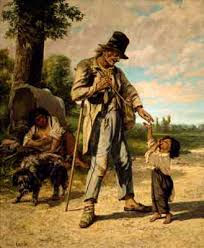
Tatt 3


Introduction

Tatterdemalion (aka Lost Child) is a 2018 horror film directed by Ramaa Mosley from a screenplay by Mosley and Tim Macy. The film stars Leven Rambin and Jim Parrack. It is a welcome addition to horror films that consciously or unconsciously break with the reigning patriarch of horror, Stephen King. 

I’ve written at length about my disdain for the novels of Stephen King. (See my King vs. Kubrick January 22, 2019 and Why I Hate Stephen King and Love Stanley Kubrick December 19, 2018 both available at Mozzochi.wordpress.com where I blog as Ghostsofantifascismpast.org). There is no single author more responsible for the infantilization of horror in literature and film than King. From the standpoint of a radical socialist his oeuvre is a cringe-worthy monument to bourgeois sentimentality and an unbearable whiteness of being. His book The Shining stands in sharp contrast to the Stanley Kubrick-directed movie of the same name. The movie, which King famously hates, is a work of art painstakingly crafted from the raw material of a serial typist. King’s approach to horror often involves a gratuitous use of racialized tropes that would shame a klansman, the ‘magical negro’ foremost among them. While we defenestrate confederate and colonialist monuments we should consider much of King’s work as fit for a toss, beginning with all those that anthropomorphize seemingly every object within the ersatz town of ‘Castle Rock’, satirized by the Family Guy cut-out below.


Thankfully, there is something of a cinematic movement afoot that is finally emerging from the dark, all enveloping shadow of Stephen King. It may be inchoate, but it is there. I’m not talking about the no-talent ass clowns Eli Roth and Rob Zombie, nor the talented Jordan Peele or Ari Aster, both of whom unfortunately have more in common with King than most of us would care to admit. No, not there. As is usually the case we have to ignore the big budget productions with all their shock and awe and turn toward the fringes, to a more punk rock -style of film making to find lasting value.

As a socialist, I am also interested in the capacity for such work to theorize proletarian collectivity — the only actually existing threat to our ruling classes, that force which sends a shiver up their spine, the one thing they really fear. Unfortunately, contemporary horror cannot do such a thing without first making a definitive break with the oppressive legacy of Stephen King. After a long, interminable wait, such a break is now underway.

That, and remember, we are always the zombies, they are the superheroes. 

Horror Film Genres

Tatterdemalion is a film that moves in the direction outlined above, even if it is not self conscious about doing so. The film sits at the crossroads of four sub genres of horror:

Folk Horror–Often set in rural or de-industrialized hellscapes with poor whites as protagonists. We see abandoned, dilapidated, backwoods anthropologies here. They can be period pieces, like Robert Eggers’s 2015 The Witch, or, like Tom DeNucci’s Almost Mercy of the same year, more contemporary. The first film indulges in supernatural tropes with some finesse while the latter locates the horror humans face within traditionalist bigotries and economic dislocation.

Supernatural Horror–The threats our characters face and therefore the source of the fear and terror they express and we vicariously feel is of supernatural origins. Often these films have a religious element (The Exorcist, The Ring). In the Stephen King thought world it is precisely the reliance on the rational, in the form of a doctor, cop, social worker or politician that is the driving force of the drama, or the MacGuffin. The protagonist must reject conventional authority figures (not necessarily a bad thing) for something else. And here is where the wheels come off. The protagonist often has special powers of perception or a special capacity for violence that must engage with what is most often some form of absolute evil. The social here is reduced to the exceptional individual, a thoroughly bourgeois concept. 

Psychological Horror–Here the reliability of the narrator and/or protagonist is questioned; frequently their sanity is suspect. Two excellent examples of this are Donnie Darko and Jacob’s Ladder. Part of the enduring value of both these films lies with the ambiguity of that question: Is it real or are they insane? As an aside, if you ever want to understand the value of a film editor, view the original theatrical release of Donnie Darko, then watch Donnie Darko: The Director’s Cut. The editor of the original film essentially saved the director from himself by deftly maintaining the ambiguity of the psychological state of the protagonist; the director’s cut removes this ambiguity and (worse) inserts some dialogue about god, thereby completely ruining the film. 

Horror Realism– We can identify the following elements of realism in literature and film and think about how Tatterdemalion stands within this tradition.

  • A focus on every-day-life, on the quotidian details of a community that lends an authenticity to the narrative.
  • The use of simple, transparent language, often local dialects.
  • The use of non-professional actors and scenes to emphasize the lived experiences of characters. A good non-horror example of this is my favorite revolutionary/anti-war film, The Battle of Algiers directed by Gillo Pontecorvo. 
  • A social critique that eschews supernatural or psychological explanations for inequality and oppression yet still enjoys a good scare.
  • Realism is often closely related to ‘naturalism’, here meaning “the philosophical belief that everything arises from natural properties and causes, and supernatural or spiritual explanations are excluded or discounted.” (Wikipedia. Retrieved 6.9.20). There is a sub genre of horror films call “naturalist horror” which involves real animals (dogs, bees, ants, what have you) attacking humans, but that is not this. 

WhileTatterdemalion blends aspects of all the sub genres above, it specifically mobilizes standard conventions of supernatural horror only to subvert those same conventions at the end of the film. There will be a plot twist. And because this film plays with those iconic supernatural tropes popularized by King, only to upend those tropes at the end, this makes it an anti-Stephen King film.

Taterdemalion, scene by scene with commentary.

1:00 A young female in army fatigues wakes up with a start from a bad dream/memory — we’re not sure which — on a bus in a rural area of West Plains, Missouri (Ozarks). She gets off the bus as a freight train roars by a crossroads near grain silos and warehouses. 

She is white, about twenty-five years old, with red hair, wearing fatigues and carrying nothing but a duffle bag. Her name is Janella “Fern” Sreaves (pronounced “Shreaves”). Fern sees a woman across the street standing beside a run-down Ford truck. She is Florine, a family friend there to meet her.

Fern is coming back to this town after 15 years. We don’t know why she’s back, only that she is looking for her younger brother. Florine doesn’t say where he might be, but about the run down little house where she deposits Fern, she remarks, “Your daddy lived a hard life. Paid for it in the end.” So presumably her father has passed away, probably the occasion for her homecoming.

Florine warns her about the people who live nearby. Fern doesn’t “believe in guns” and has “no plans to ever use one again.” This suggests PTSD, a common trope of the psychological horror genre, where we are made to doubt the reliability and motivations of the main character, even question their state of mind. 

The next day is a service for her deceased father. Fern and Florine are the only two people in attendance. As the pastor begins a prayer, Fern walks away. This further cements our protagonist as a skeptic who will presumably have their awakening later in the film. The director is deliberately leaning into familiar supernatural horror conventions here. 

There is a tense encounter between Fern and a neighbor with a shotgun.

Fern is dressed in old jeans, boots, a white t-shirt under a flannel shirt. (Few costume changes for the female protagonist is appreciated here.) Later on at a local bar she drinks a Jack and ginger then hooks up with the bartender for casual, emotionally distant sex.  She leaves in the morning, saying only “see ya.”

Through a local cop we find out that her brother is troubled (drugs, assault, stealing) and living on his own. Soon thereafter Fern glimpses a young boy (ten-years-old or so) in the woods near her house, but he runs away. Investigating further Fern finds an abandoned vehicle with a doll and plastic army soldiers inside, as though a kid had been living there. She has a memory of leaving her brother as a child.

14:34 In the middle of the night a man appears with a gas can (hereinafter Gas Can Man) and threatens to burn the house down. He asks if Fern is “Sreaves kin” and explains that “fire’s the only way to get rid of a demon.” Fern convinces him to go away.

The next morning Florine says that if Fern won’t get a gun for protection, then she should at least get a dog.

Fern visits a kennel where a worker asks her if the dog is “for protection against the living or the dead?” Fern says, dismissively, “the living.”

Back at home she opens her dad’s copy of The Living Bible. This is good attention to detail as this particular 1971 rendition of the Christian bible is a favorite among evangelicals and often considered by mainline protestants to be a ‘dumbing down’ of the King James. When Fern opens the bible she finds her dad’s flask in a hollowed out recess of its pages. 

The next morning Florine is there with soup. She comments, “Ain’t exactly Little House on the Prairie, is it?” Fern is exasperated with Florine’s mothering and tells her to leave. Florine responds that “it’s bad luck to ask a person to leave before they’re finished eating. I’m doing you a favor by staying.” 

The dog runs away. She pursues it to no avail, then while walking in the forest a timid voice says, “Hello.” It’s the boy from yesterday. He is dirty, dressed in rags and very skittish. His name is Cecil. 

Fern asks him if he wants to “come over here.” He just looks. Then she says, “Do you want me to go over there?” He nods. She convinces him to allow her to bring him to her home. 

20:00 Gas Can Man sees the two of them walking home and yells at Fern, “where’d you get that boy?” She and Cecil ignore him and continue to the house.

Fern tells Cecil the house was her Daddy’s. Cecil asks if a “Howler” got him. Fern says no, “unless it poured liquor down his throat.”

Fern calls social services. They can’t get there until tomorrow. Cecil picks some local flowers as a thanks to Fern for letting him stay.

23:00 Fern starts coughing that night. Cecil wakes Fern up holding two small birds he has caught saying, “I’ve got breakfast.” Fern replies, “What am I supposed to do with those?” Cecil responds, “I’ll show ya.” Cecil de-feathers and cooks the tiny birds in an iron skillet.

Fern does not feel well. She asks the boy if he has ever gone to school? He replies that he would like to. Can he read? “No ma’am,” he sheepishly replies. 

A pickup truck pulls into the dirt yard. It’s the bartender from the other night, Mike, whose other job is as a social worker.

“Hey, Cecil. How is it you came to live in these woods all by yourself?” he queries the boy. Cecil doesn’t answer and physically recoils as Mike takes his picture. Mike shows him it is okay by lending him the phone.

Mike tries to convince Fern to keep Cecil awhile longer so as to avoid immediate foster placement. We learn that Fern knows all about foster care, because she was in it herself from ten to eighteen years of age. But she says Cecil is “a survivor” and besides, Fern describes herself as unfit to care for the boy. Mike says she is fit. He leaves Cecil in her care and says he will straighten out who Cecil’s kin are. Fern is not happy keeping him there. There is some tension between Fern and the boy.

Again Fern isn’t feeling well. Cecil says, “Maybe you’ve got a ghost. You oughta burn your daddy’s dress shirts. If that doesn’t work I’ll catch you a rattler and give you a bit to eat.”  Fern says, “I don’t believe in ghosts.”

Mike canvasses the local homeless population trying to find someone who knows Cecil. This is one of a number of scenes where the director does not use professional actors; instead the camera slowly pans across the faces of local inhabitants. It reminded me of the anthropological technique of ‘participant observation’, used in a good way. When he looks for the picture on his phone to show someone, it is gone. Cecil did have the phone for a few minutes, so it’s plausible that he erased it. Or, if he’s a ghost, perhaps his image cannot be captured by modern technology? Again, the director is playing with these tropes.

That night Cecil asks Fern if she believes in monsters. She says no. 

The next morning Florine picks the two up so a local ‘country doctor’ can check Fern out. Upon meeting Fern the old doctor immediately says, “You’re a Shreaves.”

“How could you tell?” responds Fern.

“It’s in the eyes,” he says matter of factly. “Shame about your folks. Drugs sure have a way of hollowing people out.” An oblique, yet devastating comment. 

Fern describes her symptoms: Headaches, can’t sleep, coughs, etc. adding that she can’t rest because she recently took in a kid. The doctor asks, with alarm, “You took in a boy? From where?”

“Found him in the woods,” Fern says.

The country doctor goes out to the waiting room and interrogates Cecil: “Who’s your lord and creator?” Cecil looks at him bewildered.

“Where’d you come from boy?” Cecil doesn’t respond. The doctor shakes his head. 

Fern says, “What was that about?”

Doctor: “Old stories around these parts. Some lies, many true. You’ve got to take that boy back to the forest, Miss Sreaves…There are some sicknesses that medicine just cannot cure.” He gives her a slip of paper with the word “Tatterdemalion” written on it.  

Later, back home, Fern asks Florine about the Tatterdemalion. Florine says, “that’s an old one” and tells a story about a boy banished to the trees who cannot come out unless someone carries him across a supernatural divide. “He’ll make you love him. The whole time stealing your health, life, years ahead. They say that’s how he stays young forever.”

“And you believe that?” asks Fern.

“This place is built on stories,” says Fern “some of them true, most of them horse shit. Folktales come from necessity. Kids like me was gettin’ lost in the woods; so they made up the ‘Howler.’ You know: they tell kids stories to scare ’em into staying out of trouble. Works, too.”

Fern responds: “Yeah, but why would anybody need a story about a Tatterdemalion?” Florine doesn’t answer.

This exchange is an important key to the film, and demonstrates the ability of the writers and director to transcend the limitations of this genre by providing effective social criticism. We find out the answer to this casual question near the end of the film.

Florine proceeds to tell Cecil to go to the bathroom and wash his hands, then pours salt on his chair. When Cecil returns he sees the salt and rather than sit on the chair with the salt or clear the salt from the chair, he chooses to sit on another chair altogether — further ‘evidence’ that he is a Tatterdemalion. 

The next day Fern returns to the woods where she first encountered Cecil. She finds a crude hut made from tree branches and rags. Inside there is an old Life magazine with a mailing address on Old Hickock Road. 

Fern is still not breathing well. She tries to trick Cecil into telling her the name of his mother. But he won’t say. He only reveals that, “Momma died when the baby came out. They both died.” Cecil adds that he can’t tell her why he was living in the woods because she doesn’t believe in monsters. 

Fern’s hair is falling out.

She decides to go out to a bar and proceeds to get hammered. Inside a young tough asks Fern to go outside and she tells him, “No.” He then grabs her by the hair and drags her out the door, yelling at patrons, “this is family shit, alright!” Once outside we discover that it is her little brother, Billy. He pushes Fern, then knees her in the stomach while screaming that she ripped their family apart. Fern says she was just a kid. He says he doesn’t want anything to do with her. Social worker Mike intervenes, drawing a gun on Billy, who leaves. 

45:00

Fern is drunk as shit, throwing up outside the house. She tells Mike he has two more days to find another home for Cecil. Cecil, overhearing this, throws a tantrum, runs out of the house and stops at the edge of the woods. He then turns and asks why Fern doesn’t want him. She says it’s complicated. 

“I step in there [the woods] you’ll never see me again. Is that what you want?”

“I just want your family to know you are okay,” replies Fern.

“I don’t have any family anymore. I told you that.” Then he runs off. 

Fern pursues him and convinces him to come home.

Later that night she visits the Gas Can Man at a makeshift campfire nearby. He’s burning a Pawpaw tree and talks at length to Fern about the devil and how fire is necessary to cleanse evil. He says, “Yer gonna keep getting sicker…We got a saying around here. If they ain’t yer kin, don’t let ’em in.”

Fern: “Have you actually seen a Tatterdemalion?”

Gas Can Man: “I ain’t never seen Australia either, but that don’t mean it ain’t there!”

This last is a delicious bit of logical fallacy. The Gas Can Man, a sorcerer figure, subtly shifts the burden of proof from the claimant back to the skeptic by asserting that a proposition (the boy is a Taterdemalion) is true simply because it has not yet been proven false (Australia exists even though he’s never been there). Then, this argument from ignorance is extended when Gas Can Man asks Fern, “Need a little proof?” He gives Fern three nails to place in a triangle above the doorway of her house. “A Tatterdemalion is a demon,” he says, “and a demon is a witch. There ain’t no witch that can enter when he sees this in the shape of a triangle. No ghost, no demon, nothin’ not of this earth.”

Here instead of Occam’s Razor we get Occam’s Broom.

60:20 The next morning Billy comes up the road.

Fern tries to express her regret to Billy. But he is still enraged and blames her for the dissolution of their family. Cecil physically protects her from Billy, who runs off when Cecil says “I needs her.” The director is milking the supernatural horror tradition here.

Fern asks Florine why she didn’t take the kids when their parents abandoned them. “My Red had a real taste for drinking. Beating on me. He would have been real nasty to kids. Besides, I didn’t want to sacrifice my life for someone else’s kids.”

Fern puts the nails above the doorway in a triangle. She tries to have Cecil go into the house but he stops at the doorway, looks at the triangle and, enraged, starts punching Fern and asking why she put the nails there. “Because I need to know what you are. You think I can’t see that my hair is going gray; that I’m sick?”

Cecil says, “You shouldn’t have done that,” and runs off.

66:00 Mike returns and dismisses Fern’s superstitions, telling her, “you got scared and tried to find another way out of it.” Fern responds, “Just take him away.” Mike takes Cecil to a foster home with other kids. Cecil is heartbroken.

Fern finds Billy in a homeless encampment down by a river and they talk about the night they were abandoned by their father. Fern, Billy and their mother were waiting for their father in a car. The father left and never came back. Their mother died, presumably of an overdose, in Billy’s arms. Fern tried to get Billy to leave with her, but he wouldn’t. They were both young children. Fern tries to give Billy the key to the house.

Billy asks, “What about that boy?”

Fern states, “I know what he was.”

“What was he?” asks Billy.

“Don’t act like you don’t know. I saw the way you ran off when you saw him.”

“I ain’t run from him. I ran from what he stirred up inside of me.”

Fern states, “That kid’s a Tatterdemalion.”

Billy explodes: “No! That’s a bullshit story made up so folks can justify not taking care of kids like me.” He adds, with complete assurance, “I used to visit our daddy now and then. You know he hated this time of year, when the Pawpaws are blooming [pointing to the same type of flower that Cecil brought Fern as a gift earlier in the movie]. Terrible allergic. He said it felt like they were stealing his breath.” The wheels in Fern’s head are now turning.

About the house, Billy, exasperated, tells Fern, “Four walls and a roof ain’t gonna fix what’s wrong with me. Someone should make a home of it. Start new… Go save someone worth saving…Get out of here!”

Fern goes home and throws the flowers and the vase they are in out into the yard.

Fern asks an old timer about “Old Hickock Road”. He says, “You’ve got to cross the river” to get there. The symbolism here is of the ferryman crossing the River Styx. Fern is crossing from the world of the living to the world of the dead. And indeed it is the world of the dead — we discover this is where Cecil’s family lived and there are wooden and nail triangles all over the place. It is a squalid and ramshackle collection of plywood and chicken wire hovels. Fern discovers a shack with the same old Life magazines she found in the woods along with some iron shackles, presumably where Cecil was confined. Going into the main structure she knocks, but no answer. She enters and finds a decomposing body inside. It is that of Cecil’s father.

The police are summoned. Fern goes to get Mike, telling him she made a terrible mistake. They both go to get Cecil. At the foster home Fern calls him by his full name: Cecil Philmont. Cecil says his dad was right to punish him, and that if he exposes “the family business” the ‘Howler’ would come for him. Fern says she will protect him from now on. Together they go back to his father’s house and burn it to the ground. (Cleansing).

At home, Cecil sings Fern a plaintive, heart wrenching song:

“I am a poor, wayfaring stranger

traveling through this world alone

there is no sickness, toils or danger

to that good world to which I go

I’m going there to meet my father

I’m going there no more to roam

I am just going over Jordan

I am just going over home.”

Later Mike tells Fern about the Killdeer bird and how the mother bird will fake an injury to its wing in order to lead predators away from her eggs, “babies she hasn’t even seen yet.” Protecting children is an instinct that everybody has, he says, but sometimes you just have to wake it up.

The penultimate scene is of Fern, Cecil and Mike at a community dinner. Lots of suspicious looks, including from the country doctor. Cecil, visibly uncomfortable, wants to leave.

At home that night Gas Can Man breaks into the home and drags Cecil out into the woods. Fern must decide whether to use her father’s pistol to get him back (background noise of helicopters and gunfire, again the PTSD trope). She takes the gun and runs into the woods after Cecil. Fern finds Gas Can Man at his fire, puts the gun to him and asks where he took Cecil. He points east. Off she goes. Fern finds Cecil in the woods, but Cecil firmly believes what everyone is saying. “You thought I was a demon. Other people think I am. My momma and daddy both died. I think there’s something really wrong with me. I’ll go away. Far away from here. Keep you safe.” The wind comes up.

“It’s the Howler!” cries Cecil.

Fern shoots repeatedly into the woods (at the Howler) then tells Cecil she’s got him. The Howler is gone forever, so too the Taterdemalion. They embrace.

End of film.

Analysis 

Fern’s younger brother, Billy, becomes the unlikely, heart-wrenching and tragic source of Fern’s redemption. Her moral clarity is achieved only through the recognition of the lost child that is her little brother; her correct course of action can only be embraced when she frees herself of the self-loathing she feels for not having been able to save her brother as a child.

Tatterdemalion is a set up, brilliantly and deftly executed. The film holds that superstition and the supernatural often serve to obscure social evils. But, that’s not all. The film also insists that much folklore is born from necessity, that is real lived-in communities with real life problems, and have logics that can be understood and overcome.

Tatterdemalion is also effective at executing thrills and chills without creating caricatures of poor people, nor glorifying rural poverty and superstition as the key to defeating evil. There is at least the outlines of a collective protagonist sketched here. This is something the Stephen King thought world can never supply. 

Fern strikes me as from a region where fundamentalism is woven into folklore. Such passion and fanaticism can have both positive and negative aspects. For instance, both the Ku Klux Klan and the radical abolitionist John Brown were influential in these parts. These Scots-Irish, working class, close knit communities have long been subject to the vicissitudes of rural displacement and brutal poverty. It would have been easy for this director to disparage these people, as so many other film makers do, as ignorant and left behind, lumpenproletariat refuse who are unfortunate victims of dangerous superstitions. Thankfully, that’s not what takes place here. 

Instead, Tatterdemalion works within supernatural horror conventions so as to subvert  — through a plot twist at the end — those same conventions. We think we are watching a standard treatment of a Stephen King novel, only to find out that we are not, although we must wait until the end to discover how and why this is the case. 

What about that key question Fern asks? Why would a community need to invent the story of the Taterdemalion? What necessity, what purpose would such a morality tale serve? Such a tale rationalizes child abuse and neglect. How do we go about preventing child abuse and neglect? The film answers this question through its participant observation, which is to say social, approach to poverty and addiction. The answer, the film seems to say, is altruistic service. Fern is in the military and while she suffered from her tour of duty she eventually uses the skills she learns there to protect Cecil. The other major institution that plays a positive role here is social welfare through the character of Mike. Add to these two institutions (the military, the welfare state) the family-in-formation that Mike and Fern represent and we have an answer as to how to overcome the obstacles Cecil faces. Pretty bourgeois, but still better than the crap on offer by King.

So the bit about how folktales come from necessity is crucial here, and wonderfully nuanced. The film reminds us that folk tales have many dimensions. They can serve to protect us from real danger, e.g. discourage children from wandering off into the woods; yet also injure us by walling off ‘outsiders’ who are not ‘kin’, and thereby justify child neglect. 

I was waiting for the obligatory Native American trope, the dream catcher moment, but thankfully it never came. Unlike King, this director has a rootedness that is admirable; a respect for people, if you will, that feels real. The conflict that eventually comes into focus is that between those folktales of necessity rooted in an unjust social system that rationalize leaving orphans to the tender mercies of the Ozark woods and the real world efforts on the part of wounded soldiers and social workers to care for such abandoned human beings. Note also that the trope of the CPS social worker sent to separate a family is not present here; just the opposite. Would this film be as effective if set within a commensurate Black community? If not, why?

Conclusion

In a way, the Stephen King antihero horror movie has been born, a necessary precursor to the larger project of building proletarian collectivity. While Tatterdemalion does not offer us the only force which can offer true liberation, not least because there is no working class self organization and collectivity here, it does offer a break with a set of presumptions that are, in a sense, killing us. Of course, there can be no such thing within the Stephen King thought world (now, with Hulu’s Castle Rock, a thought universe like that of Marvel or DC Comics). First, one must break with that world. Then, one can begin to conceptualize proletarian collectivity. Tatterdemalion helps us do the former and, unlike much elsewhere, at least suggests the latter.

All that said, we should be mindful of this aphorism: ‘When you strike at the king, you must kill him.’

I’m trying.

END


Share this:

  • Click to email a link to a friend (Opens in new window) Email
  • Click to share on X (Opens in new window) X
  • More
  • Click to share on Facebook (Opens in new window) Facebook
Like Loading...

Toppling the Stephen King Monument into ‘Castle Rock River’.

Featured

Posted by Jonathan Mozzochi in Essay, Rant

≈ Leave a comment

Tags

Ava DuVernay, Black Lives Matter, Game of Thrones, George Floyd, Pulp Fiction, Quentin Tarantino Defense, Racism and Fiction, Selma, Stephen King, The Magical Negro, The Shining, The Stand, Third Reconstruction


Stephen King and Racism


Last January Stephen King was criticized for comments he made about voting for the Academy Awards, something he is apparently entitled to do as a member of that august body. “For me, the diversity issue — as it applies to individual actors and directors, anyway — did not come up…That said, I would never consider diversity in matters of art. Only quality. It seems to me that to do otherwise would be wrong” he tweeted.

Well, Stephen King is anything if not consistent. From what I can gather his literary output reflects no concern whatsoever with ‘diversity’ other than as a license to express forms of racism so extreme they might shame a klansman.

Ava DuVernay, director of the 2015 film Selma (not nominated by the Academy for best director) described King’s comments above as “backward and ignorant.” I think that’s being charitable. Even by the standards of the 1970s and 1980s King’s novels have always trafficked in what can only be described as gratuitous bigotry. So why have his works always been so popular? How is it that so much of King’s work challenges even the Urban Dictionary in depravity and yet still rakes in millions of avid readers and millions of dollars? Why does he leaven so much of his writing with grotesque stereotypes?

The common defense takes the form of a non-denial denial, insisting that because what King writes is horror it should shock and sicken; nothing shocks and sickens like racism so that’s why there is so much of it in his novels. Implied here is that he uses such bigotries in a constructive manner; they serve a larger, more edifying purpose, or so the argument goes. But this is really the Tarantino defense: it’s just plot and character development, nothing more. The problem here is that so much bigotry in King’s novels so obviously serves no purpose. It is gratuitous; which is to say unneeded and unwarranted, therefore casual bigotries that do not forward plot or character development, or, at least go far beyond such development. There is just no way to excuse or explain away the naked racism peppered throughout King’s oeuvre (we will get to examples below).


So as to undermine the Tarantino defense, I’m going to quote a couple characters from a Tarantino film. Upholding King’s legacy sans his bigotry amounts to the position that John Travolta stakes out regarding eating bacon in Tarantino’s film Pulp Fiction. You know the scene. Samuel L. Jackson holds that “Pigs sleep and root in shit. That’s a filthy animal. I don’t eat nothing that ain’t got sense enough to disregard its own feces.” Travolta counters, “How about a dog? A dog eats its own feces.”  Jackson quips, “I don’t eat dog either.” To which Travolta asks whether Jackson considers dogs a filthy animal. Jackson says a dog’s “got personality. Personality goes a long way.” Travolta counters, “by that rationale if a pig had a better personality it would cease to be a filthy animal.” Jackson famously responds, “We would have to be talking about one charming motherfucking pig!”

King’s writing is as that pig wallowing in its own shit; don’t eat the bacon.

Regardless of how one answers these questions, King’s comments should come as no surprise, as his output betrays an unbearable whiteness of being, something that remains pervasive within elite and popular culture. And in this sense, no matter how charming it may be, a pig is still a filthy animal. (That there is a literary device. For what it’s worth, I consider pigs adorable).

Do you need some evidence as to rank racism in Stephen King novels? In the unfortunately titled “Stephen King Needs More Black Friends” (Scott Woods, Medium, January 15, 2020) the image of Black people in the ‘Stephen King Universe’ is made clear. And mind you, this recounting is from a fan:

King writes almost all of his Black characters, magical or otherwise, in problematic ways. When they are not magical they are horrendous stereotypes: dope fiends and brutes (The Stand), jive-talking thugs (End of Watch), and worse (the short story “Dedication”). More, King’s characters never happen to be Black; he intentionally makes it clear that they are Black from the outset, usually with jaw-droppingly offensive descriptions: Mother Abigail in The Stand is “coal-black” and further described as looking like an “old black Everglades alligator.” The Black junta of The Stand are also Black, “huge,” nude (save for a loincloth, so sexualized to boot) and actively murdering White people with intent. The chief villain in The Running Man is a game show producer named Dan Killian who is “minstrel show” Black. The Green Mile’s John Coffey is hit with a litany of racist descriptors, including “monkey,” “big mutt,” and “big boy.” Some of these are character embellishments, insults provided through the mouths of virulently racist characters — aka the Tarantino Defense. But some of them come from the universal narrator of a given story.

Getting a bit more granular, this is from my essay “King vs. Kubrick” (Mozzochi.wordpress.com, January 22, 2019) where I compare King’s The Shining to Kubrick’s The Shining:

What the Ghosts Represent:

Book: All the ghosts are evil; all desire to continue their evil deeds–marital infidelity, gangsterism, murder, as a manifestation of their “single group intelligence”. The source of this evil is not institutional, structural, historical, political or otherwise outside of the individual. It is located within us, in our denial of the possessive individualism at the heart of the bourgeois family.

Movie: The source of evil is the hotel itself, which cannot be separated from its history, in part erected on the bones of indigenous peoples. It is rabidly racist and demands absolute servility on the part of inferiors, most pointedly workers and their families.

Racist, Homophobic, Classist or Misogynist Scenes That Contribute To Plot Or Character Development.

Book: None

Movie: Grady calls Dick Hallorran a “nigger” in the all important restroom scene. Elsewhere Jack says, “just a little problem with the old sperm bank upstairs. Nothing I can’t handle, though.” That’s about it. Sparing, short and devastating. But Kubrick doesn’t wallow in it as King does–as a teenager expressing unfiltered repressed emotions.

Gratuitous Racist, Homophobic, Classist or Misogynist Scenes That Don’t Contribute To Plot Or Character Development.

Book: an endless parade of cringe worthy and vicarious bigotries apparently pleasurable for some people to read. Emblematic is where King has a young Dick Hallorran fire a “Nigger Chaser” firework (bottle rocket) at a wasps nest. This makes no sense even on its own terms.

Movie: None

From Ben Goldstein, “Stephen King’s The Stand is Bloated, Racist and (Somehow) Still a Masterpiece” (Medium, May 10, 2015). Again, this is from a fan:

King didn’t invent the Magical Negro literary trope, but he’s spent much of his career coasting on it. Consider the psychic hotel caretaker Dick Hallorann in The Shining, who comes back to rescue Danny Torrance when Jack loses his mind. Or the hulking and simple-minded John Coffey of The Green Mile, who heals the innocent by absorbing their pain, and dies as a savior figure.

In The Stand, we’re presented with Mother Abigail Freemantle, a religiously devout beacon of benevolence…” Within the entire Boulder Free Zone community — which eventually numbers in the thousands — Mother Abigail is the only person who is described as black. That’s right, kids: Stephen King’s utopic Free Zone society contains exactly one (1) black person. Other than that, the Free Zone is a diverse tapestry, featuring white people from Maine, white people from Texas, white people from New York, and white people from Ohio.

Of course there are other black people in The Stand. You’ve got the jive-talkin’ Rat Man, who’s so creepy that even the nymphomaniac Julie Lawry wont fuck him. There’s Richard Hoggins, the young black drug addict from Detroit mentioned in the “second epidemic” section. (“He had been addicted to the fine white powder he called ‘hehrawn’ for the last five years.”) Hoggins breaks into a drug dealer’s house after the Captain Trips virus kills everyone and OD’s on the stash he discovers there. “No great loss,” King writes directly afterwards. But wait, it gets worse. I regretfully present the beginning of the aforementioned “black junta” scene:

Huge black men wearing loincloths! “Amazingly even and white teeth in his coal-black face”! Oh man, Steve, what are you doing here? And let’s not forget the “brown, smooth skinned” band of spear-carrying natives that Flagg encounters at the very end of the book. Savages. They don’t speak jive, but that’s only because they don’t speak English at all.”

…Every notable black character in King’s novels — Hallorann, Coffey, Mother Abigail, Mike Hanlon in It, Susannah Dean in The Dark Tower: Song of Susannah, Nan Melda in Duma Key, etc. — is referred to as a “nigger” at some point by another character. Usually, this is meant to signify villainy or ignorance in the character using the word. But you’d think a writer with as expansive an imagination as King would find different ways to make that point.”

No, I wouldn’t. It’s the liberal version of the unfiltered bile Trump spews. And again, the above is from Stephen King fandom. I’m not a fan of Stephen King. But I am a fan of tearing down monuments that glorify inequality, racism and reaction.

King’s comments about diversity and the Academy Awards above are classic meritocratic nonsense–the real ‘virtue signaling’ we hear so much about–that practiced by business elites, cultural influencers and celebrities designed to remind us how talented they are and how in awe we should be of that talent and the money and power it commands. Much of this ‘race blind’ and ‘post-racial’ narrative nonsense gets packaged with brutal class war attacks against the poor and vulnerable.

King stands in this artistic and political tradition, one that is thankfully under assault by antiracists everywhere. See that Robert E. Lee statue being taken down? How about the confederate flag being banned at NASCAR? Remarkable. But such atrocity exhibitions extend beyond statues and flags, to art and entertainment and government policy that goes from The Birth of a Nation and Gone With the Wind through The Negro Family: The Case for National Action (aka The Moynihan Report) onwards through King’s The Stand and The Shining and Game of Thrones, which I have described elsewhere as a “blood and soil zombie soap opera that utilizes medieval fantasy conventions.”

This tradition needs to be hog-tied, pulled down and tossed into a river, just like those confederate statues.

King is not exceptional in this regard; but he is an exceptionally rich and prolific scribbler whose work should be a focus of criticism during this amazing period of resistance, rebellion and (dare we say it) revolution. Might we be in the midst of a Third Reconstruction in America? If we are, I expect this sacred cow to be sacrificed forthwith. For if we are in a Third Reconstruction, then how could we ever accept as penance King’s frequent twitter attacks on the psychotic flaming Cheeto? Or anyone’s, for that matter? That’s a bar set so low that a hedge fund vampire like Mitt Romney can step over it and march in a protest for George Floyd without a public shaming such as that endured the mayor of Minneapolis, Jacob Frey. That just won’t do.

Isn’t it past time we chucked the Stephen King monument into the Castle Rock River?

END


Share this:

  • Click to email a link to a friend (Opens in new window) Email
  • Click to share on X (Opens in new window) X
  • More
  • Click to share on Facebook (Opens in new window) Facebook
Like Loading...

Reporter or Emoter?

Featured

Posted by Jonathan Mozzochi in Essay, Rant

≈ Leave a comment

Tags

Democracy Now!, Fourth Estate, George Floyd Protests, Racist Cops, Redfish, Reporter or Emoter?, Unicorn Riot


Reporter of Emoter?


As protests over the murder of George Floyd continue across the country there are fresh debates among radicals about the best methods for social protest. I am in favor of a concept known as “diversity of tactics”, a set of ideas that accepts a wide range of activity from non violent civil disobedience to militant, and sometimes violent, direct action. Different situations require different means of resistance, rebellion and hopefully, revolution. When it comes to getting the knee off of the neck of Black people, ‘by whatever means necessary’ means all of those tactics. Over the past few days I’ve been fortunate enough to have been present at very militant actions in the San Francisco bay area. Like you, I’m sure, I’ve also been watching other protests across the country. And, like you, I’ve noticed that news coverage of these protests, be they passive or aggressive, tends to be somewhat frustrating. No, that’s not quite right. News coverage is abominable, a disgrace to the fourth estate. That’s better.

Now we all know that the mainstream media–fake and real news included–promotes unquestioning sycophants and only occasionally breaks free from self-imposed blinders to actually report on anything of value. So we don’t expect much coverage of militant resistance to the murder of Black people to be very accurate or informative. But still, even Noam Chomsky will argue that there is a nominally free press in the United States, however much this fourth estate is also complicit in manufacturing consent. But I’ve got to tell you, I’m not sure how free that free press is anymore. When covering these uprisings virtually every mainstream (and not a few alternative) reporters somehow feel it a necessary and good thing to whinge. You know what that is–when someone’s mouth is moving and they are complaining in a persistent and peevish or irritating way such that they end up not really saying anything of value at all. To this whinging is inevitably added moralizing. These guardians of the intolerable status quo not only complain about the inconvenience of their beloved Whole Foods being emptied of merchandise, they describe such activity as inherently wrong, even evil. You know what I’m talking about. In this case such reporters aren’t reporting so much as emoting.

This raises a question. Isn’t a basic function of the fourth estate to report? Shouldn’t that reporting include, if not be limited to, Who? What? When? Where? Why? and How? How is it that every dip-shit with a microphone suddenly feels empowered to tell us, in cringeworthy and excruciating detail, how they feel about everything? What their opinion is? Perhaps an answer lies in the fact that reporters have become celebrities and thereby entitled to inflict their singular pathologies on us. Oh, I know. I can just choose not to watch and listen. But that’s not true, is it? If I want actual reporting that informs I have no real choice but to watch and listen to these narcissists because between Unicorn Riot, Redfish, and Democracy Now! there isn’t enough reporting. Our alternative media can’t get everywhere all the time. And whinging even intrudes on these platforms.

One can debate the effectiveness of marching in the streets and fighting cops at barricades so as to hold those streets, but we should all agree that plaintive cries for state and corporate power to “do better” are absurd. We need something more, and different. And look here! When comparing and contrasting previous uprisings (1969, 1992, 2014-15) with todays rebellions, isn’t it rather remarkable that so much direct expropriation is now centered not in ghettos and barrios, but on Rodeo Drive and Beverly Hills (LA), Union Square and Emeryville (Bay Area)? To me there seems to be a clear break with the dominant narrative about ‘senseless rage’ and self defeating masochism that poor and working people inflict upon themselves when they ‘riot’ and ‘loot’. But you wouldn’t know it from most reporters–they are too busy crying about people blocking traffic and how ‘mom and pop’ businesses like Target and Chase Bank are being needlessly attacked.

I haven’t found a single television report that isn’t saturated with these disgusting displays of shock and awe larded with denunciations of property damage and resistance to cops in our streets. A recent example is instructive here. I just watched a reporter and camera person covering some people engaged in expropriation at a Whole Foods in Santa Monica, California. The reporter was whinging ad nauseam and speculating wildly about how the “looters” must be “outsiders”. Then, the camera person purposefully focused on the license plate of a car being used to load liberated merchandise. The crowd noticed this and chased these “emoters” off. When one of these august members of the fourth estate gets killed, we will remember that they took sides and joined the battle–on the wrong side. They won’t be whinging then, because they weren’t actually reporting–they were being cops with press credentials.

END

Share this:

  • Click to email a link to a friend (Opens in new window) Email
  • Click to share on X (Opens in new window) X
  • More
  • Click to share on Facebook (Opens in new window) Facebook
Like Loading...

Apocalypse as Opportunity?

16 Thursday Apr 2020

Posted by Jonathan Mozzochi in Essay

≈ Leave a comment

Tags

Apocalypse, Bolshevism, Covid 19, fascism, Gavin Newsome, Mario Cuomo, Republican Cult of Death, Rosa Luxemburg, Shelter at Home, Social Distancing

Apocalypse or Opportunity?


As it is April 16, 2020 I must make note of the ongoing collapse of the world economy at the hands of a tiny, but deadly, virus. As per usual here in the United States BIPOC, the poor, the working classes, the elderly, the weak and vulnerable are being hit hardest both by the spread of the virus and the resultant economic fallout. The rich are serenading one another across well-apportioned balconies and expansive vales, clapping while we die. We need immediate material support that in most places is not forthcoming. They need a fucking guillotine. Many of us have been waiting weeks for unemployment benefits, food aid, or that one-off-signed-by-a-sociopath-stimulus-check. If the pandemic has dramatized anything it’s the fragility of the neo-liberal consensus. But the left remains largely incapable of mounting a ‘counter-hegemony’. Perhaps the far right has a better angle on exploiting such fragility? I sincerely hope not, but that remains to be seen.

The most visible opponent to the current Republican Cult of Death is New York governor Andrew Cuomo, a soulless political prevaricator whose contributions to ending the pandemic include forcing Rikers Island prisoners to make hand sanitizer and scolding working class Americans to simultaneously ‘stay at home’ and ‘go get a job’–all without a hint of cognitive dissonance. Liberalism is dead. Don’t expect this sudden, half-assed, altogether pathetic expansion of the welfare state during the pandemic to revive it. Stick a fork in it already. The other Left Coast leading liberal light, California Governor Gruesome is no better. Behind every plutocrat and celebrity clapping on their doorstep for an essential worker risking their life is a lib-con telling us all to get back to work and appreciate the fact we have a job at all. We know the bar for humanitarian response is perilously low when these clowns are regarded as leaders. We leftists have always argued for re-valorizing essential work and the workers who perform it. This system of organized theft will cough up a begrudging acknowledgment of our humanity about the time there is no longer a humanity left. 

The contrast between something so small having such a large impact is instructive here. Throughout human history radical political ideologies always, by definition, start on the outskirts of accepted public opinion. Then, that Overton Window we are all so fond of referencing suddenly and quite unexpectedly opens up, moves to another building or is shattered altogether by a projectile. Such ideas and the people who promote them grow in influence during times of major disruption. Twenty-six million unemployed in five weeks, mile-long lines at food banks and overflowing morgues are terrifying testaments to our current predicament. We just cannot say what is coming, only that it will likely be something different from whatever we have experienced before. The depth, breadth and velocity of the current economic upheavals are just too extreme not to produce some kind of political fallout.

The WWI era, for example, was characterized by a devastating inter-imperialist global war and was the hand maiden for both Bolshevism and fascism reaching for and grasping state power. However one chooses to understand and assess those radical ideologies, it is undeniable that they began among a few adherents and under certain circumstances became normative. So today, as we confront a pandemic driving an unprecedented economic contraction throughout the entirety of organized human life we should perhaps ask ourselves: What might be the character of any political upheavals that follow? What small group of conspirators–10 good comrades for Lenin, a handful of putschists for Hitler–might be waiting in the wings? How best to identify such actors so we can accurately assess their prospects and join or fight them?

By way of clarification, I don’t mention Bolshevism and fascism in the same sentence so as to suggest they are moral or political equivalents. That’s what lib-cons do–a fools errand that only perpetuates capitalist exploitation and domination or, worse, ensures the return of fascism. We need a revolution, but a deeply socialist, anti-racist and democratic one. My point here is that both movements came to power during times of extreme duress. We are now in the midst of such a global disruption, one without any precedence in human history. As the cliche goes, great peril is often accompanied by great opportunity. It’s a cliche because it’s true. For all its gruesome effects, this post modern plague has (miraculously) emptied out stadiums, office buildings, concert halls, NASCAR tracks, ocean liners, jumbo jets and golf courses. Behold: the bluest of blue skies and the brightest of stars at night, the re-wilding of diverse habitats, the disappearance of traffic overnight, the great grinding to a halt of capitalism and its ravaging effects on this habitat we call earth, albeit amidst great horror. One can marvel and dream of a different future without succumbing to eco-fascism. It might be possible to theorize an eco-socialism from the realization that the spread of this other plague (capitalism) can be arrested. Which brings us to my last point.

As working class, poor and vulnerable people struggle to survive this latest crisis of capitalism and the hollowed out democracy that provides its ever thinning legitimating narrative, we may find ourselves confronted with a choice that comes around only once every few decades. Whereas previous crises always involved some governmental intervention to temporarily discipline the capitalist casino class so as to reestablish an equilibrium of inequality that the poor and working masses could not find a way out of or around, today the shock is an exogenous one, although magnified a thousand-fold by wholly endogenous factors. It may be that no such equilibrium will be forthcoming in the aftermath. The wheels may have come off permanently. The center may not hold. Everyone is running for the exit. There are only two: socialism or barbarism. 

Whatever consensus preceded this conflagration it will hold only on a steep upward incline such that it will be driven inexorably back toward fascism. If and when it slides it won’t slide half-way; it will smash back into the 19th century but with 21st century tools of repression to hold it there. Another way of putting this: if revolutionary socialists fail to effect a revolution this time we may all be doomed to fascism. Anyone who argues that that slide is already underway is probably correct; anyone who argues it is inevitable should be pilloried. The slide can be arrested, even reversed. Rosa Luxemburg wrote:

The “golden mean” cannot be maintained in any revolution. The law of its nature demands a quick decision: either the locomotive drives forward full steam ahead to the most extreme point of the historical ascent, or it rolls back of its own weight again to the starting point at the bottom; and those who would keep it with their weak powers half way up the hill, it drags down with it irredeemably into the abyss.

Neither the slide back to fascism nor a successful ascent to socialism are inevitable. It’s up to us. 

Capitalism is the virus. To kill it we must enforce and extend the current shutdown. The only thing capitalism is congenitally allergic to is a limit on growth. It must expand. It must grow, preferably at exponential rates. 

Our logic of revolutionary redistribution should be premised on a slowing down and de-commodification, on a decentralization together with a re-valorization, and on a democratization of equality.  We must try and refocus our horizon from those narrow, two-party recapitulations of that which is possible forever chained to “There Is No Alternative” to the centrality of essential work and the essential workers who perform it: first responders, mutual aid providers, wage laborers, agricultural workers, gig workers, service workers, frontline fighters, etc. The only jobs worth protecting are those worked by essential workers. Think about that. What is the point of having ‘inessential’ jobs?Collectively, essential workers and the essential work they engage in comprise that which we cannot do without. In a collective sense such work is also desirable and, conversely, the work carried out at stadiums, golf courses, banks and so much more is inessential, that which we can (and should) do without.

What I mean here is that we should support social distancing and shelter at home policies not only because they are necessary to fight the pandemic at hand, but because they embody a better future. To that end, emerging from this crisis should be a robust challenge to the follies of perpetual growth and increased velocity that fuel inequality. We may have a unique opportunity to challenge, in a popular way, the commodity form and the logic of exchange value and pricing so central to it. In other words, the social distancing and stoppage of so much work is not only necessary to defeat the spread of Covid 19, it is necessary for any socialist future, perhaps any future at all. 

END


Share this:

  • Click to email a link to a friend (Opens in new window) Email
  • Click to share on X (Opens in new window) X
  • More
  • Click to share on Facebook (Opens in new window) Facebook
Like Loading...

The Presidential Election

Featured

Posted by Jonathan Mozzochi in Essay

≈ Leave a comment

Tags

Bernie Sanders, capitalism, Democratic Socialists of America, direct action

When we vote for anyone or anything, we should always do so with our head, heart, hands and feet.

Chileans who enthusiastically expropriated more than 60 (!) Walmart-owned department stores just last week voted with their hands.

The tens of thousands of Chicago teachers who defied yet another mayoral boss to go on strike for worker dignity and the kids they teach voted with their hearts.

When Carola Rackete captained the Sea Watch 3 to escort international workers and refugees to safe havens across the walls of fortress Europe, she voted with her feet.

Before being run out of town, Gregory Stevens, the queer First Baptist Church of Palo Alto pastor voted with his head when he declared: “The tech industry is motivated by endless profit, elite status, rampant greed, and the myth that their technologies are somehow always improving the world”

When we engage in multifarious forms of direct action, we are voting without ballots. What we do in our daily lives to strengthen revolutionary movements is our preferred form of voting.

In short, when we vote through direct action we demand nothing of our ruling class; on the contrary, we act so as to achieve everything. We say to them: everything we want is in the end of you.

In a capitalist democracy we also may vote as a ‘citizen’, but begrudgingly and with the full knowledge that this routinized, bought and paid for and largely symbolic act is still an act of will, however much it is diluted through representation. Then, if a particular candidate might be assessed as furthering our more important votes for direct democracy, then we vote in these bourgeois elections, for something greater than democracy many times removed.

In this presidential election there is only one candidate who passes such a litmus test: Bernie Sanders. It seems to me that the only presidential candidate worthy of our ‘vote’ is the one who has been leading a ‘political revolution’ within a political party (Democratic) that is itself quite at odds with such a revolution. One can criticize the Sanders campaign on a variety of fronts from the left and below, but we should bear three things in mind.

First, the Democratic Socialists of America is a member in good standing of our larger political family. Their strategy of organizing within the Democratic Party is Quixotic, but it is bearing fruit. It should garner our tactical support.

Sanders has been making the same speech for forty-years, a source of both consternation, because it hasn’t changed, but also consistency and reliability, as we know full well what his political philosophy and program are. He’s a known quantity. Sanders is no neophyte to the struggle against inequality, nor is he a triangulator or schemer. He is, for better or worse, a democratic socialist within the American tradition–what most elsewhere we might more accurately describe as a social democrat. We can reason from here what a Sanders presidency might look like, warts and all. And such a thing would be a political revolution of sorts.

Second, and of more importance is the DSA itself, and the 50,000 or so new members that have recently signed up. It is instructive to note that during its convention in August, 2017 the DSA withdrew from the so-called ‘Socialist International’. The SI has long counted such august ‘socialist’ parties as the PRI in Mexico, the French Socialist Party, and the SPD in Germany. As such it is neither socialist nor internationalist. While the DSA’s withdrawal was a positive development, it remains to be seen whether the Sanders Presidential campaign will amount to a net positive or negative for our movement. Has his campaign, replete with ad nauseam funding pleas and other trappings of capitalist electoral politics, inadvertently stalled the growth of membership and development of the DSA? Is the Sanders campaign both a source of growth for socialism but also a limit to its horizons? We can influence the answers to these questions.

Third, all other candidates are outspoken defenders of the capitalist order; they do not have a place within our political traditions. They cannot be trusted nor supported, at least not so long as an obvious better alternative is available.

Vote often, vote everywhere, vote as though our lives depended on it. Vote Sanders for President–at least while he represents a move towards our more full-throated revolution. But above all continue to vote in all the ways that will truly make a difference. Remember–direct action gets the goods.

END

Share this:

  • Click to email a link to a friend (Opens in new window) Email
  • Click to share on X (Opens in new window) X
  • More
  • Click to share on Facebook (Opens in new window) Facebook
Like Loading...

An Antifascist Army

Featured

Posted by Jonathan Mozzochi in Essay, Memoir

≈ Leave a comment

Tags

antifa, FC St. Pauli, Hank Paulson, Iron Front, Portland Timbers, Timbers Army

As a ghost of antifascism I sometimes take the liberty to be somewhat controversial. I will now take that liberty.

I despise professional sports. The more popular the sport, the more I hate it. The larger the audience, the louder the crowd, the brighter the fireworks, the faster the jets–the more I want to throw up.

Even the term ‘professional sports’ is offensive, seemingly calculated to help us forget that these ‘professionals’ are skilled workers engaged in labor within a capitalist enterprise. That enterprise rakes in considerable profits from the surplus value created by those workers. These corporations are for profit, and share the same means of enforcing exploitation and domination as an oil company, weapons manufacturer or, for that matter, a charitable foundation.

Furthermore, the non-millionaire workers who park cars, cook hotdogs, clean bathrooms and stitch hats are invisible. As with all corporations, it is from the least powerful that the lions share of value is created and then stolen by others; then that process is hidden from us. In coliseums and arenas it seems our otherwise sharp ‘critical criticism’ is set aside to allow for unbridled support for a team or competitor. There is also a certain fidelity to white settler state militarism often aptly represented by mascots, e.g., cowboys and Indians.

Professional sports are also prime vectors for the reproduction of the pathological male gaze: men, beer and hot dog in hand and mouth watching men, balls in hand in combat with one another; meanwhile women busy themselves watching those men watching men and imagine how they look to those men. Ugh. This is the male supremacy algorithm that dominates professional sports, and why there is still no out gay (American) football player who hasn’t faced organized and violent opposition of one form or another. Give it time, you might say, by the turn of the next century I’m sure there will be an out gay quarterback, or perhaps even a transgender one. But that’s precisely my point–there is no point to this short of transforming the very nature of competition by obliterating that which upholds it all–private property. Capitalism has proven itself to be the most efficient means by which to organize a form of ‘free time’ that is misogyny masquerading as sport. Big fucking deal. What an accomplishment. Oh, and don’t get me started about the grotesque enslavement that is ‘college sports’ and its cannibalism practiced on higher education, two things that should never be spoken of in the same breath. Finally, it seems that within the American tradition of professional sports ‘politics’ is verboten. If you ask me, not much to recommend here. Since when did a radical cheer on a corporation?

Remember, corporations are legalized dictatorships–they practice a form of economic totalitarianism fundamentally at odds with democracy and equality. This is what Milton Friedman meant by making the economic realm supreme, where the profit motive can replace democracy altogether. That’s the neoliberal agenda and it is not necessarily at odds with a white nationalist and male supremacist one. They can function hand and glove. Get it?

Not all sports are subject to my scorn; just those that are capitalist enterprises. Amateur sports, especially kids sports, are another matter entirely. Here, as with all facets of social life that have managed to remain at least partially outside ‘the economic’ one can find healthy and wholesome competition. Some of my most precious memories are of amateur sports. Sporting competition outside private markets and organized capitalist insanity used to be enshrined in the Olympics. Remember when it was for amateurs only? Friendly competition between nations? Remember when those scrubs from the beer league bested the Soviet hockey team? Now it is a loathsome spectacle of corporate corruption, preening celebrities and vicious gentrification programs that vacuum up the wealth of entire cities.

So it is with such disdain in mind that I turn to the Portland Timbers, a professional sports corporation no different from those discussed above, but with a fan club, the Timbers Army, unlike any other, except perhaps one: FC St. Pauli Hamburg (Germany).

First some bona fides. I have been an antifascist for more than 30 years and spent a good part of the 1980s and 1990s making that a full time occupation. During 1996 I visited 15 cities throughout Germany on a speaking tour in a concerted effort to meet and better coordinate with comrades fighting the far right there. In the United States the Oklahoma City bombing had recently taken place while Germany was in the throes of an insurgent mass-based racist anti immigrant movement. My speaking tour was hosted by radical antifascists, autonomists, ‘refoundation’ communists, squatters, anarchists and trade unionists. In Hamburg (my favorite venue of the tour) I was given the t-shirt pictured above by antifascist supporters of FC St. Pauli.

The far left, antifascist credentials of the FC St. Pauli club go back to the 1980s, which is when the Antifa began to be revived in Europe and North America. There are other European football clubs with one foot in socialism, but few that are as militant as FC St. Pauli. There are many more fan clubs with both feet in fascism.

The Timbers Army antifascism owes much to this left wing political tradition, and it is a welcome development. The Timbers Army are to antifascism in the United States what FC St. Pauli are to German and European antifascism. But the Timbers Army is also a creature of its social milieu and therefore a football fan club. I don’t live in Portland or follow any sort of football. But so long as a sports club is antifascist, I’m interested in what they mean by that and what they do about it.

Now, I am partial to the original antifascist symbol, that of the red and black flag, but I can accept others.

Also, I might chafe at Timbers Army supporters using one of three iconic arrows to target ‘communism’, or other ‘Iron Front’ antifascists distancing themselves from groups self identified as ‘antifa’, or the distinction without a difference made between ‘patriotism’ and ‘nationalism’, but I will uphold their rightful place within the larger antifascist movement. I would expect the same in return.

If the Timbers Army were to reach its full potential, what might that look like? Here the limits of a fan club become a bind. But there is a way forward: don’t just bite the hand that feeds you, take the whole arm and use it to beat the living shit out of your master. And you do have a master.

The Timbers football team is owned by Hank Paulson—the guy who helped orchestrate the bailout of America’s plutocrats and ensure the continued immiseration of the rest of us after the global shitting of the bed that was the ‘financial crisis’ of 2007-2009. During a recent match where Timbers Army supporters observed 33 minutes of silence to protest a ban on their antifascist symbols, Paulson, together with his son, also an owner, is said to have blamed the loss of that match on this vocal antifascism. It seems to me that what should be done here is pretty clear.

Radicals within the Timbers Army should agitate for the obvious next step in political development, a step that should exacerbate contradictions and divisions within the enemy camp and reinforce solidarity and unity within ours: It’s time for a community-owned Portland Timbers. The decommodification of our leisure time is an antifascist action and goal, or should be.

At issue here is not whether the owners are antifascist enough, but why anyone should own our leisure time? Here is a political movement on a platter: a loathsome dictator (every CEO is that) who is also shoving nepotism down the throats of supporters all the while undermining popular antifascism. This is also an issue all antifascists–antifa and social Democrat’s alike–could agree on. Some, however will undoubtedly cry in their beer: the defense of private property, rather than its abolition, is antifascist. Such nonsense presents itself as an opportunity to separate the antifascist wheat from chafe and reclaim that which belongs to the commons.

In any case I will always hate professional sports, perhaps not as much as corporations that manufacture cluster bombs, but not much less, either. What’s important is that there is an alternative that is possible and that we are willing to fight for it.

END

Share this:

  • Click to email a link to a friend (Opens in new window) Email
  • Click to share on X (Opens in new window) X
  • More
  • Click to share on Facebook (Opens in new window) Facebook
Like Loading...

The Worst Crimes of the Wealthy are Legal.

Featured

Posted by Jonathan Mozzochi in Essay

≈ Leave a comment

The world we live in is indelibly marked by organized and systematic theft and violence, facilitated by the dual fictions of Law and Order. The worst crimes of capitalism, perpetrated by capitalists, are legal, and therefore hidden in plain sight.

The crimes of Jeffrey Epstein, of which we know of only a few, took place over decades and were also never really hidden, only dissembled. Through the sophistry of a Law and Order beholden to money and influence, and a ruling class that loves the smell of its own shit, this particular atrocity exhibition was, in a word, enabled by that scatalogical fixation. If our ruling class can be said to have a culture, this is it. But, however despicable Epstein’s predations undoubtedly were, in terms of sheer injury they pale in comparison to, say, the crime of a luxury condominium development and the homelessness that results therefrom. While shocking and outrageous, its important to place Epstein’s organized rape along a continuum where it can be viewed alongside the daily violations of wage labor, gender inequality, racism and the general plunder that characterizes the world we live in. So when considering Jeffery Epstein, we would do well to do so in light of the ongoing evisceration of women’s reproductive health services, especially abortion rights, and the hundreds of miles and dollars a woman must often travel and spend to try and secure what should belong to her as an inalienable human right. Epstein’s crimes were illegal, after a fashion, while these other outrages are legal. But I insist: they are different not in kind, only degree.

When treated exclusively as a form of extreme pathology allowed to fester because of cracks in that edifice of Law and Order, Epstein’s crimes are diminished. On the contrary: Epstein’s crimes are the plaster and glue that hold that edifice together. He is not an outlier; he is emblematic. Their moral reasoning was sound according to the depraved precepts it follows. Refusing to say as much sets the crimes of the rich aside, in relief, where they can continue to be repackaged as progress. The ‘Epstein affair’ becomes spectacle when it is ripped from the only context that can explain it: The crimes of our ruling classes.

Showing how Epstein’s crimes are symptomatic of, rather than exceptions to, elite domination is one task of the radical. This must involve a refocusing from the spectacular to the quotidian, from the retail to the wholesale, from the individual to the political economy, and from there to an examination of what the Epstein criminal syndicate tells us about capitalism and its ruling classes. What do his predations share in common with other forms of oppression? How were they different? Then, finally, what do they tell us about ending their rule?

The toxic masculinity Epstein practiced for decades, out in the open and with the full support of his peers is inconceivable without those international pleasure palaces. It is from such a position of invulnerability that those heinous assaults on women were organized again and again. They are inseparable–the palaces and the pimping–and work well together. Private property and the theft it is based on is also an expression of illegitimate power; that this is currently legal in our society doesn’t change that universal human truth.

Just as there is no moral equivalence between neo Nazi violence and antifascist resistance, there is no analogy to be drawn between the depravity of the rich and the violence of the poor. The rich are the grand heavy weight champions of exploitation and domination; we are the only social force that can end their rule.

Capitalism and justice are mutually exclusive terms, as are capitalism and feminism.

A socialism of the 21st century must by definition be a feminist one. Where there is gross inequality, mass predation, and immeasurable suffering, one will always find the powerful justifying it all through Law and Order. That means we will never be rid of the Jeffrey Epsteins of the world, or for that matter the Elizabeth Holmes, until we are rid of the rich.

END

Share this:

  • Click to email a link to a friend (Opens in new window) Email
  • Click to share on X (Opens in new window) X
  • More
  • Click to share on Facebook (Opens in new window) Facebook
Like Loading...

Occam’s Razor Applied–Part Two

Featured

Posted by Jonathan Mozzochi in Essay

≈ Leave a comment

Tags

Alan Turing, anarcho-communism, Bit Logic, Computer Science, Digital Socialism, Fully Automated Luxury Communism, Gidget, Gig Economy, Karl Marx, Marxism, New Left Review, Wiliam Rapaport

Introduction

21st century socialism must recognize that one of the most earth shattering, horizon expanding, revolutionary developments in human history is hidden in plain view: money, once the great elixir of progress, the indispensable lubricant of trade, the sine qua non of exchange, the sinew of capitalism, the lifeblood of state socialism, is now an impediment to progress. The question of money is no longer that of more or less, public or private, sovereign or dependent, supply or demand, ‘classical’, ‘Keynesian’, or ‘modern monetary theory’, but how soon we can get rid of it, how quickly we can usher in a world where there is no longer a need for it.

Consider that it is entirely possible to measure, weigh, track, render, monitor, surveil, coordinate, network, and evaluate in real time any unit of capital or labor, all manner of goods and services, such that one knows their precise physical state everywhere and at every moment of existence, from production to distribution, consumption to disposal and/or recycling. If that is the case, we need only establish the use value of a commodity (its utility) and forego the fictitious accounting associated with its ‘stored value’ such that a commodity can be truly ‘decommodified’, becoming the ‘thing for us’. If time and space has been so utterly transformed that trust and risk (competition) no longer provide an organizing principle for our economy, what is the purpose of money? Without a need for storing value, why do we need money? Why must we store value when its use can be determined by and immediately available to all? What would be the purpose of wage labor? Of private property? Of banks? Of insurance? Of advertising? Isn’t this the whole point of a truly communist economy–to do away with these things? Isn’t this what we anarchists and communists all agree we want to rid ourselves of? For the first time in human history it may be possible to achieve this, but it won’t happen because of some inexorable law of economics, or because capitalism will collapse under the weight of its own contradictions. It will only happen if we will it to happen.

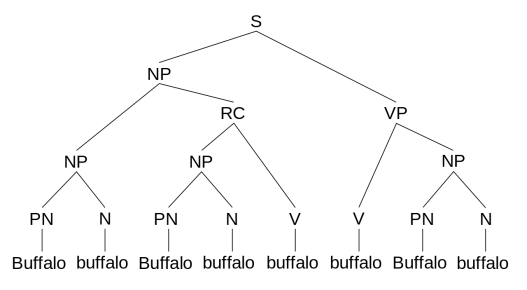
Buffalo buffalo Buffalo buffalo buffalo buffalo Buffalo buffalo.

The above was popularized by the philosopher William Rapaport in the early 1970s. The period is there at the end because it is a grammatically correct sentence. Deceptively simple, Rapaport’s word-play requires a key to unlock the logic at work. The word ‘buffalo’ conveys three distinct meanings: as a proper noun it is a city, as a common noun it is an animal (aka bison) and as a verb it means to bamboozle. These nouns and verbs conspire with one another to transform an absurd list into an entirely reasonable thought. The sentence diagram above helps, if you are into that sort of thing, or just substitute the word ‘bamboozle’ for the verb ‘buffalo’ and the sentence can be understood as ‘buffalo from the city of Buffalo are bamboozled by other buffalo from Buffalo and in turn bamboozle still other buffalo from the city of Buffalo’.

That’s a lot of crafty buffalo.

Much later Rapaport, in his book Great Insights of Computer Science, makes another observation about a seemingly mundane matter, yet one that he shows has complex and far reaching implications. The first great leap in the theory of computer science was “Gottfired Wilhelm Leibniz’s, George Boole’s, Alan Turing’s, Claude Shannon’s, and Samuel Morse’s insight: there are only two objects that a computer has to deal with in order to represent ‘anything.’ All information about any computable problem can be represented using only 0 and 1 (or any other bistable pair that can flip-flop between two easily distinguishable states, such as ‘on/off’, ‘magnetized/de-magnetized’, ‘high-voltage/low-voltage’, etc.).”

Huh. All of the most spectacular advances in computer science can be reduced to such humble origins–the binary digit, or Bit. What a relief! For someone who is mathematics illiterate, such as myself, this is comforting. All that rarified knowledge has been constructed upon a foundation that is so simple an eight-year-old can understand it. Cool. What can we do with that?

To answer this question Rapaport identifies a second great insight that belongs to Turing alone:

“…there are only five actions that a computer has to perform in order to do ‘anything’. Every algorithm can be expressed in a language for a computer consisting of only five basic instructions:

  • move left one location;
  • move right one location;
  • read symbol at current location;
  • print 0 at current location;
  • print 1 at current location.”

From this the modern electronic computer was born.

Turing, a gay man in mid-twentieth century England, is also largely credited with solving the cipher to the Enigma machine that encrypted and thereby safeguarded Germany’s most secret communications during WWII. Cracking the code facilitated an Allied victory. But what of Turing, the man? How was this singularly brilliant individual treated by the British state? He was hounded and incarcerated then subjected to chemical castration and psychological torture so as to ‘cure’ him of homosexuality. His signature contribution to solving Enigma was kept a state secret until long after his death, itself perhaps directly at the hands of that state.

The British state (as all states) pillaged the insights and innovations of its brightest ‘deviants’ then wrapped them up in the Union Jack and called it progress. The contrast between Turing’s contributions to science and the manner in which he was treated is emblematic of the difference between those insights and the political and economic system that claims them for itself. The film The Imitation Game acknowledges the injustices suffered Turing, but upholds the right of the state to pillage that which belongs to it by sovereign right. Anarchists and communists refuse to uphold that right, because all capital and labor, and the science and technology that drives inventions and innovations, belong to us, not bureaucrats or capitalists, innovators or influencers. They steal it from us. Our task, as always, is to take it back.

From the two insights above the Information Age has evolved. There are, of course, other insights and innovations, but few, it seems, are as fundamental as these two. The scaling up of Bit logic, and its service to capitalist political economy is reshaping the biosphere we call earth and our relationship to it. The so-called ‘Information Age’ with its computerized networking power, artificial intelligence and machine learning, genetic engineering, robotics and automation, are ‘disrupting’ concepts once considered fundamental to capitalist and state-socialist economics, such as trust and risk, space and time. However one assesses what are undeniably monumental, deep, broad and fast changes one thing should be crystal clear: In the hands of bosses and bureaucrats such power will only further our collective immiseration. There is no ‘progress’ here without attendant forms of domination. We must find a way to create a rupture with this process.

Value

Marx wrote something about ‘value’ that might be of some use here (pardon the pun).

Capitalism has always been characterized by an effort to instrumentalize the trust and risk intrinsic to trade so as to guarantee profits for the property owner. This presupposes the prior existence of private property owners and workers–the former with the power to compel the latter to sell the only thing that ensures their continued mutual existence: the labor power of the worker. That labor power is the basis for all value. Yet for those economists who believe that something other than labor produces value, its easy to formulate trade in an abstract, ‘pure’ form and construct what I call the Santa Claus theory of economics: Someone needs something they don’t have, so they trade something in order to obtain it. Goods and services intermingle through the magic of competition and pricing and everyone is happy. Everyone gets what they deserve in the form of presents under the tree; only the lazy and undeserving get a lump of coal in their stocking. In this way inequality is justified and reproduced.

“But ‘profit-making’ is just capitalist exploitation. Its secret gave rise to the study of political economy; and since Marx disclosed it orthodox economics has been devoted to covering it up again…Capitalism is unique in hiding its method of exploitation behind the process of exchange, thus making the study of the economic process of society a requirement for its transcendence.” (A Dictionary of Marxist Thought. Tom Bottomore, Eds., 1983).

In order to overcome great distances and long periods of time associated with much trade, money served as a fungible representation of the value such goods and services contained. While this now seems natural, and no doubt was in many ways superior to other forms of storing value associated with earlier modes of production, it was never, and can never be, a definitive and accurate accounting of that value; it can only ever be a social construction of that value. Stamp that coin with a number, print currency with heads of state and corresponding digits, watch the stock market hit 26,000, it is still constructed by human beings in relation with one another. It does not have an existence independent of that social reality. Marx wrote that money in each of its moments mediates a social relation and has a dual nature:

“Commodities come into the world in the shape of use values, articles, or goods, such as iron, linen, corn, &c. This is their plain, homely, bodily form. They are, however, commodities, only because they are something two-fold, both objects of utility, and, at the same time, depositories of value. They manifest themselves therefore as commodities, or have the form of commodities, only in so far as they have two forms, a physical or natural form, and a value form.” (Capital. Volume 1. Part 1. Section 3).

Neither the physical form nor the value form can ever be captured through a number, only approximated. Such “depositories of value” are encoded in money, be it precious metal, fiat or digital. Here, I think, a conceit is indulged, or if you prefer, a sleight of hand is performed. This sleight of hand has proven more efficient, more powerful and most of all more fungible than competing forms of valuation. Private property, capital accumulation and markets organize trade–rationalize it–and facilitate the speeding up and expansion of the forms of monetary endcoding of exchange value necessary to overcome the long periods of time and often great distances involved in buying and selling labor and capital in the form of goods and services. But, regardless of its ability to outperform competitors, it was still an imprecise and arbitrary operation that also codified relations of exploitation and domination that are intrinsic to it. This operation appears to us as naturalized, by which I mean represented as an authentic and eternal, just and good, embodiment of the value of that good or service. When economists employ mathematical formulas and assert ‘laws’, it is as though the realm of capitalism is eternal. While some of these formulas can be helpful in understanding the nature of capitalism, such as Thomas Picketty’s R > G, they are only applicable within the narrow field of economics. However many econometricians may don white lab coats to assert their empirical knowledge, what they practice is still, at best, numerical anthropology or mathematical sociology. Value in a Marxist sense is always, everywhere and throughout all of history, something human beings determine. These laws and the numbers that make them appear so solid do not stand outside of time, outside of history. This misrepresentation, (conceit, sleight of hand) lies at the heart of capitalist, and much socialist, political economy: that part of the value of a good or service can be ‘stored’ and rendered as an amount expressed by the numerical symbols of whatever currency is deemed legitimate.

Non Marxist economists believe that ‘stored’ or ‘deposited’ value can be calculated one way, through pricing signals and monetary mechanisms toward that ever elusive market equilibrium, or the cosmic balance between supply and demand; Marxist economists, through the labor theory of value, another. Both economic theories, on paper and in practice, rely on a pricing mechanism and a monetary system together with banks, private or public, as institutions necessary to facilitate trade and the meeting of human needs, however imperfect. Socialist states sought to quantify the exchange value of labor and capital in monetary forms–every socialist state has had a currency, banks, an insurance industry, etc.,–no less than capitalist states.

With the public realm of the state it was possible to socialize (usually ‘nationalize’) values, to one degree or another; with the private the goal was, and is, to privatize them. Both approaches sought to expand and speed up economic growth and thereby social development. Socializing surplus value, on the one hand, or lifting all boats by expanding the pie, on the other. Private property and ‘free’ markets have proven to be more adept at this. All things being equal the military and economic might to command large armies of labor from which super profits and surplus value can be extracted, especially from the global South, has been a constant advantage throughout the recent history of capitalism. But how that growth and development is distributed is, of course, its Achilles heal. With the public and private, everyone is fixated on monetizing labor and capital, then dividing the fruits according to the logic of either system. Both only considered communism as an economic system free from private property and wage labor, money and exploitation, as a distant utopia or an ever present threatening dystopia but not, in any case, realizable in the here and now.

Bit Logic and a Communist Future

The explosion in computing power that Bit logic has unleashed threatens to upend this by potentially making the public/private binary obsolete because it is rapidly transforming the space and time involved in trade. It is simultaneously opening up a heretofore impossible communist future while also enabling a more exploitive and domineering state and corporate nexus. The gig economy and Bitcoin are responses to this change in the fundamentals of classical economics–both represent an intensification of private capital accumulation and control. That intensification is proceeding at a frenetic pace. Well meaning politicians who bemoan workers having to live ‘paycheck to paycheck’ are missing the fact that in our increasingly informal and digitized economy workers live from gig to gig, which is to say hour to hour, in their cars or cars they rent, while corporations continue to slough off the social costs of doing business onto the backs of those workers. As the gig economy grows–and it will grow unless we strangle it–other better paying, more secure, safe and fulfilling jobs disappear. But the freedom to set a work schedule of our own desire, or to take breaks when we need them, or not have a boss up in our face is greatly diminished when we must work 12-14 hour days and the only other options to this digital treadmill are prison or homelessness. Fully half of Google’s workers are now gidgets (my word, which is a portmanteau of widget and gig), i.e., contract workers with all the flexibility of someone unemployed but none of the benefits of an employee. Dismissing or applauding the growth of the gig economy ignores the inescapable logic inherent to its spread: capital is able to massively socialize costs while increasing accumulation. What allows for this is the increase in digital networking power, the massive disenfranchisement of the masses that accompanies the privatization of electoral politics and the general speeding up of the circulation of money. Workers have no choice but to work these jobs because, as a comrade once noted, labor always follows capital, as it doesn’t wish to starve or be imprisoned. The key here, much like the key to Rapaport’s sentence above, is understanding that this power belongs to us and must be returned to us and in order to bring that about we must fight for all of it. We must wrest that power from them, not enable it. No half-measures such as increased taxes, higher wages, a reclassification of workers or more democrats in office will do. Nothing less than everything will do.

Did you know that bluetooth beacons in grocery stores track cell phones to within centimeters and can send push notifications to nearby ‘shoppers’? These changes are not coming; they are already here. The good news is that many of them prefigure an anarcho-communist future. That future will not come about by its own volition; it must be won.

Developments in Bit logic and networking power, especially during the past 10 years, expose the increasingly unnecessary and wasteful aspects of capitalism while laying the groundwork to make it possible to forego these operations altogether. Some untethered radicals and discombobulated libertarians believe that ‘data’ will supplant ‘pricing’ in the near future, a signature development of a ‘post-capitalist’ future. Call it what you may, it will be worthless without a massive redistribution of wealth.

What is different today, or at least since 2010 is that whereas at one time such advances in technology facilitated trade and the meeting of human needs, now they hamper them. This is what continues to be misunderstood about the Great Recession of 2007-09: The upheaval was less about housing bubbles or asset overvaluations per se than about a balance that needed to be re-calibrated. An explosion of value was being unleashed through technological changes and that value had to be captured–privatized–by corporations and the state. But the velocity and breadth of these changes are outstripping the ability of the modern nation state to corral it. Bitcoin and the gig economy are efforts to intensify the privatization of these advances.

Instant and Inevitable Communism

Two recent articles, one a fluff piece the other more serious fare, address something similar. Aaron Bastani’s concept of “Fully Automated Luxury Communism” first made the pages of the New York Times on June 11, 2019, but it has been around for awhile. The nut of his argument, which is equal parts preposterous and loathsome, not least because it serves as a bridge between the affluent and entitled left and the soulless libertarian right, is as follows: “The case of cultured food and drink, far from a curiosity, is a template for a better, freer and more affluent world, a world where we provide for the needs of everyone–in style.” The article reads as if it was written by a 40-something neurotic boy-man channeling Lenin as a ‘salesman’, rather than he who gave the order to put the Romanovs in the ground. The breathless prose comes off as a promotional pitch for an inevitable technological revolution–no molotov cocktails or general strikes needed. As despicable as his article is and forthcoming book will be, Bastani highlights something of importance: automation, robotics, artificial intelligence and other advances in science are transforming the world, in particular the nature of work and workers. Most radicals know this, but it is an open question as to whether our theory has changed accordingly. The problem, which most radicals also understand, and that is left entirely unaddressed by Bastani, is in whose hands this transformational power resides. The answer, of course, is theirs. The struggle to reclaim that power will not be a cake walk. It will be brutal, and of necessity lightening fast and global, while hopefully successful. But it will not come about because Sergey Brin has decided to fund another vanity tech start up that produces genetically engineered meat. The significance of the article is in the fact that intellectual elites have taken notice of such changes and are planning accordingly. Some, full of dystopian dread, are buying land in New Zealand while others believe the Bolsheviks will never come for their Doggy Hotels because the rough edges of capitalism will be smoothed over through the invention of a better mousetrap delivered to their door by a drone.

The other article of interest, with more heft to it, is that by Evgeny Morozov in New Left Review (No. 116. June 2019). “Digital Socialism? The Calculation Debate in the Age of Big Data” is concerned with similar developments in science and technology. But where Bastani laps up genetically engineered hamburgers made of petri dish grown cellular matter with squirts of commodity fetishism to sweeten the taste, Morozov is more concerned with whether Silicon Valley can cough up fresh “legitimating narratives” and “regenerative mythologies” to buttress actually existing capitalism. The most important aspect of this requires revisiting the “socialist calculation debate” and something called the “New Deal on Data” a concept that derives from a paper presented to the 2009 Davos forum. Morozov writes:

“I will go on to suggest ways in which the development of digital ‘feedback infrastructure’ offers opportunities for the left to propose better processes of discovery, better solutions for the hyper-complexity of social organization in fast-changing environments, and better matches of production and consumption than Hayek’s solution—market competition and the price system—could provide.”

Here is the whole weight of the material determining our political possibilities–sort of a reiteration of the base and superstructure debate. Mozorov is essentially arguing for a more sophisticated ‘Fully Automated Luxury Communism’ with a tweak from Picketty and perhaps Hayek. Both articles are largely non-starters because of where they begin. For Morozov a compelling argument has been made by Viktor Mayer-Schonberger through his works Big Data and Reinventing Capitalism in the Era of Big Data (or, provocatively titled in the original German Das Digital) that data will replace the pricing mechanism as the guarantee of the internal logic of capitalism.

Morozov writes:

“Das Kapital, they argue, is out of date: once it is efficiently utilized throughout the economy, Big Data will not just reinvent capitalism—the English title is too modest on this point—but end it. ‘It may be time to close the door on history and officially eliminate the term “capitalism”’, they proclaim. In place of finance capital and firms, data-rich markets will empower humans to work directly with each other. More dramatically, data will supplant the price system as the economy’s chief organizing principle.”

While Morozov does not buy this argument, he does seem to relax his critical faculties when it comes to the proliferation of feedback mechanisms associated with the big data of Amazon and related Gig economy ‘disrupters’. His casual mention of Bla Bla Car, a rideshare startup in France that allows a rider to set a ‘chattiness’ level of a driver neglects to note that this is a form of labor discipline exercised by capitalists. This feature of new data as it intersects with the gig economy is left unexplored, which is a shame because it is the nexus for the anti-labor, anti-human character of this emerging economy. Morozov forgets that the very notion of a ‘consumer’ is bound up with enforcing labor discipline as much as it is about limiting rat feces in bologna. For Marxists, there is no such thing as a consumer, only my labor power and the assholes who steal the surplus value from it. Mozorov evinces no recognition of this fact about the new gig economy.

Whether it be pricing or data, there is no way to definitively quantify the value of capital and labor, goods and services through money, although this is precisely what capitalist and socialist states and their theorists have argued over for the past two hundred years–not if it could or should be done, only how it could or should be done. That’s what the great ‘Calculation Debate’ should have been about. To suggest that it needn’t have taken place at all is not necessarily a fools errand that romanticizes ‘primitive’ modes of production, such as bartering, ‘pre-capitalist’ economies or those such as that practiced by the Zapatistas for more than twenty years throughout the region of Chiapas. We must relentlessly interrogate the notion that there are ironclad stages of development that define and constrain our ability to realize a communist future, aka the stage theory of socialism. We are constantly told that we can eventually overcome this, but to push for too much too soon is to court disaster because it is impossible. The elimination of work, of money, of private property and the state is something that must come about, but can only come about in the distant future. So we have been told. But if capitalism is experiencing a crisis of confidence, so too is the guiding logic of state socialism. Something is different from then and now. Why? Big data, with or without flexible and recursive mechanisms for ‘bringing people together’, will always trend toward monopoly and dictatorship because the dna of the modern corporation is that of domination and exploitation. They are by definition totalitarian regimes. This is not addressed by Mozorov. Small or large, if the corporation remains, our future is bleak. Right now the modern corporation is in almost complete control of all the most important advances in science and technology, not to mention the erasure of politics and culture. To theorize the state as a vector of opposition to ‘globalization’ is to miss the fact that it has been largely captured by capitalists, be they national or ‘international’ in outlook. It just doesn’t make much of a difference.

What is fundamentally different about our situation today is that if we wait, it will be too late. We court disaster by not pushing for everything now, because only everything will stave off total disaster of one type or another. Whether that imminent threat be climate change, fascism, species collapse and pandemics, or just the continuation of neoliberal digital dictatorships wobbling about as a hollowed out and emaciated liberal democracy, is irrelevant. Any one or more of these threats will end the dream of an equalitarian and democratic future. Organized human societies and the democracy and equality that give them meaning are increasingly at risk of collapse. While one could argue that making a leap toward an anarcho-communist future risks destabilizing liberal democratic alternatives, it is becoming more apparent than ever that the risks associated with not making such a leap outweigh those of attempting it.

All Accounting is Fictitious.

All ‘costs’ could be socialized without a monetary system, banks, loans, insurance, or any type of symbolic semiotic absurdity mediating the lifespan and use of a given good or service. Strip from that rutabaga plant or taxi ride, domicile or space shuttle every aspect of pricing and markets, money, buying and selling, wages and ownership, advertising and insurance–what do you have? The thing in itself which we make the thing for us, that which belongs to the commons. If we weren’t spending our time and energy fixated on monetizing exchange value, what could we spend our energy and ‘cognitive capital’ doing? All of those things above that define a good or service sans the elaborate and wasteful exercise in fictitious accounting. In other words, all accounting is fictitious. The operation, while undoubtedly surreal, is not without real world consequences, but it is and can only ever be a misrepresentation of the value it is said to embody. We arrive at that value through our collective control of the process, or it is imposed on us.

Another way of looking at this: What an extraordinary waste of human energy! If there is no longer a need for assurances of trust necessary for the taking of risk, because that trust and risk has been socialized in the commons, for what does one need money? If those great distances and long periods of time have been effectively overcome, what is the point of money? The answer is to maintain inequality. Today it is increasingly only that. It is a system that has lost its ability to project a future worth projecting so it resorts to the doctrine of TINA–There Is No Alternative. The very forces it has unleashed have become fetters on further development, as someone once said, so it forecloses on any future other than that of its continued domination.

Bit Logic ≠ Money

Consider the difference between Bit logic and money. Bit logic is perfectly logical, its operations by definition must solve an equation, complete an algorithm. It’s an arrangement of zeros and ones. This is behind that annoying statement that coders and software engineers are fond of quipping: a computer program can never be wrong; it can only be programmed (by a human) incorrectly. Exchange value, on the other hand, is not strictly logical in the above sense; it is a social construction that employs a certain logic in its execution, but can only ape bit logic. It always reflects whatever values a ruling class is able to impose on subordinated classes, something decidedly social in nature. That value is mediated by the class struggle, not independent from it. There is no ‘value’ apart from this. In this sense the value of money lies in the ability of a ruling class to live in a manse, impose a border, enforce a regime of labor, and organize all of this from its computerized citadels. It has no existence independent from this.

Try and imagine a world without finance, debt, deficits and loans, without corporations and governments, without advertising and without wage labor, without work. It is difficult because it cannot be done without an understanding of the functional and structural basis of capitalism and the state together with a theory of what can replace them, and how to bring that about. It’s also the case that such a dream of the future cannot be piecemeal, because it is always subject to the death of a thousand cuts. You want open borders? What about the chaos that would ensue? And so on. Additionally there is a dynamic to capitalism such that whatever we are able to wrest from one hand they will take back (and more) with the other. This is what we radicals mean by a ‘systemic’ analysis, or “the system”. Bit technology can help facilitate this transformation–it can be used to help us replace capitalism because it is different from it.

Now, it should be clear that I am not a Luddite. But I am also not a futurist nor a technological determinist. This technology which exists on a world-changing scale must be controlled and shaped by the commons for the common good. We ought not hide from, organize around, ignore or destroy it. We must make it serve the common good. We can only accomplish this through political struggle. Left in their hands it will bring us nothing but more misery. What we yearn for, the prize that we must always keep our eyes on, is what is meant by this quote from Marx, altered for gender clarity:

“For as soon as the distribution of labour comes into being, each woman has a particular exclusive sphere of activity, which is forced upon her and from which she cannot escape. She is a hunter, a fisherwoman, a shepherd, or a critical critic and must remain so if she does not wish to lose her means of livelihood; while in communist society, where nobody has one exclusive sphere of activity but each can become accomplished in any branch she wishes, society regulates the general production and thus makes it possible for me to do one thing today and another tomorrow, to hunt in the morning, to fish in the afternoon, rear cattle in the evening, criticize after dinner, just as I have in mind, without ever becoming hunter, fisherwoman, shepherd or critic.” (The German Ideology). 

This year the British state will adorn a 50 pound note with a visage of Alan Turing. Such a conflation of the scientific genius of Turing with that of the unscientific power of money is obscene, and perfectly in keeping with the odious nature of the United Kingdom.

This is not our future, much less the only possible future; it’s no fucking future at all. I will have none of it. Let’s bring something different into existence. Let’s take a leap toward a 21st Century socialism, in a word Anarcho-Communism.


END

Share this:

  • Click to email a link to a friend (Opens in new window) Email
  • Click to share on X (Opens in new window) X
  • More
  • Click to share on Facebook (Opens in new window) Facebook
Like Loading...

If You Insist on Driving in San Francisco

Featured

Posted by Jonathan Mozzochi in Essay, Rant

≈ Leave a comment

Tags

Big Tech, Das Kapital, Fisherman's Warf, Golden Gate Bridge, Isaac Asimov, San Francisco Homeless, Snob Hill, SoMa, Suicide deterrent system, Waymo

OccupyICE_Gehrke_ICE2June_28_2018_web

If you are a tourist, just don’t drive in the city. Don’t even consider it. This is the most unforgiving and forbidding, bat shit crazy city to drive in throughout the entire United States. Oakland is a close second, with the crappiest roads in the country, but nothing beats San Francisco’s hybrid transportation hell with its one-way, dilapidated streets, steep, winding hills, constant construction, horrific traffic and the most aggressive pedestrians and bicycle riders on the planet.  If you must travel to San Francisco–and we prefer you did not–don’t drive a car. If, however you insist on doing so, here are some vehicular pastimes that beat the crushing stupidity and corporate mendacity of those tourist traps like Fisherman’s Wharf and The Embarcadero. You might as well learn something from your intransigence.

If you are not above indulging in a bit of schadenfreude proceed to Washington and Jefferson streets where they cross Snob Hill east-west and west-east. Both streets are one way and are cable car equipped. The cable cars, long since abandoned as a means of proletarian conveyance, now cater exclusively to that most despicable of social creatures, the tourist.  Get your video ready. Note that in place of four-stop-sign intersections the cable car is granted the right-of-way, making for two-stop-sign intersections, something unexpected and counterintuitive to anyone unfamiliar with San Franscisco’s insane transportation environment. You will watch as driver after driver stops when they ought not to stop, and do not stop when they should. This, despite the prominently posted signs north and south that read Cross Traffic Does Not Stop. It makes no difference, as no-one reads a sign posted below a stop sign, unless it is for a yard sale; but it does make for constant near catastrophes, and the occasional full-on crash. Hours of enjoyment here, much superior to those creepy mobs lined up outside the Full House house, which is not the house at all, merely the exterior that formed a shot for the show. Besides, sitcoms with laugh tracks are the television equivalent of easy listening muzak.

Americans are congenitally allergic to Round-a-bouts. San Francisco is no exception. The Round-a-bout at 8th and Townsend is a shit show worthy of a Three Stooges skit. The physical comedy of vehicles, bicycles, scoots and scooters, skateboarders and pedestrians all aggressively competing for the right-of-way through a circle whose logic escapes everyone is perfectly emblematic of the future Big Tech has in store for us. And this is ground zero of Big Tech in San Francisco, with the offices of Adobe and Air BnB yards from the chaos. They have figured it all out, you see, because an algorithm can never be wrong (only the person who programmed it) therefore everything that derives from the algorithm is right and good. Now comes the pesky Round-a-bout and the many nuanced social cues and codes and all that other stuff that escapes the ironclad logic of the Bit. The logic of the Round-a-bout is straight forward and simple, yet flouted by practically everyone: if you are in, you have the right of way. If you are out, watch out. Exceptions, as always, are pedestrians and bicycles. The point system is always in effect, which is my way of saying Big Tech is Big Stupid.

Set aside time in your itinerary for the onramp to the Bay Bridge at 1st and Harrison and the neighborhood known as SoMa (South of Market). Deeply ensconced within this cradle of plutocracy is the leaning Millennium Tower (fall over already) and the worlds most posh freeway entrance. While you are there let them know we are coming with pitchforks and molotov cocktails, and a particular emphasis on those $5,000-a-month doggy day cares. During rush hour (5am-10pm everyday) watch for Lamborghinis with a right-of-way my Toyota just doesn’t have. They will cheat through that bike lane while pretending to ignore horns blaring around them then park right in the middle of the fucking intersection, stopping traffic in all directions. Taking their time, they will pretend to have misinterpreted the giant sign that reads “Do Not Block Intersection” and the civil code cited below it. Milkshakes are in order.

While not particular to San Francisco, the mantra Look, Signal, (then) Pull out should always apply. Don’t do the opposite–pull out, signal and look as an after thought. Doing the opposite means you will ram your vehicle into mine and I will be forced to exit my vehicle and beat you about the head with a copy of Das Kapital. This elementary principle, so simple and unambiguous, so very difficult to misinterpret, is unobserved everywhere. There is a phrase for doing otherwise: aggressive stupidity.

Don’t stick your phone, much less your iPad, into the middle of your front windshield. Are you daft? You will not be able to take out that Salesforce executive without backing up to finish the job. Furthermore, while you may be able to track your progress through that gps navigation program, you won’t get wherever it is you are going because you will have hit something you ought not to have hit along the way. Those large spaces at the front and sides of your vehicle called windows are transparent for a reason–so you can see through them.

Autonomous vehicles in training are legitimate targets for milkshaking and the old Issac Asimov I Robot conundrum: roll a baby carriage from one direction and an elderly person from another directly in front of the Waymo vehicle and force it to make a decision, thereby exposing bias at work in the algorithm. If it chooses to run over the baby, autonomous vehicles are baby killers; if it chooses the elderly person, it is guilty of geronticide. If it stops altogether, get your milkshake ready.

Two noteworthy tidbits of trivia to keep in mind about the Golden Gate Bridge. First, is that it was Iron workers who died building it and should be honored for it. Architects and engineers can fuck off. Second, the suicide deterrent system currently being installed on both sides of the bridge to the tune of $240 million is emblematic of the priorities of San Francisco’s city leaders. It is far more important to obstruct people trying to die with dignity, and perhaps a bit of notoriety, than do anything about the homeless crisis–which is not a crisis of too few homes available for too many people, but that of the 100,000 empty homes that the wealthy indolent and real estate industry purposefully leave uninhabited. That’s right 100,000 empty fucking homes. Occupation and expropriation are the only solution here.

The Tenderloin District is the last bastion of lumpen proletariat resistance in the entire city. Drive careful through there because God’s children are selling the dope all those Big Tech twits need to make it through their twenty-hour work days while they pray to the crack in the wallet of a Tech billionaire. That’s right, San Francisco’s African-American population has contracted by almost half in the past twenty years, which makes driving through The Tenderloin, Bayview and Hunter’s Point neighborhoods the rough equivalent of visiting a concentration camp or Indian reservation. You are witnessing a program of urban genocide carried out under the banner of Big Tech. So remember, with every  floor of a shiny new office building, a tent city is erected in its shadow.

Welcome to the City on the Hill.

END

Share this:

  • Click to email a link to a friend (Opens in new window) Email
  • Click to share on X (Opens in new window) X
  • More
  • Click to share on Facebook (Opens in new window) Facebook
Like Loading...

The Tyranny of Adverbs and Twits.

Featured

Posted by Jonathan Mozzochi in Essay, Rant

≈ Leave a comment

Tags

Antifascism, Bong Joon-Ho, Donald Trump, fascism, Google engineer, Instagag, Jeffrey Epstein, Noam Chomsky, Obama, Snapcrap, Snowpiercer, Zizek


Literally used now more than ever.

4130c931b9b46b611e2f876a70b1b1c8ac06ba6b.png


Way back in 2012, Joe Biden was criticized for using the adverb ‘literally’ nine times in one speech. How quaint. I recently listened to a level 5 Google engineer use it nine times in the space of two minutes.

This particular soulless quant had another annoying habit: He would begin every other sentence by restating my name, “Jonathan, I understand what you are saying…” If such feigned familiarity is coupled with a light touch on the arm, I feel free to reach for a knife. Most people who do this are trying to overcome skepticism and inculcate credulity. As a mnemonic device, it is annoying at best; more often it is cloying and insincere and a sure sign to distrust, even despise someone.

Honestly? Like. Literally. Actually.

While I don’t miss Obama much, I do miss his particular elocution, that patient, preternaturally calm, baritone voice and the halting ‘ums’ and ‘uhs’ that stitched together his verbal output. By today’s standards, those pauses are pleasant by comparison. They don’t have any pretense; they are space fillers that allow him to think. While I have many disagreements with what he said, I could always understand it. He was thoughtful and nuanced to a fault; dithering on the golf course while fascism made a comeback. But in this he was not alone, nor particularly exceptional. Plenty of socialists, for instance practically the entire seven-year history of Jacobin Magazine and Blog, join him in this regard. But back to those adverbs.

With Trump, it is as though every wealthy, entitled, and neurotic teenager has suddenly been given carte blanche to release their own unfiltered insanity. While I think the parallels here can be overstated (Trump as a teenager) there is still something to it. Will Trump bomb Iran or just berate the housekeeper? Will he begin in earnest the rounding up of undocumented families or just do a stint in rehab?

His verbal diarrhea is pockmarked with superlatives such as ‘winner’, ‘terrific’, ‘tremendous’ and of course, ‘great’ and ‘greatest’. It’s as though his mother, or au pair, never stopped telling him how special he was, even when he was caught eviscerating the neighbor’s cat. Good boy.

If Trump were a pornography category it would be ass-to-mouth, mouth-to-ass, with all those A-list ruling class enablers from both political parties, across every imaginable capitalist enterprise, sucking and fucking to form one giant, unending, gangrenous human centipede, just like the horror film. Jeffrey Epstein is in there somewhere.

Today it seems that adverbs, and certain nasty ones, in particular, have mounted an attack upon the nonviolence of ums and ahs, completing a scorched earth assault on the quiet dignity of anodyne place fillers so as to replace them with crutch words that, whether used correctly or incorrectly, amount to obfuscation and disorganization–i.e., bullshit. These lexical tics impulsively resorted to by the verbally disabled add emphasis where none is needed, assert drama where there is only triviality, state the obvious rather than the nuanced, and (my favorite) suggest strongly that everything said beforehand was a lie (honestly?…). The standard Trump teenage verbal diarrhea disaster asserts a recklessness with meaning that can only be regarded as aggressive stupidity. This is the hallmark of the powerful, the invulnerable, the masters of the universe who say and do as they please without repercussions, and is the hidden in plain view secret behind Trump’s attraction to some people. We have heard it again and again: Trump ‘says out loud what we can only think to ourselves’. My own take on this is that Trump says out loud, in ways some people would never even hazard, the despicable ideas that belong in the basement. They generally stay there because someone will kick your fucking ass if you say them out loud elsewhere, which is as it should be, but, alas is no longer.

The terrifying ephemeral nature of Twitter is the dominant mode of communication for this viral and noxious hate speech. But together with the sheer hatred and assault of such verbiage, there is something else underway: where everything is equally dramatic, nothing is important. Aside from links to longer written work, this platform, like instagag and snapcrap is useless for leftists. The ‘twit’ in Twitter is there for a reason. Those who are prolific in these mediums are the same shallow dipshits who prosecute juvenile intra-leftist fights. Tankies vs. insurrectionists, statists vs. anarchists, etc.

No complex thoughts or arguments are possible here, only half-ass hashtags, silly memes, and depraved gossip. Chomsky once remarked that in order to engage an audience about ideas which break with orthodoxy one must spend some time setting the groundwork to do so–you need at least 15-30 minutes to tear down presumptions that prohibit ‘out of the box’ thinking. If you are not afforded the opportunity to do this you sound insane. This fact alone means the instant ambush culture of social media and the talking heads that wallow in cultish Marxisant Zizekian nonsense ensures no such thinking is possible within such a format. Zizek and his ilk thrive there because they are full of shit. That’s why Chomsky didn’t go on cable news programs or engage in celebrity debates. Chomsky has all the more integrity because of that. More leftists, certain antifascists, in particular, need a reminder on this point. Otherwise, you are just engaging in a debate on their terms. The only corrective to this sorry state of affairs is aptly provided in the wonderful allegory of revolution that is the film Snowpiercer, by Bong Joon-Ho. If you get to the front of the train, don’t listen to the conductor, don’t even allow him to talk–cut his tongue out and remember: Kronole is a bomb, you idiot!

This is why it is largely pointless to troll celebrities and engage in the shadow boxing preferred liberals and conservatives. The questions determine the parameters of possible answers. Liberals and conservatives, establishment types, and pols consumed with issues and policies are congenitally allergic to our thinking and action. Are they concentration camps? Is Jeremy Corbyn an antisemite? Was Brett Kavanaugh qualified for the Supreme Court? Is there a U.S. presidential candidate other than Bernie Sanders worth two shits? Did Jeffrey Epstein receive preferential treatment for his predations? If you debate these questions, you have lost before you begin because there is no debate. To debate what is obvious is the death of debate. It is to die a dithering death, full of thoughtfulness and nuance, that amounts to nothing. It won’t stop fascism or overcome capitalism. Enough already. Try a long-form essay, FFS, and mind your adverbs

END

Share this:

  • Click to email a link to a friend (Opens in new window) Email
  • Click to share on X (Opens in new window) X
  • More
  • Click to share on Facebook (Opens in new window) Facebook
Like Loading...
← Older posts
Newer posts →

Subscribe

  • Entries (RSS)
  • Comments (RSS)

Archives

  • February 2023
  • December 2021
  • August 2021
  • July 2021
  • May 2021
  • January 2021
  • November 2020
  • October 2020
  • September 2020
  • August 2020
  • July 2020
  • June 2020
  • May 2020
  • April 2020
  • November 2019
  • September 2019
  • August 2019
  • July 2019
  • June 2019
  • May 2019
  • March 2019
  • February 2019
  • January 2019
  • December 2018
  • November 2018
  • October 2018
  • September 2018
  • June 2018
  • March 2018
  • February 2018
  • January 2018
  • October 2017
  • May 2015
  • April 2015
  • November 2014
  • July 2014
  • December 2013
  • October 2013
  • August 2013
  • July 2013
  • June 2013

Categories

  • Book Review
  • Essay
  • Fiction
  • Memoir
  • Movie Review
  • Podcast Review
  • Portland Anti-Fascist Archives Project
  • Rant
  • Snippets

Meta

  • Create account
  • Log in

Blogs I Follow

  • Counting Crowds
  • Rain Coast Review
  • birchsays
  • BRAINCHILD
  • In Dianes Kitchen
  • Being Zab
  • chrislondon.org
  • Wandering Ambivert
  • The Decolonial Atlas
  • Site Title
  • HARD CRACKERS
  • R.J. Slater
  • ∞
  • strangeparadisehq.wordpress.com/
  • Work With Lapo
  • rajchandran2013
  • Table 41: A Novel by Joseph Suglia
  • Mark Bray
  • Selected Squibs, Scrips, and Essays by Joseph Suglia
  • Democracy & Good Governance

Blog at WordPress.com.

Counting Crowds

Blog of the Crowd Counting Consortium

Rain Coast Review

Thoughts on life... by Donald B. Wilson

birchsays

BRAINCHILD

gehadsjourney.wordpress.com

In Dianes Kitchen

Recipes showing step by step directions with pictures and a printable recipe card.

Being Zab

The Storyteller (Qissa-Go)

chrislondon.org

Wandering Ambivert

The Decolonial Atlas

Site Title

HARD CRACKERS

R.J. Slater

educator, writer, photographer

∞

strangeparadisehq.wordpress.com/

A hotchpotch of random stuff I'm working on... articles, songs, writing/YouTube projects

Work With Lapo

rajchandran2013

4 out of 5 dentists recommend this WordPress.com site

Table 41: A Novel by Joseph Suglia

Mark Bray

Historian. Organizer. Writer.

Selected Squibs, Scrips, and Essays by Joseph Suglia

The Web log of Dr. Joseph Suglia

Democracy & Good Governance

Building A Better World

  • Subscribe Subscribed
    • Ghosts of Anti-Fascism Past
    • Join 35 other subscribers
    • Already have a WordPress.com account? Log in now.
    • Ghosts of Anti-Fascism Past
    • Subscribe Subscribed
    • Sign up
    • Log in
    • Report this content
    • View site in Reader
    • Manage subscriptions
    • Collapse this bar
 

Loading Comments...
 

    %d