• Home
  • About Jonathan
  • Essay
  • Fiction
    • Rant
  • Memoir
  • A House Divided, Full of Secrets: Kid Lit., Conspiracies and the Bohemian Club

Ghosts of Anti-Fascism Past

~ Essays. Memoirs. Rants.

Ghosts of Anti-Fascism Past

Category Archives: Essay

Meeting With A Stalinist

Featured

Posted by Jonathan Mozzochi in Essay

≈ Leave a comment

Tags

fascism, John Brown Anti klan Committee, John Brown Gun Club, Joseph Stalin, Pacific Northwest Anti fascist Workers Collective, Socialist Rifle Association, Uncle Joe

If only in 1991 there had been a John Brown Gun Club, a Pacific Northwest Antifascist Workers Collective, a Socialist Rifle Association, or even a communist caucus within the Democratic Socialists of America, I wouldn’t have been visiting a Stalinist at a Victorian overlooking Delores Park, in San Francisco.

But then again, I wouldn’t have enjoyed that reefer in the park, either.

Somewhat delirious after frolicking in the Castro during Gay Pride, I sat in the parlor of a woman who was an aficionado of the great abolitionist, John Brown. In fact she called her organization the John Brown Anti-Klan Committee (JBAKC–what an acronym!). A committed Stalinist, she held forth at length about ‘Uncle Joe’, and was a militant and mostly nonsectarian (really) antifascist. But between the two of us–I am not in any sense a communist in the Stalinist tradition–we did what we could, from within a political environment vastly different from that of today, to stem the tide of fascism. We shared intelligence on fascists, protested fascists, and fought them in the streets, all the while hoping to ignite a prairie fire of resistance and rebellion. But all this we did at a time when radicals who were socialists, anarchists and communists, were not so frisky. Most people from these traditions split the difference as ‘progressives’, the remainder operated from radical grouplets. The most dedicated and principled among us did prison support work to honor and protect comrades on the inside.

Much of our conversation in that Victorian proceeded in the manner of a seasoned dialectician gently head-patting a skeptical neophyte:

“Kicking the shit out of Nazis seems to be at least somewhat effective,” I would say. My Stalinist friend would reply, “well, I agree with you in practice, and will even do it with you, but, look here,” pointing to a passage from Stalin’s Dialectical and Historical Materialism, “I’m not sure it works in theory.”

What the Antifa practices works, damn the theory.

The theory will come round, eventually.

END

Share this:

  • Click to email a link to a friend (Opens in new window) Email
  • Click to share on X (Opens in new window) X
  • More
  • Click to share on Facebook (Opens in new window) Facebook
Like Loading...

King vs Kubrick

Featured

Posted by Jonathan Mozzochi in Essay

≈ Leave a comment

Tags

possessive individualism, Stanley Kubrick, Stephen King, The Shining

I was always fond of the phrase, “the book is always better than the movie.” Then Stephen King wrote The Shining, and Stanley Kubrick made a film by the same name.

Let’s compare and contrast the book and film, shall we?

Title

Book: The Shining

Movie: The Shining

Setting

Book: Overlook Hotel in Colorado

Movie: Overlook Hotel in Colorado

Operative Motif

Book: a wasp’s nest

Movie: a maze

Principle Conflict

Book: (literal) Ghosts of hotel seduce father to kill mother and child; (figurative) hive mentality vs bourgeois individualism; addiction vs sobriety.

Movie: (literal) Ghosts of hotel seduce father to kill mother and child; (figurative) White settler colonialism vs. everyone else; industrial capitalism vs. nature; the leisure class vs. the working class; patriarchy vs. women and children.

MacGuffin

Book: Jack’s drinking.

Movie: Danny’s ability to ‘shine’.

Jack’s Principle Weapon

Book: a mallet from the lawn game of roque.

Movie: an axe for clearing forests.

The Supernatural vs. Science Cliche

Book: Stock characters are present everywhere in the King universe to support a main conceit indulged by seemingly all purveyors of supernatural horror, and therefore common to all of it: science and rationality are ill equipped to apprehend and control the spirit world. To believe otherwise is folly and brings disaster. This is why a doctor, a cop, a lawyer, a scientist or a government agent always appear in such narratives as well intended, but naive and ineffective, allies to the main character(s). There are many in the book.

Movie: one scene involving a child psychologist establishes Danny’s gift will be misunderstood as pathology.

Supernatural anthropomorphic manifestations

Book: Topiary animals. A firehose. A boiler. A lamp (just kidding).

Movie: None. Only ghosts.

Bullshit Pop Culture Reference Worked Into The Narrative As Though It Was A Postcard Tacked Onto A Refrigerator

Book: Creedence Clearwater’s “Bad Moon Rising” lyrics portend a coming snowstorm?

Movie: none. Kubrick is meticulous and reviles pop culture.

Bullshit Literary Reference Worked Into The Narrative As Though It Was A Postcard Tacked Onto A Refrigerator

Book: Edgar Allen Poe’s Masque of the Red Death.

Movie: none. Unless you count the maze, in which case it is effectively worked in and therefore not bullshit.

Annoying Incongruity

Book: Caribou in Colorado. (elk yes, but not caribou).

Movie: none

Jack’s Choice of Liquor

Book: Gin Martini.

Movie: Bourbon, of course.

Jack’s Typewriter

Book: Underwood–Faulkner, Fitzgerald, Hemingway, Kerouac.

Movie: Adler–Nazis.

Source of Evil

Book: Bad people who did illegal and immoral things in the hotel, then got trapped there in the afterlife.

Movie: The hotel itself–a monument to the parasitical leisure class that demands everyone become a ‘Jeeves’ to serve them. The worst fucking place on the planet where the spoils of exploitation and war coagulate in shimmering infinity pools of conspicuous consumption. Our hell, their heaven.

Metaphor Used By Dick To Explain the Presence of Ghosts

Book: “Fingernail clippings and boogers” which does not work as a metaphor as both reference the entirely quotidian and therefore not frightening sloughing off that every human being experiences.

Movie: Dick says, “Burnt toast”–the perfect metaphor to represent traces a ghost leaves behind. Burnt, as in something went wrong with the cooking of the toast such that an unpleasant smell would linger. Ghosts are emotional remnants made material in our world because of unfinished business of a nefarious nature.

What Jack Means When He Says, “White man’s burden, Lloyd, my man. White man’s burden.”

Book: The civilizing mission of paint by numbers genre fiction is a heavy burden.

Movie: what a suckup asshole says to impress his bosses.

What the Ghosts Represent

Book: All the ghosts are evil; all desire to continue their evil deeds–marital infidelity, gangsterism, murder, as a manifestation of their “single group intelligence”. The source of this evil is not institutional, structural, historical, political or otherwise outside of the individual. It is located within us, in our denial of the possessive individualism at the heart of the bourgeois family.

Movie: The source of evil is the hotel itself, which cannot be separated from its history, in part erected on the bones of indigenous peoples. It is rabidly racist and demands absolute servility on the part of inferiors, most pointedly workers and their families.

Racist, Homophobic, Classist or Misogynist Scenes That Contribute To Plot Or Character Development.

Book: None

Movie: Grady calls Dick Hallorran a “nigger” in the all important restroom scene. Elsewhere Jack says, “just a little problem with the old sperm bank upstairs. Nothing I can’t handle, though.” That’s about it. Sparing, short and devastating. But Kubrick doesn’t wallow in it as King does–as a teenager expressing unfiltered repressed emotions.

Gratuitous Racist, Homophobic, Classist or Misogynist Scenes That Don’t Contribute To Plot Or Character Development.

Book: an endless parade of cringe worthy and vicarious bigotries apparently pleasurable for some people to read. Emblematic is where King has a young Dick Hallorran fire a “Nigger Chaser” firework (bottle rocket) at a wasps nest. This makes no sense even on its own terms.

Movie: none.

Resolution

Book: Serve different masters. In Wendy’s case, following escape from the Overlook Hotel, this is made possible by the generosity of Jack’s former alcoholic buddy, Al, who can be distinguished by two things: he’s rich and with his connections can get Wendy a job, and he’s emotionally stable, having defeated the demon of alcoholism. Oh, and he’s part owner of the hotel?! This makes perfect sense if the idea of the hotel is not what the problem is, just its mismanagement. This satisfying ending is a continuation of the real horror unaddressed by the novel.

Movie: Dick is killed by Jack. Wendy and Danny escape by snowcat. Jack then freezes to death in the maze.

Symbol of Eternal Horror

Book: something about August 1945 and “group intelligence”. Almost completely unintelligible, as though King finally, mercifully, tired of typing.

Movie: Jack is immortalized in a framed group photo of rich, white revelers at an eternal Fourth of July celebration, circa 1921.

In conclusion.

All of this flaunts two unavoidable truths about the world we live in: first, that the true source of horror in the world is capitalism, a system of private property and markets that is eminently rational in organization, yet bat shit crazy in its unrelenting imposition of the inequality and suffering that are the unavoidable hallmarks of its rule; and, secondly, the only way out of this maze-like house of mirrors horror show is collective struggle and a socialist future. Everything else is a part of that horror show.

Kubrick, brilliant nihilist that he was, ably deconstructed the hypocrisy and hubris at the heart of the capitalist narrative. He acknowledged that horror and identified its sources, but without any exit strategy, (as a nihilist he didn’t believe such a thing could ever exist) he succumbs to the traditional failure of nihilism: cynicism and its doppelgänger, fatalism.

Kubrick is still preferable to King, who misidentifies the true source of horror in the world we live in, then prescribes more of it as a way to escape it.

END

Share this:

  • Click to email a link to a friend (Opens in new window) Email
  • Click to share on X (Opens in new window) X
  • More
  • Click to share on Facebook (Opens in new window) Facebook
Like Loading...

Love Letter To The Antifa

Featured

Posted by Jonathan Mozzochi in Essay

≈ Leave a comment

Tags

anti capitalist, antifa, Antifa Spycraft, Antifascism, communism, fascism, Leopold Trepper, Little Beirut, white Aryan Resistance

Dear Antifa,

After all these years, I remain hopelessly in love with you.

From our first meeting, I was head over heels.

The initial courtship, that labor of love called the Antifascist Archives Project, blossomed into a passionate love affair.

We became friends, comrades and lovers.

You would tutor me in the manner of a sober socialist dialectician. But, Oh!–how my heart would skip a beat and I would blush when you pronounced the word, “dialectician.”

So many late nights with comrades buried in newspaper clippings, pamphlets and balaclavas, it was a wonder we ever slept.

That cold call you insisted I make to an old Yippie–“castigate him for not sufficiently appreciating the legacy of the Black Panthers,” you exhorted. That same old Yippie would laugh uproariously at my chutzpah, then spend countless hours sharing trade secrets over latkes and coffee.

“Only from ignorance can the greatest leaps of wisdom be made,” you later said.

Thrumming your fingers on a wooden desk piled high with papers, you look up: “The best protection from being infiltrated by your enemies is to infiltrate them. Simple and irrefutable. Know what they are thinking before they think it; act before they act. Then crush them.”

You were always straight to the point.

Long before his posthumously published Millennium Trilogy, you claimed Stieg Larsson as one of our own–an international socialist and antifascist who lapped other researchers by practicing the dark arts of Antifa spycraft, all the while hewing close to your dictums.

Gazing up at the entrance to a segregated country club, you mused: “Pedagogy is important. Where the rich have been so shortsighted as to construct their temples of conspicuous consumption in close proximity to us, we will occupy them so as to provide a teachable moment.”

The Great Game, by Leopold Trepper, always at your fingertips.

“Trapped between the anvil of Stalin and the hammer of Hitler, Trepper chose an independent, antifascist communism. He also developed long term spies and a formidable intelligence network.”

Later: “Sometimes I feel trapped between the hammer of Trump and the anvil of Clinton.”

You were never so relaxed and jovial as with that knock-nosed miner from Northern England. The Godfather of the American Antifa (who, in keeping with tradition shall remain anonymous) dispatched this foul mouthed hooligan to disrupt fascist enclaves in the Pacific Northwest, and we sang songs about gay and lesbian liberation, armed strikes and Native resistance.

In 1996, over weird breakfasts and not a few pints in a baker’s dozen of cities throughout Germany you showed me the Antifa flag flying high.

“Look”, you pointed up. “There, hoisted high above that community center, the red and the black. The only flag the Antifa will ever fly–if it flies one at all.”

You were everywhere over there after the fall of that wall, from Stuttgart to Bremen, Wuppertal to Keil and of course Berlin and the wonderful organized chaos of Kreuzberg.

“What’s that smell?”, I asked in Leipzig. “Braunkohle”, you murmured, “distinctive and dirty.”

Defending refugees the urgent task of the day; fighting cops what the Antifa did on its lunch break.

“All cops are bastards,” you would spit, the taste of cayenne pepper fresh in your mouth.

Later: “Most cops are workers, too. Find a few still capable of cognitive dissonance; they will help us liberate their intelligence reports on fascists and identify racist cops.”

Then, after a shot and a beer, another tattoo, and dancing to LKJ at a meet up with the RABL, you woke up with a terrific hangover, then got back at it.

As you remember I continued to fight fascism, and fascists, but sometimes wound up in odd situations, occasionally a forum where I did not belong.

You never thought much of that cocky, droll southern lawyer and his legal sophistry; less of the television repairman and his White Aryan Resistance. Something was amiss during that trial and verdict. I have heard rumors of a fateful meeting at a Shari’s Restaurant that one day will provide a curious postmortem to this instance of American justice carried out in the little city known as ‘Little Beirut’.

Sometime thereafter I was drafted to appear before an unofficial meeting of some subcommittee or another of the United States Congress, where I read something about terrorists and white supremacists.

You shrugged.

I lectured judges about ‘citizen militias’ and white supremacists, keen to know if any of them were sympathetic.

We always found a few.

I then became an unpublished footnote to a libel suit filed by a peripatetic Holocaust denier, a suit he lost to a scholar of the Holocaust.

“I see you are slated to provide testimony for the trial,” you casually noted.

“Will they be in wigs?” I asked.

“Yes,” you said, “but it won’t be as much fun as a drag show.”

I stayed home.

Finally, I was approached (not the first time) to expand my intelligence network to target a part of the left that was dancing with brownshirts. I refused.

The request came from an unlikely source, and its refusal was difficult. What’s more, the logic behind the request and its integrity were not without foundation. It was something I would not do, but, could not categorically state should not be done. That’s a conundrum.

Ugh. I was a mess. So was the left.

But I never betrayed you, a statement many comrades close to you then, and perhaps close to you now, cannot truthfully say.

Sometime later you passed me a note which read, simply “What have we become?”

I burrowed deep within my files.

The bloom was off the rose.

Then I left. Or was shown the door. Probably a bit of both. I cast myself adrift, but always found myself moored somewhere close to you. I thought perhaps you would be better off without me. I watched from a distance, and you were hardly aware of my existence.

Throughout many years I’ve never really had another proper lover; paramours, flings, but nothing serious.

After you, no one could compare.

Today things are much different. Today the fascists are on the march and there are more of them. But so too have the red and the black multiplied and spread.

When Trump noted that opposition to the Antifa would include cops, soldiers and “tough guys” no one leapt to your defense.

Radicals who should have leapt to your defense instead demurred.

Others, however, expressed their solidarity.

The Socialist Rifle Association through its slogan “Arm the Working Class”, is an antidote to both the National Rifle Association and David Hogg. They are organic allies to the Antifa, as I’m sure you would agree.

I see you deepening your ties to allied antiracist, anticapitalist, left struggles. Even the New York Times references you, once removed, in begrudging acknowledgement of your successes.

Recent efforts by Al Jazeera, Hate Not Hope and even The Stranger in Seattle to infiltrate fascist groups follow a template you established.

But the terrain will be tricky.

Recently you were bashing the fash when a comrade approached you wearing a button that read, “I Am George Soros”. You shrugged, “Billionaires can take care of themselves, until we do. And fuck Charlie.”

A few months ago you exclaimed, “Look here! There is a veritable cottage industry in doxing, outing, de-platforming, shaming, exposing and ostracizing fascists online.”

A bit later, “human intelligence is often the foundation for signals intelligence. Not the other way around.”

When discussion strayed and the autonomous nature of the Antifa in doubt, you would retort:

“The Antifa is a conspiracy: Small, local, anonymous, decentralized, and flexible, with both feet churning in para politics, holding a compass oriented to the red and black.

Then:

“It has a twofold mission.

“First, fight fascism by attacking fascists. Destroy their capacity and disrupt their organizing.

“Second, protect kindred movements from attack. As socialists, anarchists and communists, the Antifa places priority on left popular movements and communities targeted by fascists.

“Safeguard the political integrity and independence of the Antifa in part by never using spycraft against the left or targeted communities.”

Warming up to it, you would continue:

“The Antifa is not a mass organization. The Antifa is not a, much less the, vanguard.

“The Antifa does not base build, hold conferences on privilege, organize unions, coordinate voter registration drives or practice entryism. All of these can be fine activities, but are not the province of the Antifa proper.

Finally, channeling Lenin or Luxemburg:

“The Antifa is a defensive formation that fights a rearguard battle against fascists to clear and prepare the way for popular revolutionary movements.”

“The Antifa does not fight to preserve liberal democracy, nor on behalf of liberal democracy, nor even according to the norms of liberal democracy; only, when appropriate, alongside liberal democracy, in opposition to fascism.”

“Such support is provisional and never in support of capitalist war, only class war.”

I’m breathing heavy just remembering your off-the-cuff harangues.

“Having an intelligence advantage is often a prerequisite to everything else. If you don’t develop it, you will be dependent on the state or para state formations to do so. That’s a relationship of dependence that will corrode your principles.

“Be bold. Push the envelope. Be conspiratorial.

“When recruiting people to infiltrate fascist organizations, ‘already antifascists’ are always preferable to someone motivated by money, or a recent epiphany. Leave them to the ADL and SPLC.”

As I look upon you now, in an epic battle with fascism, my love burns anew, if a bit less bright.

Do you still consider me one of your ‘original gangsters’? An O.G. Antifa? After all, once a gangster…

I am also, of course, an Old Ghost of Antifascism.

Whatever I am to you, I will always love you.

Jonathan

Share this:

  • Click to email a link to a friend (Opens in new window) Email
  • Click to share on X (Opens in new window) X
  • More
  • Click to share on Facebook (Opens in new window) Facebook
Like Loading...

Zombies vs The Superhero

Featured

Posted by Jonathan Mozzochi in Essay, Fiction

≈ Leave a comment

Tags

antifa, Batman, Boiling pot, brains, Dr. Strange, fascism, no pasaran!, superheroes, Thor, Tony Stark, Trump, Zombies

Have you ever seen a superhero take a shit?

Every superhero secretly craves the limelight, and will even battle one another for it.

The superhero is a con artist, a narcissist posing as an altruist. Hence the disguise.

The superhero is a reclusive millionaire (Batman) a flamboyant millionaire (Tony Stark) a magical millionaire (Dr. Strange) or, getting right to it, a god (Thor).

The arch-enemy of a superhero emerges from the shortcomings of that superhero; the wealth and privilege the superhero defends produce the evil they will eventually vanquish, at their leisure.

The superhero sets the barn on fire, then expects applause when they put it out.

For zombies, a superhero is scum coagulating at the top of a boiling pot.

Zombies stir that pot.

Zombies are filthy and eat without utensils.

Zombies eat brains because direct action against cognitive capital never tasted so good.

Zombies are the salt of the earth, the great unwashed.

Zombies swarm and are anonymous.

Zombies say, ‘an injury to one is an injury to all’; the superhero says, “hold my cape.”

Zombies rush through borders, climb over walls; a superhero builds them.

Zombies cry out: No Pasaran! The superhero pats us on the head, and says, “this too shall pass.”

Zombies harness the ‘wisdom of the crowd’ against the private power of the few.

Zombies lose their teeth and hair from disease; the superhero secretly harvests black market organs so as to live forever.

Zombies act to satisfy basic needs and desires denied them; the superhero stands for ‘a man and his castle’ and ‘every man for himself’.

The superhero is, in a word, an ubermensch. A word from which every zombie recoils, yet also a meat sack every zombie will devour with relish.

To the superhero, zombies are irredeemably different, less than human, and an eternal threat; to zombies, a superhero is meat.

A superhero will hold the line.

Zombies do not wait in lines.

Zombies just don’t behave.

A superhero is clean, bright, mostly white, fashionable, and, above all, ironic.

Irony: when fate conspires, unexpectedly and often humorously, against you.

Zombies don’t believe in fate.

Zombies believe that ‘we make our own history, just not in conditions of our own making.’

(Zombies slur their speech, so I may not have got that exactly right.)

Zombies feast on superhero irony, then spit the bones into that boiling pot.

Zombies are anti-heroes, yet also something more than just the opposite of a hero; something more than a collection of individuals who either shuffle or run really fast.

Zombies represent that movement towards liberation the masses carry out when, by becoming a class for themselves, they engage that inexorable motor of history, the struggle of poor against rich, class against class, us vs them–and win.

No gods.

No masters.

No superheroes.

We are many, they are few.

‘Everything we want is in the end of you’.

END

Share this:

  • Click to email a link to a friend (Opens in new window) Email
  • Click to share on X (Opens in new window) X
  • More
  • Click to share on Facebook (Opens in new window) Facebook
Like Loading...

Back To Little Beirut

Featured

Posted by Jonathan Mozzochi in Essay, Memoir

≈ Leave a comment

Tags

Antifascism, coalition for human dignity, Dan Quayle, Eric Foner, George HW Bush, Howard Zinn, Little Beirut, Oregon, Portland, Portland Protest, Regis Debray


Back in the late 1980s, in the embryonic days of the Coalition for Human Dignity,  together with a small group of student radicals I cobbled together something called the Antifascist Archives Project. It amounted to little more than a poster featuring a bundle of sticks with the blade of an axe protruding from the top being broken in half. The symbol is that of the fasces, the Latin term from which fascism derives. Together with our fanatic hearts and a pile of research files to inspire the breaking, we began ferreting out fascists wherever they might be, in whatever stage of development they had progressed, at whatever cost to ourselves. We operated from the second floor of a warehouse space located at 333 SE 3rd Street in Portland, Oregon known as The Matrix. From the beginning my antifascism always involved no small amount of rebellion.

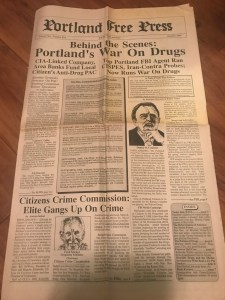
Below our second-story ramshackle office was a tortilla chip factory where (in my mind’s olfactory eye) I can still smell those fresh tortillas cooking. After being cut into chips, they would slowly make their way down a small conveyor belt where they would be bagged and often consumed, hot and fresh, by yours truly. My memories of this collective space are bound up with the smell of those tortilla chips and that of another: the fresh ink that emanated from the giant offset printing press which periodically disgorged the finished broadsheets for the long defunct, and somewhat bizarre, Portland Free Press.

Fronted by Andrew Seltzer, the cantakerous and idiosyncratic editor and publisher, the newspaper had a short run of a couple years. I was listed on the masthead as “Staff Researcher”. In late 1989, I dug up a connection between the local top representative for the Federal Bureau of Investigation and government surveillance of the left. Seltzer told me to call the local FBI office for an interview, which I did. To my surprise, I was granted an audience with the Special Agent in Charge (SAC) of the Portland, Oregon FBI, a guy named Danny Coulson. Two of us marched up to his office and were allowed to record the proceedings (where is that tape recording?). We grilled him about the FBI’s Cointelpro (Counter Intelligence Programs) of the 1960s-1970s, armed with the accusation that such efforts to “infiltrate, disrupt and neutralize” the left were continuing, in particular around groups such as CISPES, (Committee in Solidarity with the People of El Salvador). I was young and well on my way to a political philosophy that does not appear on any conventional ideological map. The interview didn’t win me a Pulitzer, but it was an interesting peek into the top office of America’s Secret Police.

img_1448

The Matrix warehouse collective was a motley crew of antiracists and anarchists, Earth First! environmentalists and anti-gentrification activists (some of whom would burn to the ground a number of rowhouses being built by developer Phil Morford, and get away with it) antiauthoritarians who had stools alloted them at the Laurelthirst Pub, cop watchers and ACT-UP militants (some of whom I joined in occupying a federal office building more than once) anti-repression activists and numerous denizens of alternative music venues such as Satyricon and the Pine Street Theatre. The Matrix was a crucible for radical politics and an incubator for a subculture of resistance that would later be dubbed, “Little Beirut.” On more than one occasion I had a tasty meal procured from dumpsters at the back of a local grocery store. On other occasions, following rolling street brawls featuring Anti Racist Action and SHARP (Skinheads Against Racial Prejudice) activists fighting racist skinheads, comrades armed with shotguns and rifles patrolled the roof of The Matrix.

Around the same time I was interviewing the Portland SAC, my comrades and I were organizing the first protests against Dan Quayle and George H.W. Bush. The two would visit Portland over the next few years for a series of very expensive, very posh, private fundraising dinners, mostly held at the Hilton Hotel in downtown Portland. Chuck Palahniuk, by the way, doesn’t know shit about any of this, and neither do the scribblers at Willamette Week. Allow me to fill you in on a few details left out of these sanitized versions of what took place. First, the earliest of these protests were conceived, planned and carried out by militants in The Matrix collective. Get that right.

The symbolic protestors of Reed College who were self identified as “Reverse Peristalsis Painters” and who swallowed ipecac and food coloring so as to vomit in red, white and blue, were a sideshow, and came much later. The main events involved something quite different: gauntlets organized at two entrances to the Hilton Hotel, through which the well heeled Republican millionaires had to travel if they wanted to eat dinner. We disrupted the fuck out of that dinner party. Projectiles of all kinds–fruits, vegetables, eggs, rocks, etc., hit their mark. Cops were unprepared for the first two events, and rolling battles took place in the streets. I know, because I was there. One group of us dressed in the manner of Teenage Mutant Ninja Turtles–straight out of the sewers. What animated us was one main objective: raise the social costs of staging such events by interfering with the material capacity of the organizers to carry out such events. Symbols and imagery were secondary.

“Everything we want is in the end of you.”

That gauntlet, by the way, was what earned Portland the moniker ‘Little Beirut’, not the kids from Reed College and their ‘shocking’ performance art. And we threw all manner of projectiles, soiling the fur coats of the rich, burning newspaper boxes and cars. For a brief moment in time, at a few intersections in downtown Portland Oregon, the rich were on the run from impending violence. You don’t see that often enough.

History, as the saying goes, is written by the victors and they write whatever necessary to justify their continued dominance. Let this missive from a ghost of antifascism past be a token of resistance to that history.

Socialism, the great revolutionist Regis Debray reminds us, “was born with a printer’s docket around its neck.”

“Writing collectivizes individual memory; reading individualizes collective memory. The back-and-forth between them fosters the sense for history by unearthing potentials within the present, creating backdrops and foregrounds; it is fundamental for the idea of socialism. When it is cold outside and the night is long, memory means that we are not alone.” “Socialism: A Life Cycle” Regis Debray, New Left Review, No. 46, July-August, 2007.

For a new generation of radicals at the barricades I ask this: What happens to a society that no longer writes or reads, but posts and records in the manner of a compulsive self-documentarian? The selective timelines and creepy sanitized nostalgia of Facebook displace historical memory. Not that history by the victors was objective to begin with, but for every Richard Hofstadter or John Lewis Gaddis there is a Howard Zinn or an Eric Foner. Who shall replace them?

Socialism was born with a printer’s docket around its neck, and a molotov cocktail in her hand.

Long Live Little Beirut.

END

Share this:

  • Click to email a link to a friend (Opens in new window) Email
  • Click to share on X (Opens in new window) X
  • More
  • Click to share on Facebook (Opens in new window) Facebook
Like Loading...

Why I Hate Stephen King And Love Stanley Kubrick

Featured

Posted by Jonathan Mozzochi in Essay

≈ Leave a comment

Tags

A Clockwork Orange, Full Metal Jacket, George Lucas, Jonathan Swift, Magic Negro, Repressive Desublimation, Stanley Kubrick, Star Wars, Stephen King, Steven Spielberg, Stranger Things, The Duffer Brothers, The Green Mile, The Shining

I hated Stephen King’s books when they came out and I was in high school. I had to read more than one, just to keep up with the pop culture references. I loathe them even more, today. For me his low point (to date) was writing the teleplay from his book, The Shining for the TV series of the same name (1997). There is no better example of King’s narcissism, hubris and corresponding lack of talent than this laugh out loud effort to ‘correct’ what is arguably the greatest horror film of all time, Stanley Kubrick’s The Shining (1980). The only thing to be said about the television version is that it is indeed faithful to King’s book, while Kubrick’s is not. But that’s exactly the point: King’s writing has always been cloying and soft in the middle, unconsciously mendacious in that uniquely ‘ugly American’ way. At once insipid and preternaturally neurotic, the horrors visited upon Stephen King’s Americans–and they are always stock Americans–are the character flaws and psychological failures of individuals, even when they take an institutional form.

This is precisely what Kubrick has never trafficked in, the melodrama and kitsch that characterize contemporary morality plays in the wasteland of genre fiction.

What Kubrick did with King’s pablum is extraordinary–he made a mediocre text obsessed (as always) with individual themes of personal responsibility and psychology into an indictment of American exceptionalism and universalism. And it was terrifying, but in ways that were difficult to verbalize.

Kubrick linked profoundly disturbing themes of child abuse, murderous misogyny and alcoholism with capitalism, racism and white settler genocide–he made the personal, political, and the political, personal.

This achievement is partially recognized through the fanciful documentary film Room 237, (2012). The filmmakers make much of Kubrick’s fanatical attention to detail, noting the frequent appearance of symbols that reference two genocides–those of Native America and the Holocaust. And I agree that the repeated appearance of certain symbols–cans of baking powder and a typewriter, for instance, were not incidental nor accidental; but intentional. Kubrick puts them there for reasons cited above.

Room 237 is an interesting homage to Kubrick’s The Shining but it doesn’t take King to task. As befitting the pay-to-play state of modern academia, it also includes a lengthy, tedious and stupid section that is incidental to the film, repeating conspiracy theories that Kubrick assisted in faking the 1969 moon landing. The film also fails to note what is hidden in plain view within the important scene that takes place in the bathroom between Jack and the ghost of the previous caretaker, Grady. Grady refers to the Black head cook, played by the iconic actor Scatman Crothers, as a “nigger.” Kubrick was as careful crafting language as he was with symbols, so that’s there for a reason, too. Jack’s mental illness is brought on not least because he craves acceptance into upper management at a resort hotel that caters to the well heeled, white and rich, who are forever dancing and drinking at a Fourth of July celebration. The price Jack must pay for admittance to the upper crust is the sacrifice of his family. The character played by Scatman Crothers is the only one trying to protect them. For King its all about the ‘demons’ of alcoholism and the ‘salvation’ of AA. To King, Crothers is the ‘magical negro’, a frequent staple of his stock and trade (The Green Mile, The Stand) but in Kubrick’s hands the character represents something much more.

King always resolves whatever conflicts he conjures within a morality play of possessive individualism. His characters–an endless parade of pop psychology tropes torn from a high school year book–are as wooden as his plots: The magical negro, the overburdened patriarch, the evil foreign interloper, the randy daughter, the undersexed milf, the touched giant, the addicted adolescent, so on and so forth. Each character a world unto themselves; all forbidden from exercising the only possible resolution to their woes–radical collective action.

King hated Kubrick’s movie because it skewered the very myths King had spent his entire literary career so passionately defending–the bourgeois family, the myth of a melting pot America, the ‘up by your bootstraps meritocracy’, Democracy vs the Evil Empire, etc.

All of this is now reappearing with a vengeance through a virulent strain of reactionary nostalgia for 1980s America, which is really the golden era of Stephen King. And he has imitators galore: Here come the amnesiac and conspiratorial Duffer Brothers, and Stranger Things, followed by Steven Spielberg and his Ready Player One. Both try and recast conformist and repressive strains of pop culture such as Van Halen and Yacht Rock, Dungeons and Dragons and Back To The Future as rebellion. The naval gazing, Wall Street speculating, anti communist computer nerds of Reagan’s America are the hero’s making America Great Again. There is a term for this, it’s called repressive de-sublimation. Look it up.

As an old ghost of antifascism I must draw the analogy: King’s entire oeuvre is to horror what the Anti-Defamation League is to antifascism, the Nature Conservancy is to ecology, or the 2017 Women’s March is to feminism. The latter the result of celebrities ‘leaning’ so hard into their ‘resistance’ they fell over the day after Donald Trump was inaugurated. Ooh. Scary!

Kubrick, while not a leftist, and probably not a feminist, was at least my kind of nihilist, unsparing and sharp, his erudite vitriol always serving to clarify relations of power, rather than obscure or justify them.

He may not have had an alternative to the world of shit within which we live, but his work helps us not mistake that world for a flower garden, which is more than one can say for all the typing Stephen King has ever clacked out. “All Work And No Play Makes Stephen A Dull Boy.”

Aside from the greatest American horror film ever made, Kubrick also made the greatest film of political satire: Dr. Strangelove or: How I Learned To Stop Worrying and Love The Bomb (1964!?!). A great satirist needs a wicked sense of humor, and I think Kubrick took some inspiration from Jonathan Swift’s, A Modest Proposal For preventing the Children of Poor People From being a Burthen to Their Parents or Country, and For making them Beneficial to the Publick (1729). You remember what that proposal was, yes?

Did Kubrick also create the greatest American antiwar film ever made in Full Metal Jacket? (1987).

A Clockwork Orange (1971) is a searing indictment of the postwar boom in youth subcultures, consumerism, social control and the inherent violence of the state.

2001: A Space Odyssey exposes every asinine iteration of George Lucas’ Star Wars as the juvenile cartoons they are. Yes, I hate Star Wars, too and I don’t care that it was originally conceived as having something to do with protesting the Vietnam War. They are all wretched films.

Long Live Kubrick!

END

Share this:

  • Click to email a link to a friend (Opens in new window) Email
  • Click to share on X (Opens in new window) X
  • More
  • Click to share on Facebook (Opens in new window) Facebook
Like Loading...

When Fascists Are Naughty Or Nice

Featured

Posted by Jonathan Mozzochi in Essay

≈ Leave a comment

Tags

fascism, French New Right, Gilets Jaunes, Laicite, Marion Marechal-Le Pen, Mark Lilla, May 1968, National Front, Populism, Viktor Orbán, White Nationalism

“Two Roads For the New French Right” by Mark Lilla, New York Review of Books December 18, 2018.

Mark Lilla has written an essay on the French Catholic Right without using the term laïcité’, an achievement of sorts. It strikes me as a bit like writing an article about The National Rifle Association and not mentioning the Second Amendment, which you can do, but only if you are Sacha Baron Cohen, and its not an article you are writing, but a satirical sketch.

Come to think of it, Lilla also manages to explore a good chunk of the French far-right ecosystem without once using the term ‘fascism’. This will not do.

A liberal heavyweight of ‘populism’ studies and a critic of identity politics, Lilla writes that something is underway in France that is more than “xenophobic populist outbursts”. A “New French Right” is being assembled by some characters with questionable democratic credentials.

But what Lilla purports to identify as a new political phenomenon is not in any sense new to veteran anti fascists. It’s only new to him. Lilla, who understands not a bit of the essence of fascism, waxes cheerily about the hip, countercultural credentials of this latest iteration of the French far-right, as though this is the first time a political movement has raided the nostalgia box of May 1968.

For instance, what he describes as a New French Right owes much to the 1980-90s writings of Alain de Benoist, an obvious progenitor of the ideas that are the focus of his essay. de Benoist and his Nouvelle Droit (New Right) of the 1980s and 1990s was also influenced by Gramsci, and I think de Benoist coined the term ‘the right to difference’ way back when. The Génération Identitaire fascists of today, with their millionaire funders behind their slick tech savvy media stunts, are similarily fascsinated with Gramsci and hegemony,  the counter culture, environmentalism, etc. So is it a new, new French Right? Let’s not go down this road, for I fear we will end up reinforcing what is already a lexical hell.

Through this critique of Lilla’s essay, I will try a different approach.

The 3rd generation neofascist from the Le Pen stable, Marion Maréchal-Le Pen, (pictured above on her Granddaddy’s lap in a Riefenstahlesque National Front poster of yor) gets a treatment that reads like a human interest piece. She is a “stylish Frenchwoman” with a “slight, charming French accent” who politely opposes what she calls a “nomadic, globalized, deracinated liberal system”. “Deracinated” translates here as “uprooted”, but it works in the other sense, too.

Lilla writes that French intellectuals dismiss these new-right Gramscians as closet National Front supporters and therefore of little political significance. He then laments that “The left has an old, bad habit of underestimating its adversaries and explaining away their ideas as mere camouflage for despicable attitudes and passions.” We probably don’t agree on what is referenced above as “the left”, but what Lilla doesn’t understand is that it is not all of the left that is guilty of this, just part of the left.

Comrades within the Gilets Jaunes (Yellow Vests) who beat the living shit out of a National Front organizer during a recent Saturday protest are not paralyzed by attempts to parse French fascism into naughty and nice. But that’s what Lilla trys to do here.

Lilla is wringing his hands, as all liberals do when they sense the salience of their ideas approaching a denouement. One solution, of course, is to hop in the sack with the fascists by calling them conservatives.

“One possibility is that a renewed, more classical organic conservatism could serve as a moderating force in European democracies currently under stress. There are many who feel buffeted by the forces of the global economy, frustrated by the inability of governments to control the flow of illegal immigration, resentful of EU rules, and uncomfortable with rapidly changing moral codes regarding matters like sexuality. Until now these concerns have only been addressed, and then exploited, by far-right populist demagogues. If there is a part of the electorate that simply dreams of living in a more stable, less fluid world, economically and culturally—people who are not primarily driven by xenophobic anti-elitism—then a moderate conservative movement might serve as a bulwark against the alt-right furies by stressing tradition, solidarity, and care for the earth.”

Note how encouraging the nice French New Right could have a positive effect on democracy. And that’s the crux of the problem here: if the liberal democratic state is “under stress” and in need of a “moderating force” then the possibility that capitalist democracy is itself the problem is out of the question. This is the key concept around which all descriptions of ‘extremism’–from right or left–are constructed. And it is dangerous for antifascists to traffic in this stupidity.

The other possibility, according to Lilla, is this:

“A different scenario is that the aggressive form of conservatism that one also sees in France would serve instead as a powerful tool for building a pan-European reactionary Christian nationalism along the lines laid out in the early twentieth century by Charles Maurras, the French anti-Semitic champion of “integral nationalism” who became the master thinker of Vichy.”

So we have a passive and an aggressive conservatism that are behind what he calls the French New Right.

Both of Lilla’s scenarios are bunk. What is underway, and has been for some time, is a continental project of neo-fascism that has outstripped and scrambled familiar liberal categories. The only way to unscramble them is to reject both using a theoretical framework that is antifascist and socialist–from the left and below.

Lillla’s second scenario unconsciously references what I call the political geography of white nationalism within which all of this is taking place. This, together with neoliberalism, are what condition and structure this ‘new’ expression of the French far right, not vague notions of a global economy about which peope feel a generalized anxiety.

Let’s call it what it actually is: a fascist international in formation.

Also, just because one political creature of the far right prefers terms like “culture war” or “social organicism” in place of “race war” and “white nation” doesn’t mean such efforts have any empirical value for antifascists. Such  rhetorical flourishes cannot help us distinguish ‘good conservatives’ from ‘bad conservatives’.

All of this is ripped from history, as when Lilla writes “This is consistent with trends in Eastern Europe, where Pew [Research Center] found that Orthodox Christian self-identification has actually been rising, along with nationalism, confounding post-1989 expectations.”

Confounding whose expectations, exactly? Most antifascists I knew in the 1990s correctly predicted a profoundly destructive unleashing of far right forces once they were freed from the Cold War parameters that had previously limited their political options. Much of this neo-fascism had a Christian bent–not surprising at all if you understood the twin pillars of fascism to be white nationalism and the Chrisitian Right. If, however, at the time you believed in the righteousness and stabilizing influence of the post Cold War American led neoliberal order–the end of history, the universal utopia of the European Union, the expansion of ‘free markets’ and civil society, etc.,–there was no real threat of a renewed fascism, only a gradual diminishing of those ancient prejudices that would accompany progress. But that was never going to be the case.

Some of us were arguing way back when that a pan-European white nationalism was developing into what can only be described as a fascist international. The collapse of the Soviet Bloc didn’t unleash long buried ancient prejudices that ‘communism’ kept artificially suppressed, as some inept anthropologist or another wrote, it burst the Cold War anti-communist consensus and opened new horizons for fascism to challenge capitalist democracies and authoritarian states alike.

Perhaps most disturbing, however, is that Lilla, together with so many of his dim witted colleagues, never tire of fretting about the ‘anxiety’ and ‘xenophobia’ that supposedly accompanies (excessive) immigration. Exhausted from such intellectual turbidity, they have nothing left for an analysis of why people from the Global South move northward. To do so would mean bringing up the pulverizing wars, economic super exploitation and social dislocation that is always justified, when it is even acknowledged, by a zero-sum racism that says, effectively, “that’s the nature of the nation state. You can’t change that, only fight for your piece of the pie within it.” That successive French governments and corporations have played no small role in prosecuting these wars for profit and conquest is totally ignored.

In any case Lilla gets it backwards: immigration doesn’t drive xenophobia. The de facto racism of the French state (or American) and its beneficiaries drive the manufacture of immigrants, creating the finished product that becomes refugees. It’s a global killing machine, with an engine that uses humans as fuel. Liberals are incapable of getting this, which is why Hillary Clinton recently floated her ‘tough on immigration’ proposal, clearing the way for Chuck Schumer and Nancy Pelosi to offer Trump $1.5 billion for construction of his border wall. Will Democrats provide a ceremonial signature brick in that wall? How convenient and despicable, yet predictable and predicted. But I aggress.

As everything continues to slip sideways, the ground shifting beneath our feet, yesterday’s comrade today’s foe, everyone is reaching, struggling to capture what the fuck is going on. Lilla’s fumbling about illustrates my point: precisely when everything appears to be up in the air, fascism begins to thrive and has an opportunity to arrive.

“In countries as diverse as France, Poland, Hungary, Austria, Germany, and Italy, efforts are underway to develop a coherent ideology that would mobilize Europeans angry about immigration, economic dislocation, the European Union, and social liberalization, and then use that ideology to govern. Now is the time to start paying attention to the ideas of what seems to be an evolving right-wing Popular Front. France is a good place to start.”

No, it’s not a “right-wing Popular Front”, but a fascist international.

“The prerequisites for a European Christian nationalist movement may be falling into place, as Hungarian president Viktor Orbán has long been predicting.”

Again, this is fascism in formation and we don’t need a Hungarian dictator to point it out. Lilla has no problem expressing awe for the supposed prognosticatory powers of Orbán, but he can’t bring himself to say as much about antifascists who have predicted as much for thirty years. Orbán, by the way, isn’t only ‘predicting’ such a social transformation, he’s actively bringing it about. That’s called a self fulfilling prophecy, not a prediction. And as long as academics such as Lilla continue to use the framework of liberalism vs populism to try and apprehend 21st century fascism, and comrades on the left ape that analysis, then Orbán and his fascist humunculi will be rendered as oracles, rather than the fascist meat sacks they actually are.

It’s good that Lilla is reaching for a way to apprehend this transformation of the European Right, but trapped as he is within the sociology of ‘populism’ and the liberal assumptions that go with them he does not have much to offer.

Yanis Varoufakis and Bernie Sanders are fumbling in a similar manner with their newly launched ‘Progressive International”, which is at once progressive, but not socialist, and international, but not internationalist. From this confused and confusing framework both continue to waffle on the so-called ‘issue’ of immigration, which is not an ‘issue’ at all, only an expression of racism vis a vis the eternal and inviolable right to movement, which it denies. In any case, about the time Lilla, Varoufakis and Sanders get their shit together to confront the so-called ‘populist threat’,  the terrain has probably shifted again underneath their feet.

Academics and their postmortems.

END

Share this:

  • Click to email a link to a friend (Opens in new window) Email
  • Click to share on X (Opens in new window) X
  • More
  • Click to share on Facebook (Opens in new window) Facebook
Like Loading...

Correlations

Featured

Posted by Jonathan Mozzochi in Essay

≈ Leave a comment

My latest empirical research supports a strong correlation between good taste and high income levels. I just killed and ate a Facebook executive—he tasted delicious.

Share this:

  • Click to email a link to a friend (Opens in new window) Email
  • Click to share on X (Opens in new window) X
  • More
  • Click to share on Facebook (Opens in new window) Facebook
Like Loading...

No Wall, No Border

Featured

Posted by Jonathan Mozzochi in Essay

≈ Leave a comment

I wrote the following, last May, as part of a speculative fiction piece.

“June 1, 2018–The Summer of The Dancing Exodus

The Summer of 2018 begins with blistering heat waves and thousands of refugees forcibly reopening the land route through the Balkans and Greece; the restart of the migrant caravans on both sides of the U.S.-Mexico border; and, a deepening of militant memorials to the Nakba. With these signature developments the three great movements of people in the global south begin to coalesce.

June 5, 2018–Discourse

Slogans of ‘Family Reunification First’, ‘We Are All Refugees’, ‘On Demand Housing’ and ‘No More Work, So You Can Play’ begin to be shouted by wild-eyed subversives from makeshift pulpits.”

“Here, it seems, framing the right of movement in terms of fundamental human rights and survival begins to outstrip notions of charity, for which one is expected to be grateful, and access, which must be earned.”

“June 25, 2018–The Worm Turns

ICE raids in the U.S. begin to be met by unruly crowds of mothers and children. Street gangs begin targeting enforcement agents. An ICE picnic in a Texas park, replete with silhouettes of sprinting ‘illegals’ that participants shoot with paint guns, is demolished by protesters.

Thousands willfully obstruct ICE raids on meat packing plants in Illinois, Tennessee and Ohio, blocking armed raiders access to their targets.”

While my timeline may be a bit off, such fervid speculation has not been entirely off base.

From the New York Post November 25, 2018

“US Border Patrol agents fired tear gas to repel rock-throwing migrants who tried to storm through a border fence separating California and Mexico Sunday…”

The confrontation came after a caravan of several hundred Central American migrants — including women pushing kids in strollers — overwhelmed Mexican cops standing guard near the San Ysidro crossing that links San Diego with Tijuana, Mexico.

The group breezed by the blockade, carrying hand-painted Honduran and American flags and chanting, “We are not criminals! We are international workers!”

From the Washington Post

“Singing ‘Amazing Grace,’ a church surrounded an ICE van to stop an arrest. 27 were jailed.

And from a post on my webpage Mozzochi.wordpress.com from a few weeks ago:

“Border attacks need manse occupations. The next complimentary phase will be housing and rent protests–mass non violent direct action aimed at palatial estates, penthouses, resorts, yacht and golf clubs. Anywhere the elite live, reproduce and recreate.

Finally, from the NYT

“But Mr. Trump’s dystopian imagery has clearly left an impression with some. Carol Shields, 75, a Republican in northern Minnesota, said she was afraid that migrant gangs could take over people’s summer lake homes in the state.

“What’s to stop them?” said Ms. Shields, a retired accountant. “We have a lot of people who live on lakes in the summer and winter someplace else. When they come back in the spring, their house would be occupied.”

Oct. 22, 2018

My response, from the film Almost Mercy:

Exactly…

One day we will look upon these fortresses as so much concrete and steel that had to yield to the far more powerful force of human freedom. Walls are never a guarantor of freedom, but a singular impediment to that freedom.

Share this:

  • Click to email a link to a friend (Opens in new window) Email
  • Click to share on X (Opens in new window) X
  • More
  • Click to share on Facebook (Opens in new window) Facebook
Like Loading...

Dear Max

Featured

Posted by Jonathan Mozzochi in Essay

≈ Leave a comment

Ok. You don’t like that picture. Sorry, but I do. That grin is from our kitchen sink, where I am bathing you, and we are both ecstatically happy. And I want more of those moments, together.

Please come home.

You are truly a force of nature. Your will is indomitable. You have proven, once again, that you will not be denied. Rather than endure another group meeting, you fled through a bathroom window, out into a hellscape with freezing temperatures and a massive toxic cloud of smoke from the Camp Fire–only a few miles north of you, with no money and a location you were totally unfamiliar with. After 24 hours on the run, I hope you have reached a safe haven.

Time to come home.

You have a wonderful character trait I lack: physical bravery. I am brave with my thoughts, in speech and writing, but a coward in body.

But you are so powerful and beautiful that sometimes we just hold you in awe. And that can be frightening, because that same unbounded courage can lead you to act without self regard. You hurt yourself. And we need to work on that–you and I–because I do that, too.

Time to get home.

You are loved. We miss you. Please come home. Your extended family is here for you.

Stay away from the shit. You know what I mean. Have your fun–you have earned it, in a peculiar sort of way. But go easy on your mind and body–chill, but don’t turn to the shit. If you have already, make the call. Right now.

I love your fierce loyalty and incipient anarchist contempt for authority (ask me what I mean by that later). But your loyalty to family and friends means listening to them. And all of your most important family is saying,

Get your ass home.

Make the call, soon. Or at least let me know you are ok, and we can negotiate a pick up.

We can add this to your roll call of shenanigans.

Another bed time story you can tell your children, when they are home with you, safe and warm.

I love you more than life itself.

Please come home.

Pops.

P.S. It’s Sunday, I won’t be working. I’ll be watching my version of the Super Bowl–match seven for a stake of the World Chess Championship. It will be a six hour thrill ride for me. But it could never compare to a call from you. Call me, come home.

Love you more.

Pops.

Share this:

  • Click to email a link to a friend (Opens in new window) Email
  • Click to share on X (Opens in new window) X
  • More
  • Click to share on Facebook (Opens in new window) Facebook
Like Loading...
← Older posts
Newer posts →

Subscribe

  • Entries (RSS)
  • Comments (RSS)

Archives

  • February 2023
  • December 2021
  • August 2021
  • July 2021
  • May 2021
  • January 2021
  • November 2020
  • October 2020
  • September 2020
  • August 2020
  • July 2020
  • June 2020
  • May 2020
  • April 2020
  • November 2019
  • September 2019
  • August 2019
  • July 2019
  • June 2019
  • May 2019
  • March 2019
  • February 2019
  • January 2019
  • December 2018
  • November 2018
  • October 2018
  • September 2018
  • June 2018
  • March 2018
  • February 2018
  • January 2018
  • October 2017
  • May 2015
  • April 2015
  • November 2014
  • July 2014
  • December 2013
  • October 2013
  • August 2013
  • July 2013
  • June 2013

Categories

  • Book Review
  • Essay
  • Fiction
  • Memoir
  • Movie Review
  • Podcast Review
  • Portland Anti-Fascist Archives Project
  • Rant
  • Snippets

Meta

  • Create account
  • Log in

Blogs I Follow

  • Counting Crowds
  • Rain Coast Review
  • birchsays
  • BRAINCHILD
  • In Dianes Kitchen
  • Being Zab
  • chrislondon.org
  • Wandering Ambivert
  • The Decolonial Atlas
  • Site Title
  • HARD CRACKERS
  • R.J. Slater
  • ∞
  • strangeparadisehq.wordpress.com/
  • Work With Lapo
  • rajchandran2013
  • Table 41: A Novel by Joseph Suglia
  • Mark Bray
  • Selected Squibs, Scrips, and Essays by Joseph Suglia
  • Democracy & Good Governance

Blog at WordPress.com.

Counting Crowds

Blog of the Crowd Counting Consortium

Rain Coast Review

Thoughts on life... by Donald B. Wilson

birchsays

BRAINCHILD

gehadsjourney.wordpress.com

In Dianes Kitchen

Recipes showing step by step directions with pictures and a printable recipe card.

Being Zab

The Storyteller (Qissa-Go)

chrislondon.org

Wandering Ambivert

The Decolonial Atlas

Site Title

HARD CRACKERS

R.J. Slater

educator, writer, photographer

∞

strangeparadisehq.wordpress.com/

A hotchpotch of random stuff I'm working on... articles, songs, writing/YouTube projects

Work With Lapo

rajchandran2013

4 out of 5 dentists recommend this WordPress.com site

Table 41: A Novel by Joseph Suglia

Mark Bray

Historian. Organizer. Writer.

Selected Squibs, Scrips, and Essays by Joseph Suglia

The Web log of Dr. Joseph Suglia

Democracy & Good Governance

Building A Better World

  • Subscribe Subscribed
    • Ghosts of Anti-Fascism Past
    • Join 35 other subscribers
    • Already have a WordPress.com account? Log in now.
    • Ghosts of Anti-Fascism Past
    • Subscribe Subscribed
    • Sign up
    • Log in
    • Report this content
    • View site in Reader
    • Manage subscriptions
    • Collapse this bar
 

Loading Comments...
 

    %d