• Home
  • About Jonathan
  • Essay
  • Fiction
    • Rant
  • Memoir
  • A House Divided, Full of Secrets: Kid Lit., Conspiracies and the Bohemian Club

Ghosts of Anti-Fascism Past

~ Essays. Memoirs. Rants.

Ghosts of Anti-Fascism Past

Tag Archives: fascism

Left Woos Right: Glenn Greenwald’s Pink-Brown “Populist” Alliance

Featured

Posted by Jonathan Mozzochi in Essay, Podcast Review, Rant

≈ 1 Comment

Tags

Black Lives Matter, fascism, George Floyd murder, George Wallace, Glenn Greenwald, Krystal Ball, left-wing populism, Nathan Robinson, Reagan Democrats, Right-wing populism, TINA, Tucker Carlson

Introduction

This is a deliberately splenetic critique of an Intercept Podcast hosted by Glenn Greenwald that aired on June 25, 2020, entitled “Should the Populist Left Work With the Populist Right Where They Have Common Ground or Shun Them?” Along with Greenwald as a not-so-disinterested-host, the podcast features Krystal Ball and Nathan Robinson. Since 2018 Ball has promoted a left-right “populist” convergence through the television show Rising, which she co-hosts with right-winger Saagar Enjeti. The two debate topical fare “Crossfire” style (arch-paleoconservative Pat Buchanan was an original “Crossfire” host in the 1980s, a noteworthy historical reference here). Ball and Enjeti also co-authored The Populist’s Guide to 2020: A New Right and New Left Are Rising, released in February 2020. Robinson is the editor-in-chief of the socialist magazine Current Affairs, arguably the most unfortunately named socialist magazine in the history of socialist magazines, but a socialist magazine nonetheless. He wears funny outfits but is an articulate reform-minded socialist.

This debate was ostensibly prompted by Robinson’s article in Current Affairs “Isn’t Right-Wing Populism Just Fascism?” but has been ongoing ever since Greenwald first appeared on Tucker Carlson Tonight a few years ago. Given Carlson’s growing status as a more authentic neo-fascist alternative to Trump, it’s of no small importance that we try and understand how efforts to engage with him are utter folly. I think both Greenwald and Ball argue for what amounts to a ‘pink-brown’ alliance, a potentially disastrous response to the ongoing collapse of the center in American politics. Robinson’s critique of Greenwald and Ball is largely correct, although because he upholds much of the language and theoretical framework of “populism” rather than discarding it altogether, his response is somewhat misguided. I think there is an alternative to all three of these pundits, but it can only be conceptualized by challenging the basis from which Greenwald and Ball base their politics. Robinson doesn’t quite do this; hence the need for this essay.

To Robinson’s question “Isn’t right-wing populism just fascism?” the short answer is: Fascism is fascism; populism isn’t anything at all (at least not in 2020). That means the short answer to Greenwald’s question “Should we work with or shun them?” should be: We should crush them.

But I’m fond of long answers.

Glenn Greenwald is a litigation attorney; his worldview is steeped in laws, constitutionalism, and abstract theories of rights. This bourgeois legalism can provide powerful critiques of the political economy of capitalism, but too often in America it is also blind in the white eye. For instance, Greenwald the activist helped found and lead The Intercept, an important investigative journalism project. But, Greenwald the attorney has also represented in court neo-Nazis such as Mathew Hale. Anti-fascists understandably have a problem with this. Greenwald thinks such professional conduct is a testament to his fidelity to equal access under the law. We think it’s collaboration. This contradiction is not unique to Greenwald, it is the case with all celebrity intellectuals, entertainers, and liberal idealists. On principle we should figuratively hammer those who would sacrifice lives on an altar of abstract rights.

Greenwald is also preternaturally clever. If one accepts his premises (sometimes unstated) it’s difficult to argue his conclusions. Therefore, we need to challenge the foundation of his framework to show why the coalition-building he and Ball are proposing involves a disastrous politics of the pink and brown.

It’s important to note that “pink” here means blue-dog, liberal or social Democrat, not LGBTQ+. “Brown” means far-right, white nationalist, and fascist. Red is far-left (not Republican) and denotes revolutionary socialist, communist, and anarchist politics. With me? The dangerous overlap here is not “red-brown” but “pink-brown”; between disaffected (white) Democrats, and far-rightists. In terms of historical precedence think George Wallace or Reagan Democrats. Greenwald and Ball want to break out the beer and bratwurst and discuss “legitimate grievances”; I want to destroy their organizations, from the top down, and thereby their capacity to organize, even function. By doing so we can also make space for a good many of their rank and file to become anti-racists, anti-fascists, even raging leftists.

Part of what Greenwald will not accept is that many radical conservatives have moved into a more revolutionary camp and prefer an eliminationist form of actually existing capitalism. Such a radical turn means that when they inveigle against “elites” or “foreign wars” they are not reinvigorating “populist” democracy or helping constrain American imperialism. This is not an opportunity for cross-class coalition building, nor is it a component of a “popular front” against fascism. It is one important aspect of a burgeoning 21st-century fascism in formation. It must be fought, not finagled.

Greenwald’s TINA (There Is No Alternative) 

Greenwald introduces the podcast exchange as follows:

“For me, the starting point has to be the current state of left-wing populism. I don’t think that it can be reasonably disputed that left-wing politics in the United States does not claim a majority of people which support it. By which I don’t mean that left-wing populism has no views which garner the support of a majority of people. Left-wing populism does have key views, such as medicare for all and raising the minimum wage and even to some extent universal healthcare that garner substantial support among the entire U.S. population if not a majority which means it has broad appeal beyond its left-wing precepts. But, left-wing populism as a movement, as an ideology, as a philosophy, does not claim anywhere close to a majority–nowhere near a majority among people in the United States claim to be leftists or left-wing populists…That means in order for it to implement its policy goals–which has to be the ultimate objective of politics, otherwise, politics is like art or poetry, something one does for the art of it, or the purity of it, or the self-enjoyment of it, but not actually to change the world for the better in meaningful ways through legislation and reform. If that is the goal (which it has to be) it means that left-wing populists have to form coalitions and alliances with other people in order to form majorities. And the question becomes, in those numerous instances where left-wing populists can’t form a majority with democratic corporatists and democratic imperialists and democratic centrists–and oftentimes they can’t, which is why there is such a cleavage…the fact that there are so many instances where there is no way to form a coalition or a majority with democratic centrists because they oppose the agenda of left-wing populism prompts the question: With whom are left-wing populists going to form coalitions and alliances on an issue-by-issue basis–not permanently, not for every issue, but on an issue-by-issue basis where there is common ground, if there is a prohibition, as Robinson argues there should be, in that article at least, where he said: “the left should have nothing to do with that movement?” With whom is the left-wing going to form alliances and coalitions if not right-wing populism?”

This is a clever, but fatuous, elevation of congressional politics at the expense of other forms of political struggle. Social movements like Black Lives Matter are expected to reach their apex of development when politicians are all in Kente cloths; anarchist mutual aid networks, worker militancy, housing occupations, teacher and health care worker strikes, and much more are completely ignored here. Nothing exists outside “serious politics.” Greenwald is trying to defend a sweeping claim about how power functions in a capitalist society by reducing that power to a very narrow expression of it: legislation in the congress between donkeys and elephants. Furthermore, the American political spectrum is notoriously tilted to the right, at least in part because there has never been a labor party here; just two capitalist parties. That’s a long-term, built-in, structural disadvantage to working-class, multi-racial, movements that must be overcome. We can overcome it, but not through elections. Social movements often drive and move beyond electoral politics, as is now the case with the uprising following the murder of George Floyd. Greenwald and Ball seem to think the best response to cops murdering Black people is making tactical alliances with Rand Paul and Josh Hawley.

So Greenwald’s first premise is that electoral politics is the only form of politics; everything else is just art or self-expression. Notice also that throughout this debate so-called ‘left-wing populists’ are limited to two choices: pacts with corporate democrats or those with right-wing populists.

Anti-fascists refuse both options.

My central argument is that one cannot practice what Greenwald and Ball are proposing and expect to defeat fascism and build an alternative to capitalism. Of course, if one’s goal is majority control of both chambers of Congress, then none of this applies. If you accept his premise here, it’s hard to reject his conclusion. Don’t accept the premise. Greenwald and Ball inhabit a thought world with self-limiting horizons. Our politics are excluded from their world of “There Is No Alternative”; what is hardly ever acknowledged is that this engenders a built-in preference for and susceptibility to the siren songs of the far-right. When the center of what is acceptable debate between the two capitalist parties has moved so far to the right that it includes fascist ideas, the solution is not to accommodate such ideas, but to reject them. Fascist ideas have moved from the margins to the mainstream of that electoral consensus precisely because the “dead center” of liberalism and conservatism is bereft of solutions to today’s crises. They fear the Black-led uprising more than they do fascism.

One of the strongest arguments to be made against cooperating with the far-right is this: forging alliances with them — tactical or otherwise — precludes movement building that is genuinely multi-racial, working-class, and that promotes left-unity.  The far-right is so steeped in eliminationist and accelerationist politics as to make the tactical alliances Greenwald and Ball so cherish a fool’s errand. To court allies among fascists is to court disaster for people in their crosshairs.

Elsewhere in the podcast, Greenwald poses a hypothetical union member who believes in workers over management, medicare for all, raising the minimum wage, and is against free trade agreements because of offshoring. On the other hand, this worker is also a social conservative — pro-life, not LGBTQ positive, and favors restrictive immigration policy. Are they to be shunned? Greenwald doesn’t mention anti-Black racism, police brutality, or the carceral state in his convenient equation. He doesn’t mention this hypothetical (white) worker’s support for “law and order” expressed through “Back The Blue” bumper stickers. I think the omission is instructive. This podcast aired on June 25, 2020, while protests were still ongoing (as they are now) across the United States. While statues to confederate generals and colonialist masters were being hauled down throughout the country, Greenwald and Ball persisted with their fantasy of building a multi-racial, working-class movement without confronting racism and white supremacy while one was underway all around them. Instead of turning to that movement, they mistook a phantom constituency for a new “agent of history.”

Greenwald’s Exemplar of Right-Wing Populism

But Greenwald isn’t just talking about breaking bread with regular white workers; he’s got something very particular in mind when he uses the term ‘right-wing populist’:

“For this discussion to be profitable we need to have an understanding of what right-wing populism is…To me, the most vivid and comprehensive expression of right-wing populism in the United States is the rhetoric and the branding of the 2016 Trump campaign. Not the reality of the Trump presidency, which deviated radically and abruptly from what the rhetoric and branding of what the campaign was, but the campaign itself. What did the campaign in 2016 say that it stood for, particularly when engineered by Steve Bannon in order to attract enough voters, particularly in the industrial Midwest, in order to win the election…?”

What it stood for then, as now, is “America First”: a reinvigorated racist nationalism that is the core of a 21st-century fascism-in-formation. Greenwald argues that Trump “deviated radically and abruptly” from Bannon’s authentic populist program. This amounts to a distinction without a difference. Here, both the thing he is trying to measure and evaluate together with the ruler and criteria which he uses to measure it, are both flawed. Bannon and his ilk engineered Trump’s campaign from largely the same template Trump is now governing, setting aside the wild card of the global impact of COVID-19. In other words, there has been no substantive break between promises and results that don’t always occur when either capitalist party secures the executive. Far more important is the continuity that persisted from campaign to governing regime: building the wall and ICE raids, vicious anti-Black racism, organized misogyny, hyper-nationalism, more advanced forms of kleptocracy and cronyism, together with an iron-fisted fidelity to the economic imperatives of Wall Street, Silicon Valley, and corporate America. Even if one were to hold that there is a meaningful difference between Bannon’s “populism” and that of Trump, the proposition that the former offers viable terrain for cooperation is reprehensible.

There should be no need for a quote here from Bannon to demonstrate his moorings in the white nationalist, alt-right political universe.

The question becomes, what are Greenwald and Ball up to?

Greenwald’s Pink-Brown Alliance

Many leftists are accustomed to hearing about “red-brown” alliances, the most dreadful example captured in the slogan “After Hitler, Our Turn,” popularized by the Stalinized communist left in 1930s Germany. There was, of course, no “turn” for the left “after Hitler” because the left, then everyone else, was obliterated, literally; this being perhaps the single most important lesson learned for what happens after fascism attains state power. That slogan flowed from the equally disastrous Stalinist slogans of “socialism in one country” and “social fascism,” the former a betrayal of proletarian internationalism and the latter a refusal to distinguish between routine capitalist rule and that of a fascist dictatorship. Today there are numerous examples of some radical leftists adopting a political framework that involves much overlap with far-right and even neo-fascist movements. One has only to look at the degenerated publication of the U.S. Socialist Worker’s Party organ The Militant, or the bizarre syncretic monstrosities like Spiked Magazine and Russian “National Bolsheviks” to see such overlap. When anti-racism and anti-fascism are discarded as central principles that should guide revolutionary praxis, such alliances become possible. The term ”campist” comes to mind here, a largely anarchist critique of socialists and communists who allow their political praxis to be overly influenced by states, many of which are not on the left (e.g., Russia, Syria). Geopolitical priorities become over-determined by conflicts with the United States; “anti-imperialism” devolves into a reflexive “anti-Americanism” itself enmeshed within the priorities of those reactionary states, where they risk becoming nothing but a creature of them. Max Blumenthal and The Greyzone come to mind here. This political tendency on the left is real and needs to be countered, but what we are addressing here is different.

Together with vigilance against such developments, we need to be equally aware of “pink-brown” alliances. After all, it was the German Social Democratic Party (SPD) that carried out the assassinations of Rosa Luxemburg and Karl Leibnicht in 1919. From then on the leadership of Germany’s largest worker’s party would periodically forge its own alliances with right-wing reaction which also contributed to a failure of the left to unite against Nazism. The leadership of the social democrats considered there to be no appreciable difference between Nazis and communists, a political stupidity that was epitomized in posters from the Iron Front that featured three arrows targeting the Conservative Franz von Papen, NSDAP leader Adolph Hitler and Ernst Thälmann, leader of the German Communist Party (KPD). The Iron Front was demobilized by the SPD leadership in the run-up to the Nazi ascension to power while at the same time the communists considered there to be no appreciable difference between social democrats and Nazis. Any front against Nazism — popular, united, or otherwise — became impossible.

Today’s purveyors of the “populism” thesis for understanding political power have learned nothing from history. Their attempts to forge an impossible unity between fascists and social democrats will only demobilize constituencies that cannot possibly benefit from such a project.

Greenwald thinks there is a realignment underway within the American body politic that has permanently rejiggered the familiar right-left spectrum. This realignment now pits “populists” of the right and left against the “establishment” or “insiders” of the center. Such claims are not new. They are, in fact, stock and trade of the far-right. While Greenwald doesn’t argue that all politics is now “populists” vs. “elites”, he does argue that many things can be grasped through this lens and that now is the time for leftists to forge alliances with what amount to fascists on the right. He’s wrong.

The Dead Center

For all his radicalism, Greenwald is committed to liberal, constitutional, democracy as he understands it. The problem he faces, and it is the same for everyone in the “dead center,” is that the ground underneath him is shifting, although not in the ways he thinks. Greenwald outlines what he thinks has changed in American politics over the past few years and how his political analysis accounts for that change:

“What all of this illustrates to me is that while there are some political debates that are still best understood by Republican vs. Democrat, or left vs. right — things like social issues, reproductive rights, and LGBTQ rights, crucial political issues to be sure–and more substantive policies such as the environment and climate where there are still differences (meaningful ones) that are understood best by the division between Republican vs. Democrat, there are numerous issues where the establishment wings of the Democrat and Republican parties have more in common with one another than they do with the populist wings of either party; where left-wing populists have more in common with right-wing populists than they do with what has long appeared to be their closer allies in each party. And what this illustrates is that while some politics is still best understood and Republican vs. Democrat, much of it is not. Much of it is better understood as pro-establishment vs. anti-establishment, insider vs. outsider.”

Here Greenwald doesn’t use a race-class-gender framework to guide his analysis of political struggle, and it shows. This leaves him susceptible to pitchfork and torch rightists like Tucker Carlson. The American far-right has always framed their politics as “anti-establishment” and “outsider vs insider” but there should be an unbridgeable gulf between what they mean and what we mean by those terms. Greenwald thinks otherwise.

“… Is it the case that the views of right-wing populists on immigration, on race, and on other issues that are so pernicious and odious and anathema to left-wing populists that working with them ought to be morally impermissible? If that is the case, the question becomes: Number one, how is the left-wing ever going to implement its agenda or even attract converts if it refuses to engage constructively with [them and instead] scream at them and call them Nazis and fascists and racists but actually engage with them and try and find common ground? And it leads to the [second] question: Why is it that the pernicious views of the populist right render them off-limits for engaging with them in any kind of constructive or issue by issue alliances or coalition but that the hideous and horrendous views of the corporatist and imperialist democrats doing regime change wars in other countries, serving the interests of Wall Street and Silicon Valley at the expense of workers–why are those hideous views that so many Democrats have [not off limits]?”

No. 1: These “populist” Republicans Greenwald is so enamored with are pockmarked by pathological fetishes for private property, racism, and fascism. If it waddles like a pig, oinks like a pig, and roots like a pig, it is probably a pig. Stop calling it a duck.

No. 2 The left will never implement its agenda through congress. We fight for a revolution, not a bill.

No. 3. Both fascists and capitalists are our mortal enemies. Greenwald is trying to render what is a structural deformation of the American political system into a moral failure practiced by progressives: a double standard for which he offers the opposite as a solution. The corporate Democrats are worse! It’s lesser evilism in reverse. But Greenwald knows the Democratic Party is a capitalist party and therefore prefers to make alliances with the business class. Only someone who doesn’t understand this would be vexed by the altogether routine and inflexible pro-corporate policies and legislation favored by Democratic party elites. Congressional politics is generally limited to disagreements among capitalists that are structured to exclude arguments put forward by movements that challenge this. See: Sanders Campaign for president 2016, 2020. The only question is why someone would continue to try and make a “dirty break” with the Democratic Party so as to smuggle in democratic socialism. That will have to wait for another time.

It is also important to point out that what Greenwald calls “right-wing populism” is really an American hybrid of libertarianism and Christian nationalism. It is the worship of private property and the Cross wrapped up in the American flag. These two ideologies constitute the most important pipelines that convey raw political material to a more toxic refinery called 21st Century fascism. The most dynamic center of gravity for this emerging fascism is precisely what Greenwald thinks is “right-wing populism”. It is right-wing, but it is in no sense an expression of “the people.” For example, Peter Thiel is by no stretch of the imagination a “populist”; he’s a powerful tech billionaire inspired by ubermensch, dark enlightenment elitism. He believes capitalism and democracy are antithetical, and that the former should vanquish the latter. Yet Thiel is an important, even central, figure within the “populist” firmament. If that’s the case, then how can one argue for tactical alliances with that political tendency? So too with Rand Paul, the Senator who has repeatedly opposed anti-lynching legislation. Paul is a tea party libertarian — a crypto-fascist by any other name. Wouldn’t such an alliance be predicated on a rupture with other constituencies (immigrants, Black people, undocumented workers) because their very existence is at stake? Yes, it would.

Greenwald always uses the term “populism” in ways to favorably contrast it with “establishment” centrism. What he won’t acknowledge is that the term has its roots, and not a small amount of limbs and branches, within Cold War sociology and political science and the singular contention that all politics can be understood as an eternal contest between democracy, on the one hand, and totalitarianism, on the other. This political tradition argues that democracy is fundamentally compatible with capitalism; fascism, anarchism, and communism are not. There is no anti-capitalist option according to these precepts, only a defense of liberal democracy (capitalist democracy) through a never-ending war against “extremism.” A major problem with that framework is that by excluding left options to capitalism, the “anti-totalitarians” will often turn to right-wing authoritarians or outright fascists to solve the recurring problems that capitalism generates. They routinely sacrifice democracy and equality in favor of private property and inequality. While Jeanne Kirkpatrick articulated this best from the conservative right as a distinction between “totalitarian regimes” vs. “authoritarian regimes” and a marked preference for the latter, most Democrats sing the same song, if in a different key. When Greenwald argues that right and left “populists” need to work together he’s arguing against that long political tradition of corporate centrism, but in favor of alliances with fascism. His break with centrist orthodoxy, with the iron-clad hold of the two all-but indistinguishable parties run by and for the ruling class, is to appease the far-right in the interests of strengthening the liberal center. His alternative to the domination of the two capitalist parties is to empower the most reactionary, noxious elements of one in the hopes of stabilizing the ship of state. It won’t work and besides, we want to sink it.

“Populism” here is a term used by centrists as a cudgel against “extremists” of any political stripe. The term has no claim whatsoever to any analytical legitimacy and wherever one observes its use, be wary. There was, of course, a “populist movement” during the late 19th Century, but it has little if anything to do with either contemporary scholars who use the term as a weapon in defense of capitalist democracy, and even less with that vast cornucopia of political groups that have adopted it worldwide. The seminal text on the term is by Marco D’Eramo, in New Left Review (July-August 2013, No. 82) “Populism and the New Oligarchy.”

The Pitchfork and Torch Crowd

In discussing Tucker Carlson, Greenwald makes the laughable claim that it is often only Carlson who is willing to attack corporate Democrats.   Greenwald plays an excerpt of a Carlson show where he rails against “banking” and “foreign wars,” “the private equity model” and “a ruling class”. This Greenwald believes to be a “questioning the fundamentals of capitalism” one can’t find elsewhere. But white nationalists and Christian Patriots would agree with these descriptions of ruling class power; they just believe such power is Jewish and arrayed against white people. Greenwald is too smart to be unaware of this fact; therefore he just dismisses it. He doesn’t think it’s relevant. But it is. His appearances on Carlson’s show are loathsome. Greenwald deliberately misrepresents Carlson’s “populism” by white-washing it; downplaying or disregarding altogether the vicious anti-Black racism that is a core value of all white nationalists. Greenwald also describes Carlson as an important voice against “regime change” in Syria, Iran and Venezuela. He apparently regards Carlson as an anti-imperialist, a complete denigration of the term Lenin developed a century ago. Of course all of this debate about American power abroad amounts to nothing more than counterposing the boots on the ground option vs. the Qassem Suleimani option; it is an argument among capitalists about how best to exercise that power abroad, not dismantle it. What Carlson articulates flows from the perceived interests of the one unit of analysis that for him rises above all else: the (white) nation. Carlson is best understood within this political tradition, and as such his brand of politics is beyond the pale because it implies the jettisoning of any meaningful antiracist praxis.

Robinson correctly points out that both Greenwald and Ball exaggerate areas of agreement between “populisms” to suit their argument, noting that in actuality such overlap is virtually non-existent. Greenwald, ever the attorney, then tries to pigeon-hold Robinson into supporting “cooperation on principle.” Robinson responds that on principle, yes, there can be cooperation; but it doesn’t matter because they are “on principle” too radically different. Our principles don’t overlap enough with theirs to justify cooperation. Rand Paul, Robinson correctly asserts, is not a “populist” but a “tea party libertarian”.

I find it remarkable that at this juncture of the podcast there is only mention of Black Lives Matter in relation to right-wing calls to invoke the Insurrection Act to crush the rebellion. Libertarians might well signal opposition to the state using the military to quell dissent, only to prefer cops, III Percent militias, and Oath Keepers do it instead. The three podcast presenters here evince no real apprehension of what is happening on the streets; they seem disconnected from the powerful protests underway and the attendant reinterpretations of social reality that go with them. This powerful multi-racial, poor and working class social movement is a threat to both traditional capitalist political control (liberal and conservative) as well as far-right alternatives to that consensus. A pink-brown alliance would serve to short-circuit our most advanced revolutionary forces and assist the capitalist state as it faces what could be a genuine existential crisis.

Greenwald gives Trump’s anti-NAFTA and anti-WTO political stances both too much and too little weight. He ascribes far too much importance for these policy stances as somehow “pro-union” or “pro-worker” and not near enough to the core constituencies Trump seeks to mobilize through them: white workers (Steel workers, cops, prison guards, etc.) For example, with prison and cop unions, Trump is not trying to gut them; he counts on them for support. Trump’s pro-union bonafides always run through his anti-Black racism, which is as a central a precept within his worldview. When we are crying for defunding and abolition, he is doubling down on Back the Blue. Our problem is with the existence of those unions and their role in anti-Black racism and generalized repression. Those white workers are not “duped” into supporting Trump, he is fighting for their real interests as they understand them. We have to dismantle those interests, not find ways to accommodate them. It will do us no good to deny agency to right-wingers; they know who butters their bread.

Greenwald cites Missouri Senator Josh Hawley as someone ‘genuinely’ committed to challenging corporate power. This hagiography of Hawley is only possible by stripping his right-wing, libertarian, Christian worldview from the individual legislation that he does or doesn’t support and ignoring the pipeline to fascism within which it all flows. Greenwald is intent on distinguishing between authentic and ersatz populists, then between right-wing populism and (classical) fascism. Robinson chimes in on the distortion of Rand Paul:

“Wait. If Rand Paul is a part of this…[then] the whole premise that…right-wing populism is a kind of combination of left economics and social conservatism just falls apart completely, because Rand Paul is a radical free market libertarian.” In other words there is no “economic populism” to work with there. As usual, one needs to add that he’s a fucking racist.

Greenwald believes that this “right-wing populism” represents a “serious ideological rift” within the Republican Party and conservatism in general and that this division can be capitalized on. Robinson thinks it is politics as usual — both are wrong. There is a rift within the Republican Party between corporate conservatives and a growing fascist wing. That divide can be capitalized on by attacking both and developing our movement but no element should be opportunistically engaged with. At least not without dire consequences for a revolutionary movement of the left.

Krystal Ball’s contribution to the debate revolves around more distinctions without differences: between leaders and a base, racists and non-racists, left economics and right culture. Ball states she is in favor of a multi-racial, working class coalition and is a social democrat. I take her at her word, and therein lies the problem.

Ball argues that too many Democrats are influenced by neo-liberalism and “identity” politics and hold up “representation” alone to keep their coalition active. The policies and legislation they support do not offer substantive change. For corporate and imperialist Democrats it is most important to keep the multi-racial working class in line following the dictates of Wall street and Silicon Valley. You will get no argument from me here, either.

Likewise her description of Trump deliberately fanning “white racial anxiety” as a continuation of the Southern Strategy from the Nixon years, geared toward keeping large segments of the white working class in the GOP tent where it does the bidding of their corporate masters, is also spot on.

It is in her prescription for addressing that division where we find the same intractable problem as that of Greenwald. How do we get them together? They ask. Why the fuck is that even a question? I respond. I don’t want to find common ground. To Ball there is the approach of the traditional, socialist left which she describes as “shunning and condemning” vs. that exemplified by her program, which is “debating and engaging.” Then she conflates our opposition to working with the far-right with that of Hillary Clinton’s “basket of deplorables” comment. Ball makes the argument that the flip-side to leftist dismissal of poor whites is Mitt Romney’s “47% of the people will never support Republicans” elitist gotcha audible. Ball is arguing that there is a virtuous, populist (white) middle caught in between a crafty and comfortable corporate elite on the one hand and an out of touch, elitist, Bernie-bro group of professors who harbor disdain for poor whites on the other. The elitist leftists dupe people into hating racists and not capitalists. This, combined with platitudinous appeals to “honest dialogue” and straw-man denunciations of claims that all Trump supporters are Nazis, dovetails quite nicely with what I describe as the motor of fascism: that eternal struggle against ungrateful, cosmopolitan elites above and unworthy, racialized, parasitic masses below. The fire they are playing with here is the MARS (Middle American Radicals); it will burn all of us we don’t put it out. It is presently white hot and smoldering, even flaring up in places. Greenwald and Ball are playing directly into it.

Conclusion

At the very end of the podcast there is a brief discussion between Greenwald and Ball about “race.” Greenwald seeks to draw an analogy between Black civil rights and LGBTQ struggles. The passage, both breathtaking in its liberal naiveté and cringe-worthy in its historical illiteracy is worth quoting in full:

“As you mentioned, this is an amazing moment. Some incredibly significant shifts [are underway]: rapid, radical shifts in how people think about policing, how people think about race…One of the things I would compare it to is the very radical and abrupt and positive progress that was made in the course of a couple decades on how people think about same sex couples and gay rights and [how] that happened not because people were called bigots and homophobes enough times or because their churches were invaded violently enough but because just through humanitarian interaction; of people seeing that gay men and gay women weren’t these predators outside playgrounds but were their neighbors and their teachers and their relatives and their children did they start to break down those barriers that had been erected for them about how to think of their fellow gay citizens and that made them much more accepting and I think that that kind of human interaction and human engagement is always a prerequisite for finding common ground.”

He actually said “radical and abrupt and positive progress…in the course of a couple decades”. This is the pink-washing pablum issued forth by HR departments and the Human Rights Campaign as applied to Black liberation. Here, Greenwald does a triple disservice. First, his notion of LGBTQ+ rights having been won through increments accumulated over time as a feature of a generalized “progress” is an affront to all those radical activists in ACT-UP, among many others, who died for those rights in very militant ways. Secondly, the notion that such incremental progress is analogous to what is underway with the current Black uprising is painfully off base. Lastly, and perhaps most importantly, Greenwald does not believe it possible that those same rights “incrementally” won could be summarily stripped away.  Like most liberals Greenwald believes such rights, once won as a matter of capitalist modernity, are not subject to a radical and abrupt reversal. They are.

Making common cause with fascists is precisely the kind of political suicide that makes such a catastrophic reversal of rights not only possible, but probable.

END

Share this:

  • Click to email a link to a friend (Opens in new window) Email
  • Click to share on X (Opens in new window) X
  • More
  • Click to share on Facebook (Opens in new window) Facebook
Like Loading...

Bookchin, Cockburn and Libertarianism.

Featured

Posted by Jonathan Mozzochi in Essay

≈ Leave a comment

Tags

Alexander Cockburn, anarchism, anti-fascism, Black Lives Matter, communism, fascism, Libertarian, Murray Bookchin, Populism, tankie

8.22.20

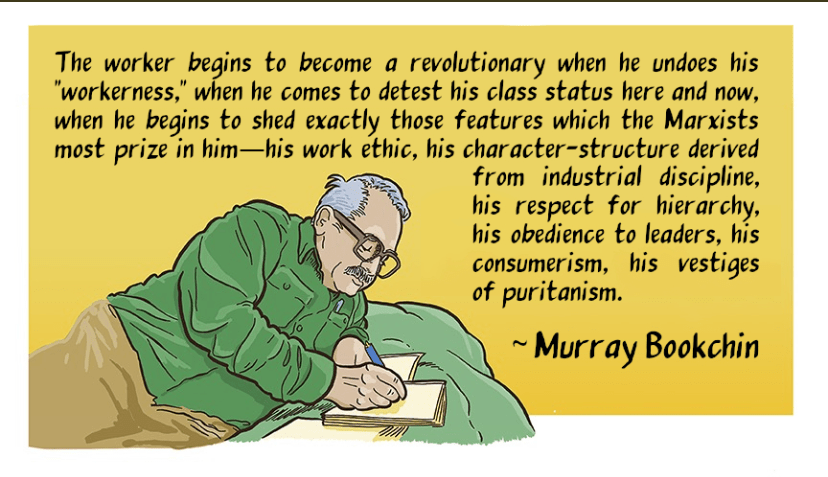
Anarchists are often at their best when they critique communists for unhealthy admiration of order and authority. This tradition is captured in the term of abuse “tankie”, which is anarchist shorthand for a communist who does not shy from bringing out the tanks to crush rebellion, like those deployed during the Hungarian Uprising of 1956 and the Prague Spring of 1968 in then Czechoslovakia. Murray Bookchin, a social ecologist, and philosopher of libertarian municipalism whose writings continue to animate leftists from Rojava to Seattle, often wrote with a profound contempt for the more authoritarian traditions found in various expressions of Marxism and socialism. If he were alive today, he would not be a “tankie”. As an anarcho-communist, I am sympathetic to many of his views. For instance, the quote below is an effective broadside against the kind of Marxism that needs cops, commissars, and soldiers to keep everyone in line.


img_2055


That’s great stuff. But there is another Murray Bookchin, a writer who, for whatever misbegotten reason, was a featured speaker at the 1978 national convention of the Libertarian Party USA in Boston, Massachusetts. The following year the party nominated the billionaire David H. Koch for Vice President. You can look up Bookchin’s presentation online. It is not his finest hour. He also contributed this to a right-wing journal.

“There was a period of time, indubitably, in Jefferson’s time, when the farmer, the yeoman—the American yeoman, standing on his land with his musket—represented a forward step for individuality. But today the millions that flow in and out of New York anonymously, through mass transportation, through the tunnels and over the bridges that lead into and out of the suburbs—these are among the most de-individualized people I’ve encountered in 57 years of living. Most of them are organization men and women and have become denuded of all personality and uniqueness. They’re figments; they’re creatures, in fact. They’re creatures of the mass media and of the corporate world that has rendered them totally homogenized and anonymous. Now already the attempt to preserve what we in America would call private property, the rights of US Steel and the rights of General Motors, has become literally a step in the direction of the de-individualization of the American people and their reduction to masses.” (Interview with Murray Bookchin Reason Magazine 1979.)

I have long maintained that libertarianism in the United States constitutes a deep reservoir of reaction completely antithetical to anti-fascist praxis. Together with Christian nationalism, American libertarianism functions as a political pipeline that transports the raw material of white reaction to the toxic refineries of 21st-century fascism. It has always had its center of gravity in the American South, where fetishes for private property and “individual liberty” run through so-called “states rights.” The entire philosophy and praxis of libertarianism are anathema to revolutionary anti-fascism. There is no bargaining with it, cozying up to it, or riding alongside it that doesn’t involve the wholesale betrayal of our principles.

Fuck libertarians.

That yeoman farmer was also a white settler, a slaveholder, a nascent bourgeois individualist, and a colonialist monster. This abstract individual is favorably contrasted with a de-individualized, homogenized, and anonymous “creature.” This contrast between the agrarian individual and the urban masses –New Yorkers in particular — between the inherent worth of the individual and the mind-numbing, worthlessness of the masses is not a part of any anarchist tradition I am very fond of. In fact, I find it repulsive. I am familiar enough with Bookchin’s later work, when he attempted reconciliation between Marxism and anarchism, to know this is not representative of his entire corpus. Perhaps he clarified such comments elsewhere? In any case, I think efforts on the part of leftists to find “common ground” with organized libertarianism are at best misguided and at worst potentially fatal to our revolution. Our time is better spent reconciling anarchism and communism, a project I think possible and worthwhile.

My problem with Bookchin is similar to my problem(s) with the late Alexander Cockburn. While Louis Proyect, the “Unrepentant Marxist” has posthumously conferred upon him secular sainthood, I’m less inclined to exalt Cockburn. His frequent attacks on the anti-racist liberal/left are now a matter of historical record; so too his veneration of the tea party as a welcome riposte to liberal identity politics. But he was blind in the white eye; he couldn’t see the bigotry at the heart of the Tea Party as anything other than unfortunate, and irrelevant, a holdover from another era. How wrong he was. As someone once noted: The past isn’t dead; it’s not even past.

One can find much in the vast body of work of Bookchin and Cockburn that is important to uphold today; there’s also a great deal there that was crap in the 1980s and 1990s and has only gotten stinkier with time. Had he lived to see the election of Trump in 2016 to the U.S. presidency, can anyone seriously doubt where Cockburn would now stand on the so-called ‘populist right’? I’m pretty sure that his anti-anti-racism and warm feelings for the so-called right-wing populists of the Tea Party era would have propelled him to make arguments similar to those now being made by Crystal Ball and Glenn Greenwald about the desirability of a right-left realignment across “populist” lines. That’s a fool’s errand.

Cockburn and his ilk could not grasp racism as anything other than labor market competition and a cynical ploy foisted on the white working class by clever elites. But racism has always been more than that, and always at the center of ruling class command and control in the United States, a structural feature of American capitalism and empire. It is a fundamental pillar of inequality, not a vestige of a bygone era.

All socialists, anarchists, and communists, whether of the “tankie” or “insurrectionist” varieties, are simultaneously anti-racists and anti-fascists; or should be. Any fundamental, lasting, and desirable change must run through Black liberation. That’s partly why we chant, “Black Lives Matter!” The other reason being, of course, that for so many people, Black lives so obviously matter so little, if at all.

END

Share this:

  • Click to email a link to a friend (Opens in new window) Email
  • Click to share on X (Opens in new window) X
  • More
  • Click to share on Facebook (Opens in new window) Facebook
Like Loading...

Image

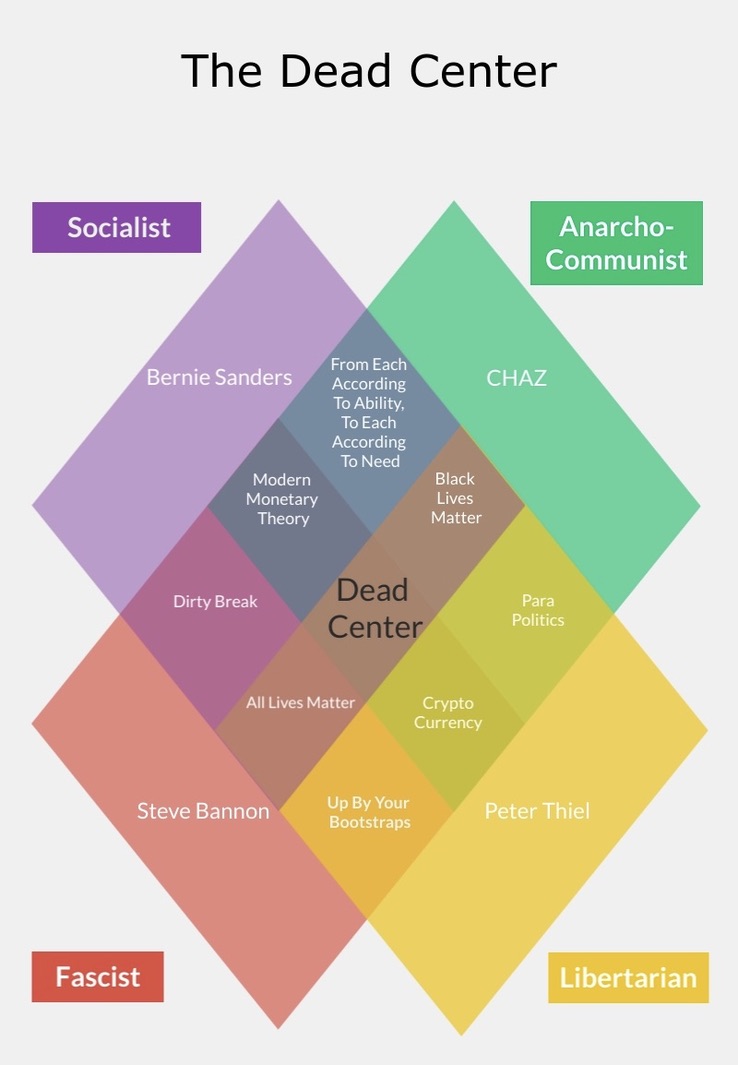
The Dead Center

Featured

Tags

Anarcho-Communist, Bernie Sanders, Black Lives Matter, Crypto Currency, Dead Center, fascism, Libertarian, Modern Monetary Theory, Peter Thiel, steve bannon, Up By Your Bootstraps

B724F481-2C54-45F4-96F1-D4490B8649CF_1_105_c

Share this:

  • Click to email a link to a friend (Opens in new window) Email
  • Click to share on X (Opens in new window) X
  • More
  • Click to share on Facebook (Opens in new window) Facebook
Like Loading...

Posted by Jonathan Mozzochi | Filed under Snippets

≈ Leave a comment

Apocalypse as Opportunity?

16 Thursday Apr 2020

Posted by Jonathan Mozzochi in Essay

≈ Leave a comment

Tags

Apocalypse, Bolshevism, Covid 19, fascism, Gavin Newsome, Mario Cuomo, Republican Cult of Death, Rosa Luxemburg, Shelter at Home, Social Distancing

Apocalypse or Opportunity?


As it is April 16, 2020 I must make note of the ongoing collapse of the world economy at the hands of a tiny, but deadly, virus. As per usual here in the United States BIPOC, the poor, the working classes, the elderly, the weak and vulnerable are being hit hardest both by the spread of the virus and the resultant economic fallout. The rich are serenading one another across well-apportioned balconies and expansive vales, clapping while we die. We need immediate material support that in most places is not forthcoming. They need a fucking guillotine. Many of us have been waiting weeks for unemployment benefits, food aid, or that one-off-signed-by-a-sociopath-stimulus-check. If the pandemic has dramatized anything it’s the fragility of the neo-liberal consensus. But the left remains largely incapable of mounting a ‘counter-hegemony’. Perhaps the far right has a better angle on exploiting such fragility? I sincerely hope not, but that remains to be seen.

The most visible opponent to the current Republican Cult of Death is New York governor Andrew Cuomo, a soulless political prevaricator whose contributions to ending the pandemic include forcing Rikers Island prisoners to make hand sanitizer and scolding working class Americans to simultaneously ‘stay at home’ and ‘go get a job’–all without a hint of cognitive dissonance. Liberalism is dead. Don’t expect this sudden, half-assed, altogether pathetic expansion of the welfare state during the pandemic to revive it. Stick a fork in it already. The other Left Coast leading liberal light, California Governor Gruesome is no better. Behind every plutocrat and celebrity clapping on their doorstep for an essential worker risking their life is a lib-con telling us all to get back to work and appreciate the fact we have a job at all. We know the bar for humanitarian response is perilously low when these clowns are regarded as leaders. We leftists have always argued for re-valorizing essential work and the workers who perform it. This system of organized theft will cough up a begrudging acknowledgment of our humanity about the time there is no longer a humanity left. 

The contrast between something so small having such a large impact is instructive here. Throughout human history radical political ideologies always, by definition, start on the outskirts of accepted public opinion. Then, that Overton Window we are all so fond of referencing suddenly and quite unexpectedly opens up, moves to another building or is shattered altogether by a projectile. Such ideas and the people who promote them grow in influence during times of major disruption. Twenty-six million unemployed in five weeks, mile-long lines at food banks and overflowing morgues are terrifying testaments to our current predicament. We just cannot say what is coming, only that it will likely be something different from whatever we have experienced before. The depth, breadth and velocity of the current economic upheavals are just too extreme not to produce some kind of political fallout.

The WWI era, for example, was characterized by a devastating inter-imperialist global war and was the hand maiden for both Bolshevism and fascism reaching for and grasping state power. However one chooses to understand and assess those radical ideologies, it is undeniable that they began among a few adherents and under certain circumstances became normative. So today, as we confront a pandemic driving an unprecedented economic contraction throughout the entirety of organized human life we should perhaps ask ourselves: What might be the character of any political upheavals that follow? What small group of conspirators–10 good comrades for Lenin, a handful of putschists for Hitler–might be waiting in the wings? How best to identify such actors so we can accurately assess their prospects and join or fight them?

By way of clarification, I don’t mention Bolshevism and fascism in the same sentence so as to suggest they are moral or political equivalents. That’s what lib-cons do–a fools errand that only perpetuates capitalist exploitation and domination or, worse, ensures the return of fascism. We need a revolution, but a deeply socialist, anti-racist and democratic one. My point here is that both movements came to power during times of extreme duress. We are now in the midst of such a global disruption, one without any precedence in human history. As the cliche goes, great peril is often accompanied by great opportunity. It’s a cliche because it’s true. For all its gruesome effects, this post modern plague has (miraculously) emptied out stadiums, office buildings, concert halls, NASCAR tracks, ocean liners, jumbo jets and golf courses. Behold: the bluest of blue skies and the brightest of stars at night, the re-wilding of diverse habitats, the disappearance of traffic overnight, the great grinding to a halt of capitalism and its ravaging effects on this habitat we call earth, albeit amidst great horror. One can marvel and dream of a different future without succumbing to eco-fascism. It might be possible to theorize an eco-socialism from the realization that the spread of this other plague (capitalism) can be arrested. Which brings us to my last point.

As working class, poor and vulnerable people struggle to survive this latest crisis of capitalism and the hollowed out democracy that provides its ever thinning legitimating narrative, we may find ourselves confronted with a choice that comes around only once every few decades. Whereas previous crises always involved some governmental intervention to temporarily discipline the capitalist casino class so as to reestablish an equilibrium of inequality that the poor and working masses could not find a way out of or around, today the shock is an exogenous one, although magnified a thousand-fold by wholly endogenous factors. It may be that no such equilibrium will be forthcoming in the aftermath. The wheels may have come off permanently. The center may not hold. Everyone is running for the exit. There are only two: socialism or barbarism. 

Whatever consensus preceded this conflagration it will hold only on a steep upward incline such that it will be driven inexorably back toward fascism. If and when it slides it won’t slide half-way; it will smash back into the 19th century but with 21st century tools of repression to hold it there. Another way of putting this: if revolutionary socialists fail to effect a revolution this time we may all be doomed to fascism. Anyone who argues that that slide is already underway is probably correct; anyone who argues it is inevitable should be pilloried. The slide can be arrested, even reversed. Rosa Luxemburg wrote:

The “golden mean” cannot be maintained in any revolution. The law of its nature demands a quick decision: either the locomotive drives forward full steam ahead to the most extreme point of the historical ascent, or it rolls back of its own weight again to the starting point at the bottom; and those who would keep it with their weak powers half way up the hill, it drags down with it irredeemably into the abyss.

Neither the slide back to fascism nor a successful ascent to socialism are inevitable. It’s up to us. 

Capitalism is the virus. To kill it we must enforce and extend the current shutdown. The only thing capitalism is congenitally allergic to is a limit on growth. It must expand. It must grow, preferably at exponential rates. 

Our logic of revolutionary redistribution should be premised on a slowing down and de-commodification, on a decentralization together with a re-valorization, and on a democratization of equality.  We must try and refocus our horizon from those narrow, two-party recapitulations of that which is possible forever chained to “There Is No Alternative” to the centrality of essential work and the essential workers who perform it: first responders, mutual aid providers, wage laborers, agricultural workers, gig workers, service workers, frontline fighters, etc. The only jobs worth protecting are those worked by essential workers. Think about that. What is the point of having ‘inessential’ jobs?Collectively, essential workers and the essential work they engage in comprise that which we cannot do without. In a collective sense such work is also desirable and, conversely, the work carried out at stadiums, golf courses, banks and so much more is inessential, that which we can (and should) do without.

What I mean here is that we should support social distancing and shelter at home policies not only because they are necessary to fight the pandemic at hand, but because they embody a better future. To that end, emerging from this crisis should be a robust challenge to the follies of perpetual growth and increased velocity that fuel inequality. We may have a unique opportunity to challenge, in a popular way, the commodity form and the logic of exchange value and pricing so central to it. In other words, the social distancing and stoppage of so much work is not only necessary to defeat the spread of Covid 19, it is necessary for any socialist future, perhaps any future at all. 

END


Share this:

  • Click to email a link to a friend (Opens in new window) Email
  • Click to share on X (Opens in new window) X
  • More
  • Click to share on Facebook (Opens in new window) Facebook
Like Loading...

The Tyranny of Adverbs and Twits.

Featured

Posted by Jonathan Mozzochi in Essay, Rant

≈ Leave a comment

Tags

Antifascism, Bong Joon-Ho, Donald Trump, fascism, Google engineer, Instagag, Jeffrey Epstein, Noam Chomsky, Obama, Snapcrap, Snowpiercer, Zizek


Literally used now more than ever.

4130c931b9b46b611e2f876a70b1b1c8ac06ba6b.png


Way back in 2012, Joe Biden was criticized for using the adverb ‘literally’ nine times in one speech. How quaint. I recently listened to a level 5 Google engineer use it nine times in the space of two minutes.

This particular soulless quant had another annoying habit: He would begin every other sentence by restating my name, “Jonathan, I understand what you are saying…” If such feigned familiarity is coupled with a light touch on the arm, I feel free to reach for a knife. Most people who do this are trying to overcome skepticism and inculcate credulity. As a mnemonic device, it is annoying at best; more often it is cloying and insincere and a sure sign to distrust, even despise someone.

Honestly? Like. Literally. Actually.

While I don’t miss Obama much, I do miss his particular elocution, that patient, preternaturally calm, baritone voice and the halting ‘ums’ and ‘uhs’ that stitched together his verbal output. By today’s standards, those pauses are pleasant by comparison. They don’t have any pretense; they are space fillers that allow him to think. While I have many disagreements with what he said, I could always understand it. He was thoughtful and nuanced to a fault; dithering on the golf course while fascism made a comeback. But in this he was not alone, nor particularly exceptional. Plenty of socialists, for instance practically the entire seven-year history of Jacobin Magazine and Blog, join him in this regard. But back to those adverbs.

With Trump, it is as though every wealthy, entitled, and neurotic teenager has suddenly been given carte blanche to release their own unfiltered insanity. While I think the parallels here can be overstated (Trump as a teenager) there is still something to it. Will Trump bomb Iran or just berate the housekeeper? Will he begin in earnest the rounding up of undocumented families or just do a stint in rehab?

His verbal diarrhea is pockmarked with superlatives such as ‘winner’, ‘terrific’, ‘tremendous’ and of course, ‘great’ and ‘greatest’. It’s as though his mother, or au pair, never stopped telling him how special he was, even when he was caught eviscerating the neighbor’s cat. Good boy.

If Trump were a pornography category it would be ass-to-mouth, mouth-to-ass, with all those A-list ruling class enablers from both political parties, across every imaginable capitalist enterprise, sucking and fucking to form one giant, unending, gangrenous human centipede, just like the horror film. Jeffrey Epstein is in there somewhere.

Today it seems that adverbs, and certain nasty ones, in particular, have mounted an attack upon the nonviolence of ums and ahs, completing a scorched earth assault on the quiet dignity of anodyne place fillers so as to replace them with crutch words that, whether used correctly or incorrectly, amount to obfuscation and disorganization–i.e., bullshit. These lexical tics impulsively resorted to by the verbally disabled add emphasis where none is needed, assert drama where there is only triviality, state the obvious rather than the nuanced, and (my favorite) suggest strongly that everything said beforehand was a lie (honestly?…). The standard Trump teenage verbal diarrhea disaster asserts a recklessness with meaning that can only be regarded as aggressive stupidity. This is the hallmark of the powerful, the invulnerable, the masters of the universe who say and do as they please without repercussions, and is the hidden in plain view secret behind Trump’s attraction to some people. We have heard it again and again: Trump ‘says out loud what we can only think to ourselves’. My own take on this is that Trump says out loud, in ways some people would never even hazard, the despicable ideas that belong in the basement. They generally stay there because someone will kick your fucking ass if you say them out loud elsewhere, which is as it should be, but, alas is no longer.

The terrifying ephemeral nature of Twitter is the dominant mode of communication for this viral and noxious hate speech. But together with the sheer hatred and assault of such verbiage, there is something else underway: where everything is equally dramatic, nothing is important. Aside from links to longer written work, this platform, like instagag and snapcrap is useless for leftists. The ‘twit’ in Twitter is there for a reason. Those who are prolific in these mediums are the same shallow dipshits who prosecute juvenile intra-leftist fights. Tankies vs. insurrectionists, statists vs. anarchists, etc.

No complex thoughts or arguments are possible here, only half-ass hashtags, silly memes, and depraved gossip. Chomsky once remarked that in order to engage an audience about ideas which break with orthodoxy one must spend some time setting the groundwork to do so–you need at least 15-30 minutes to tear down presumptions that prohibit ‘out of the box’ thinking. If you are not afforded the opportunity to do this you sound insane. This fact alone means the instant ambush culture of social media and the talking heads that wallow in cultish Marxisant Zizekian nonsense ensures no such thinking is possible within such a format. Zizek and his ilk thrive there because they are full of shit. That’s why Chomsky didn’t go on cable news programs or engage in celebrity debates. Chomsky has all the more integrity because of that. More leftists, certain antifascists, in particular, need a reminder on this point. Otherwise, you are just engaging in a debate on their terms. The only corrective to this sorry state of affairs is aptly provided in the wonderful allegory of revolution that is the film Snowpiercer, by Bong Joon-Ho. If you get to the front of the train, don’t listen to the conductor, don’t even allow him to talk–cut his tongue out and remember: Kronole is a bomb, you idiot!

This is why it is largely pointless to troll celebrities and engage in the shadow boxing preferred liberals and conservatives. The questions determine the parameters of possible answers. Liberals and conservatives, establishment types, and pols consumed with issues and policies are congenitally allergic to our thinking and action. Are they concentration camps? Is Jeremy Corbyn an antisemite? Was Brett Kavanaugh qualified for the Supreme Court? Is there a U.S. presidential candidate other than Bernie Sanders worth two shits? Did Jeffrey Epstein receive preferential treatment for his predations? If you debate these questions, you have lost before you begin because there is no debate. To debate what is obvious is the death of debate. It is to die a dithering death, full of thoughtfulness and nuance, that amounts to nothing. It won’t stop fascism or overcome capitalism. Enough already. Try a long-form essay, FFS, and mind your adverbs

END

Share this:

  • Click to email a link to a friend (Opens in new window) Email
  • Click to share on X (Opens in new window) X
  • More
  • Click to share on Facebook (Opens in new window) Facebook
Like Loading...

Counterintuitives—Hate The Good Hate

Featured

Posted by Jonathan Mozzochi in Essay

≈ Leave a comment

Tags

antifa, fascism, Hate, Nazi

An old comrade would often remind young antifascists of two sayings.

Nazis are people too.

Fighting Nazis can be fun.

The first I always understood as a reminder that even the most vile and violent fascists have all too human motivations at work, often quite pedestrian. In order to fight them effectively, one must understand them on their own terms. Not empathize with them, but understand them so as to defeat them.

I don’t agree, but I understand.

This, rather than a variation on what I gather to be the original saying, “kids are people too”. It was never meant to mean ‘don’t punch Nazis’, allow them platforms or that doxing is mean.

Which leads us to the second saying, ‘fighting Nazis can be fun’. Antifascist action, especially that work undertaken in the shadows, can be painstaking and laborious, with results that don’t yield immediate benefits. Rewards and plaudits will not be forthcoming, because Antifa activists, by definition, are anonymous. Some comrades will attack your work as adventurist or so much tilting at windmills. So what’s to recommend? Anti fascists fight fascists and uphold the red and the black. That, and at the end of the day, dance once in awhile, then do what LKJ said, so as to dance on their graves. Did you get that?

To these fine recommendations I offer a third that on first glance may appear cheeky, even disingenuous. But I mean it sincerely.

Hate the good hate.

Hate is a strong word. We have come to associate it with the foulest expressions of bigotry, as we should. But there is a flip side to this emotion and the language that expresses it that, if left only to the bigots, can render us monolingual. We should speak from love, but not always. Too often the language of love renders as false hope rather than daring audacity; surrender and victimhood are misrepresented as progress; tolerating that which is intolerable is upheld as a virtue.

We love our enemies, it is true, but that love must insist on our own common humanity, precisely that which they deny. When they deny even our basic human dignity, the bile will rise up in your throat. So as not to choke on it, you must spit it out.

Spit it back at them.

Hate the good hate.

Just be mindful of whom you strike, how and why.

If you can, live to fight another day; if not, leave us, and them, something to remember you by.

But strike back, nonetheless.

Strike back with fury, precision and devastating effectiveness.

Strike back.

Hate the good hate.

END

Share this:

  • Click to email a link to a friend (Opens in new window) Email
  • Click to share on X (Opens in new window) X
  • More
  • Click to share on Facebook (Opens in new window) Facebook
Like Loading...

Fascism and Populism

Featured

Posted by Jonathan Mozzochi in Book Review, Essay

≈ 2 Comments

Tags

capitalism, Ernesto Laclau, fascism, Francis Parker Yockey, Julius Evola, Kevin Passmore, Populism, Social Reproduction Theory

Fascism: A Very Short Introduction by Kevin Passmore

2002 Oxford University Press

As a primer on fascism this little book is useful. I’ll use it as a jumping off point for my arguments about fascism and populism. So don’t expect a thorough review.

Passmore opens with a series of historical vignettes set in France, Italy, Romania and Germany that illustrate the varied character of what have been called ‘fascist’ movements and regimes, their distinctiveness and specificity on display. He does this, however, with an eye toward upholding what is common between them, setting the stage for a later use of the term ‘fascism’ that has both general applicability and analytical clarity. This tension between the diversity of forms of fascism and what they all have in common and the seemingly contradictory nature of that relationship is an important problem Passmore identifies early on through a quote by the Spanish philosopher Jose Ortega y Gasset that opens the book.

“Fascism has an enigmatic countenance because in it appears the most counterpoised contents. It asserts authoritarianism and organises rebellion. It fights against contemporary democracy and, on the other hand, does not believe in the restoration of any past rule. It seems to pose itself as the forge of a strong State, and uses means most conducive to its dissolution, as if it were a destructive faction or a secret society. Whichever way we approach fascism we find that it is simultaneously one thing and the contrary, it is A and not A…” (Sobre el Fascismo, 1927).

Passmore restates this problem in a more contemporary fashion:

“In the 21st century interest in the history of fascism and its cries is perhaps greater than ever. Yet how can we make sense of an ideology that appeals to skinheads and intellectuals; denounces the bourgeoisie while forming alliances with conservatives; adopts a macho style yet attracts many women; calls for a return to tradition and is fascinated by technology; idealizes the people and is contemptuous of mass society; and preaches violence in the name of order?” (p. 11).

The short answer here is racism. We will get to that.

Passmore then poses this seeming conundrum as one that has vexed scholars of and activists against fascism as ‘the problem of definition’. To solve this he outlines three broad approaches to fascism: Marxist (1935 Comintern, Trotsky), Weberian (Max Weber), and Totalitarian-nationalism (Hannah Arendt).

All three approaches don’t adequately handle what W.E.B. DuBois succinctly called “the color line”. Passmore does a somewhat better job of this than most when he seeks to borrow useful aspects from all three traditions, while dispensing with their limitations, so as to formulate a synthesis. He makes some progress toward this end, but fails. That failure has a name: Ernesto Laclau. But more on that in a bit.

My own definition of fascism proceeds from a different premise than that of Passmore: a definition of fascism that is analytically sound must serve human liberation. Another way of saying this is that there is no ‘true’ definition of fascism possible because we formulate that through struggle. Ours will be different from theirs. That struggle is not only carried out in the ‘marketplace of ideas’. If we want to define fascism our dream of the future and our belief in the desirability and possibility of that future must inform our definition of ‘fascism’ within a historical framework that can facilitate its defeat and our triumph. As an Anarcho-Communist, I believe the struggle against fascism is inextricable from those struggles against capitalism and the state and the exploitation and domination that are their defining features. A more or less useful definition of fascism can only be constructed from a theoretical framework that derives from a hybrid of anarchist and communist philosophies. Part of doing as much requires a recognition that the use of terms such as ‘populism’, ‘liberal democracy’, and ‘race relations’ is incompatible with that project. These terms usually dispense with the notion of a political right or left. When there is no right or left arranged along a spectrum informed by inequality, there is no possibility of analytical clarity in regards fascism or of much else. But there is a left, distinguishable from a right. Even when there isn’t a viable left, there still exists that wellspring of ideas and actions that we call socialist, anarchist and communist. If your dream of the future is limited to liberal democracy, your understanding of fascism will be bound up with the presumptions that undergird that philosophy. As fascism thrives within conditions liberal democracy depends, one must theorize the end of that system as a solution to the problem of fascism. Liberals, conservatives, purveyors of the ‘populist’ thesis all are forced to imagine the end of the very institutions that give meaning to their lives. Unfortunately for them, this is a prerequisite for the defeat of fascism. This they will not do; so we shouldn’t expect it of them. So I don’t of Passmore. But he does have much to offer, nonetheless.

If one’s frame of reference is democracy vs authoritarianism as liberal, Weberian, and totalitarian approaches utilize, there is virtually no way to account for the continuity fascism has with modernity, progress and capitalist institutions. Fascism, on this reading, represents a discontinuity with capitalist progress. It is an outlier, a deviation, an anomaly. On the other hand, if one follows the 1935 Comintern definition of fascism as “the open, terroristic dictatorship of the most reactionary, the most chauvinistic, the most imperialistic elements of finance capitalism” the relatively independent nature of fascism is lost. It shares too much in common with capitalism and cannot be distinguished from it. So too the role of racism as a primary structuring feature of fascism and the particular form of that in anti-Semitism is obscured. One cannot really account for the wholesale destruction of European Jews at the hands of Nazis and fascists throughout Eastern Europe well past the point of Aryanizing businesses, to the point where such activity undermined the general war effort and had no benefit to fascist regimes. A failure to understand eliminationist racism as a central feature of fascist ideology risks a misunderstanding of fascism as solely a product of a crisis within capitalism. Much of this is tricky, but it is not splitting hairs, so much distinction without a difference. It is important.

Passmore does hold racism as central to fascism, but he doesn’t really flesh it out, not least in how it continues to occupy a central role in contemporary fascism. This is the case today as well as 2002 when he wrote this book.

Here’s another humdinger: Fascism is a constitutive feature of a particular type of capitalism, that found in Europe and North America. In writing this I am not arguing, much as Ta-Nahesi Coates does, for the existence of what amounts to a ‘primordial’ white supremacy, that fascism somehow attaches itself to ‘white’ genes or that whiteness is somehow eternal in the imagination of white people. I am arguing that fascism has a political geography that roughly corresponds to what I call the ‘white belt’. In this sense there is a fascist international in formation, a social and cultural process within such geo-political formations as the European Union that made its construction possible. Racism was baked into its cooking, regardless of the lofty humanitarian principles that animate its pronouncements. This process of fascistization underway throughout ‘the West’ seeks to rectify regional differences between fascist programs (Catholic here, Protestant there; urban vs rural, worker vs capitalist, etc.) in favor of a pan European whiteness that can only be conceptualized as against a dark, swarthy, foreign other. This is as fundamental to understanding anti immigrant racism as labor markets and competition over jobs. It cannot be understood apart from the larger divide between North and South, Core and Periphery. This is key to understanding the appeal of and prospects for 21st century fascism. In a frightening way, the ‘super fascism’ of Julius Evola, the ‘Imperium’ of Francis Parker Yockey and the snarky postmodern ‘race realism’ of Generation Identitaire foreshadow much worse to come. The future of fascism is there. If much worse is to come, it will ride this horse, and not that of the German donkey or the Italian mule.

In response our struggle cannot be limited to the terrain of the national, according to the rules of liberal democracy, within the suffocating possibilities of the here and now. We fight here, on this contested terrain of the national, but from an internationalist standpoint. Solidarity is a non-negotiable principle. We also should not pretend social democracy is up to the fight; the ‘populist’ leaders of France Insoumise and Podemos are social Democrats, but without a strong base within organized labor, so they cannot lead this fight. We must. If the broad struggle remains within the confines of the social-democracy, and we are unable to envision and fight for a communist future, we will be trampled, staring at a digital jackboot forever.

In his attempt to offer a redefinition of fascism Passmore gets much correct. But his effort lacks a grounding within a liberatory communism and will therefore be stuck within one or another of the schools of thought above. His observation that the strength of the Marxist approach, as he understands it, is that it illuminates the relationship between capitalism and fascism that other approaches either dismiss or ignore, allows us to make a more important argument, that fascism is constitutive of ‘progress’. Just as poverty and exploitation are essential components of economic development, rather than unfortunate errors of that development, so too does fascism necessarily exist, always and everywhere, within the general capitalist mode of production. It never left, most people just didn’t pay attention.

This informs my insistence that fascism never went away and that a primary problem scholars and activists have with defining and fighting fascism is that they tend to begin and end their efforts with classical fascism, giving short shrift to the subsequent eras of the movement. Rather than yet another dense scholarly work about Hitler’s relationship to his German Shepherds, how about a monograph on how fascism persisted in the war between South Africa and Angola? How about a close reading of that extraordinary experiment in anti racist communist organizing that was the Sojourner Truth Organization? How about a treatise on American white nationalism and fascism? Is American white nationalism a unique form of fascism? Or is it part of a generalized development of fascism that is trans national, the peculiarities of Trump an expression of something much larger? Perhaps it’s not fascism at all? I have offered up my opinions about all of these questions; most radicals appear fixated on Trump’s style of rule, the latest trade tariffs, or the coming national elections. They seem unable to formulate a useful question. Better questions help us reach better conclusions.

Over its 100-year history, through its now three distinct eras (Classical, Cold War and 21st century) fascism is as much a permanent feature of capitalist society as it is a threat to that society. It is both, but not in the sense that Arendt used it, as a fundamentally ‘revolutionary’ reorganization of society that is the doppelgänger of ‘communist totalitarianism’. Passmore, writing in 2002, gets an important part about the uses and abuses of ‘totalitarianism’ correct when he writes: “as a scholarly idea the term enjoyed its heyday in the 1950s and 1960s, when anti-Marxist social scientists favoured a concept that discredited communism by linking it with fascism.” That link, by the way, is mostly bullshit and in any case not nearly as important as the link between capitalist democracy and fascism. That general academic project, always a political project in the sense it twists history to fit unsupported premises, is still operative today and informs virtually all non-Marxist interpretations of fascism. Most of that work, especially as it is rendered by journalists, is deeply flawed. Unfortunately, the Marxist rejoinder tends to remain stuck with scholarly work and frames of reference from the Classical period alone. Will the bourgeoisie fund the fascists? Will the fascists seek a red-brown alliance against monopoly capital? Yes, they are funding them. All capital is monopolistic. Meh. This will not do.

Passmore will end up articulating a ‘post-Marxist’ position on fascism, indebted to Ernesto Laclau’s theories of ‘populism’. My central problem with this is that Laclau’s theories are not transferable to the capitalist core–Europe, the United States, Canada, etc., because of the fascist element. Has anyone ever argued this? Someone should. One cannot construct a successful program for ‘populist hegemony’ on this terrain without dismantling the white supremacy, now expressed politically as white nationalism, within it. That demands a discrete fight that is not possible within the thought world of populism. Left wing hegemony cannot be achieved here through a program of populism because that program is both too reformist–it doesn’t offer anything to the most oppressed among us that addresses their particular forms of exploitation and domination (reparations, open borders,etc) yet is also too radical–it proposes universal programs that capitalist power will not accept. Furthermore the populist program is electoral, with a social movement component as an adjunct. Direct action movements must drive electoral politics, not the other way around. The discourse on discourse is too discursive, if you will, chasing public opinion and ideas as though the variability of their meanings float somewhere above and separate from the material conditions of existence. Sociotopes make the animal; the animal does not exist within conditions of its own making.

The limits of the ‘pink tide’ movements in Latin America, which ubdoubtedly owed much to this theory, are now evident everywhere. While acknowledging the contributions of Marxist theory Passmore seeks to articulate a theory beyond the centrality of class but he has picked a frame of reference that only applies, and in a limited way, to the global south.

I agree with Laclau and other ‘populists’ or ‘hegemonists’ however, that social class needs to be re-theorized beyond an industrial proletariat as the agent of history; beyond a peasantry that can surround the cities or a Black lumpenproletariat that can ignite an urban rebellion. Today, add or subtract however many agents of history to however many points of production however much one likes, it will amount to a pointless search for a vanguard that will never emerge. This then is what is different from then to now. What may have been possible in Russia of 1917 cannot be reproduced today. And it shouldn’t be. Something has changed. What is it?

My own unique contribution to this problem is to expand social class without diluting it; rather than an amorphous ‘people’ or ‘populism’ a new set of social actors could be theorized by examining the role of Border, Manse, Factory and Bit in our current mode of capitalist production. The fulcrum for these new social classes is the city, ground zero for insurrection. And, in what is surely to be regarded as a confusing twist, I think a central locus of rupture with capitalism is precisely where it is most wasteful–those centrally located, densely populated, impossibly tall, blindingly bright at night, giant penises we call skyscrapers. Here, where the most pointless of activity takes place in that utter waste of space called the office, by human beings so alienated from themselves and the products of their own labor they don’t even want a union because they prefer the taste of boot, under the watchful eyes of the permanent panopticon, is ground zero of the greatest insurrection in the history of humanity. Oh. That and our ruling class, holding their own dicks, are so blinded by hubris as to locate their primary loci of social reproduction in many of these same buildings. They live where their networking power is concentrated. It’s great that they have it all in one place. This fact will provide us with a wonderful teachable moment.

Today, borders and prisons create social class as much as a factory. So too the Manse is a point of social reproduction that shapes and conditions our existence. If social class is social, then it seems one locus of its reproduction is the home, where, apart from work, socialization takes place. Theirs and ours. While it is true that we live in the street, in a home much larger than theirs, we will take back that which is ours, which is everything.

Social Reproduction Theory is an essential tool for understanding this. The overarching theme here, and its the same one since 1968, is RCG–Race-Class-Gender.

The unification of anarchist and communist theory proceeds from here, where it must tackle the question of fascism.

END

Share this:

  • Click to email a link to a friend (Opens in new window) Email
  • Click to share on X (Opens in new window) X
  • More
  • Click to share on Facebook (Opens in new window) Facebook
Like Loading...

Trump and the Ruling Class

Featured

Posted by Jonathan Mozzochi in Essay, Fiction, Rant

≈ Leave a comment

Tags

Alan Gisburg, Boots Riley, capitalism, Das Kapital, David Rockefeller, deus ex machina, Donald Trump, fascism, Hip Hop, JP Getty, Karl Marx, Miles Davis, Sorry to Bother You, the Coup, Tupac Shakur

Marx and Trump

The election of Donald Trump to the presidency of the United States was an epic shitting-of-the-bed with no parallel in American election history. The first, most important point to be made about this is that our corporate and political elites made that bed; we need to make sure they must now lie in it. When they blather about Russians stealing the election or the deplorable nature of the white working class, force-feed them the truth. It was their hubris that fertilized a garden overrun with weeds that produced the superbug that is Trump.

According to virtually all prognosticators, once the Sanders ‘political revolution’ was dispatched the Unfiltered Orange Sociopath would surely lose, and the ship of state, with another captain Clinton at the helm, would continue on course. Only two newspapers with circulations above 100,000 endorsed Trump for President, while all other major media formats, excluding Fox News, and only after the primaries, either dismissed his candidacy with a shrug or actively campaigned against him. He was not from the establishment. He was not the first choice of the ‘smart money’. He wasn’t their 20th choice. He was not one of them. Trump arose from a social movement he did not create within conditions, not of his making. He is more an expression of those developments–riding the wave, so to speak–rather than the wave itself. What produced that wave is most certainly a generalized crisis within capitalism and its ruling ideology, neoliberalism. But the wave is now large enough that it drives that crisis as much as it is a product of it. It’s important to call that wave what it is: white nationalism or the American form of fascism.

If what happened on November 8, 2016, is best understood as a sharp departure from an otherwise healthy and democratic political culture, then the solution might plausibly be a restoration of democratic norms. But what took place was not a departure from the norm, but a logical outcome of that norm. What they call ‘progress’ will always invite the eternal return of fascism. What transpired was not a coup, a ‘stolen’ election, or an excess of American democracy that, if you listen closely, certain bloodless technocrats now argue requires an enlightened despotism as a corrective. This is, of course, how everyone from conservatives to progressives views things: Everything was more or less fine until–WHAM!–the impossible came to pass. The solution is to boot the bigot out of office, fix the damage and move on. But the problem is much more than that and much worse. Even Bernie Sanders can’t fix it now.

On this question of fascism and Trump, much of the socialist left is mistaken in other ways. For instance, a rendering of Trump’s triumph as the ‘rotten fruit of the ruling class’ correctly locates the general responsibility for the world of shit that we live in with the rich and powerful, but it cannot explain two things about that world: first, Trump’s contradictory relationship to that ruling class and, second, his ability to command support from millions of (white) people manifestly not from that ruling class.

To understand how what happened came about and what, more than two harrowing years later, can be done in response, requires an understanding of Trump’s appeal, especially that ‘authenticity’ so often associated with his “saying out loud what some people only dare to think”. Part of what that something amounts to is the genuinely contradictory relationship he has with established centers of economic and political power–what we anarchists and communists call the ruling class. He is from their family but in their eyes, he has always been and will always be something of an embarrassment. They will never fully accept him, something that is, oddly enough, part of his strength. Trump was always invited to the party, but the hosts secretly hoped he wouldn’t show up. If he did appear, everyone would cringe, but they would not kick him out. Why is that? What is it about Trump that makes him a social outcast, yet a fixture at the same time? And why do certain people turn to a billionaire in order to punish a ruling class?

Sometimes wisdom can be found in unlikely places. The nooks and crannies of oppositional subcultures sometimes become the interstices that make history. It took Marx’s body of work decades to marinate before becoming a set of ideas followed by millions across the planet; but those ideas started on the fringe, within spaces in between what is and what could be. If we want to understand Trump and fascism here’s a source from the recent past that sheds important light on a particular dynamic of Trump’s ascendency and its relationship to fascism. Set aside that academic article, that peer-reviewed journal, the latest tweet from that celebrity intellectual. For the moment dispense with those shopworn terms: ‘populism’, ‘authoritarianism’, ‘monopoly capital’, and ‘privilege’.

Listen to some rap and read the lyrics.

The Oakland-based Hip Hop band The Coup released an album in 1994 called Genocide and Juice. It is my favorite work of art in that musical genre and is to hip hop what Alan Ginsberg’s Howl is to poetry, Miles Davis’ Kind of Blue is to Jazz, or Marx’s Das Kapital is to socialist theory. It is remarkable in many ways and anticipates band member Boots Riley’s film, Sorry to Bother You, released to critical acclaim last year. I will focus on two songs, “Fat Cats, Bigga Fish” and “Free Stylin at the Fortune 500 Club”. If you can, listen to these two songs and follow along with the lyrics. And remember, all of this was created prior to 1994. Apologies in advance for any lyrics that are incorrect.

“Fat Cats, Bigga Fish”

Well, now haha, what have we here?

Come with it
Get down, get down, get down 2ce
Come with it
Get down, get down, get down 2ce

It’s almost ten o clock, see I got a ball of lint for property
So I slide my beenie hat on sloppily
And promenade out to take up a collection
I got game like I read the directions
I’m wishing that I had an automobile
As I feel the cold wind rush past
But let me state that I am a hustler for real
So you know I got the stolen bus pass

Just as the bus pulls up and I step to the rear
This ole lady looks like she drank a forty of fear
I see my old-school partner, said his brother got popped                                       pay my respects, “Can you ring the bell?” We came to my stop
The street light reflects off the piss on the ground
Which reflects off the hamburger sign as it turns round
Which reflects off the chrome of the BMW
Which reflects off the fact that I’m broke
Now, what the fuck is new?
I need loot, I spot the motherfucka in the tweed suit
And I’m on his ass quicker than a kick from a grease boot
Eased up slow and discreet
Could tell he was suspicious by the way he slid his feet
Didn’t wanna fuck up, the come on,
So I smiled with my eyes, said: “Hey, how’s it hanging guy?”
Bumped into his shoulder, but he passed with no reaction
Damn this motherfucka had hella of Andrew Jacksons!
I’m a thief or pickpocket, give a fuck what you call it
Used to call ’em fat cats, now I just call them wallets                                        Getting federal, ain’t just a klepto
Master card or visa? I gladly accept those Sneaky motherfucka with a scam, know how to pull it
Got a mirror in my pocket but that won’t stop no bullets
Story just begun but you already know
Ain’t no need to get down, shit, I’m already low

Come with it
Get down, get down, get down 2ce
Come with it
Get down, get down, get down 2ce

My footsteps echo in the darkness
My teeth clenched tight like a fist in the cold sharp mist
I look down and I hear my stomach growling
Step to Burger King to attack it like a Shaolin
I never pay for shit that I can get by doing dirt
Linger up to the girl cashier and start to flirt
All up in her face and her breath was like murder
Damn the shit I do for a free hamburger

“Well, you got my number, you gonna call me tonight?”
“It depends…is them burgers attached to a price?”                                                “Sorry, sorry, I’m just kidding, I’m a call you, write you love letters…”
“It’s all good…”                                                                                                           “Thanks for the burgers…um, hook me up with a Dr. Pepper?”
“That’s cool you want some ice?”
“Yeah, and some fries will be hella nice!”
“Damn, my manager’s coming, play it off, okay? Have a nice day!”
“I’m up outta here anyway”

I use peoples before they use me
‘Cuz you could get got by an Uzi over an OZ.
That’s what an OG told me
Gots to find someplace warm and cozy to eat the vittles that I just got
Came to an underground parking lot
This place is good as any, fuck, it’s all good
Walked in, found a car, hopped up on the hood

Ate my burger, threw back my cola
Somebody said, “Hey!” It was a rent-a-pig, I thought it was a roller
“Want me to call the cops?” I don’t want them to see me
Looked down and saw that I was sitting on a Lamborghini
It was Rolls, Ferraris and Jags by the dozen
A building door opened…Damn, it was my cousin!
Getting off a work, dressed up, no lie                                                     Tux, cumberbund, and a black bow tie
I was like hey, “Who is it?” “Me”
“Oh, what’s up man, I just quit this company
They hella racist and the pay was too low,”
I said, “Right, what’s was up in there though?”
“A party with rich motherfuckas, I don’t know the situation
I know they got cabbage, owning corporations
IBM, Chrysler, and shit is what they said”

Just then a light bulb went off in my head
They be thinking all black folks is resembling
“Gimme your tux and I’ll do some pocket swindling”
Fit to change in the bathroom and I freeze off my nuts
Let’s take a short break while I get into this tux
Alright, I’m ready

Come with it
Get down, get down, get down 2ce
Come with it
Get down, get down, get down 2ce

Fresh dressed like a million bucks
I be the fliest muthafucka in an afro and a tux
My arm is at a right angle, up, silver tray in my hand
“May I interest you in some caviar, ma’am?”
My eyes shoot ’round the room there and here
Noticing the diamonds in the chandelier
Background Barry Manilow, Copacabana
And a strong-ass scent of stogies from Havana

Wasn’t no place where a brother might’ve been
Snobby ole ladies drinking champagne with rich white men
All right, then let’s begin this
Nights like this is good for business
Five minutes in the mix, noticed several different cliques
Talking, giggling and shit
With one motherfucka in betwixt
And everybody else jacking it, throttling

Found out later he owns Coca Cola bottling
Talking to a black man whose confused
Looking hella bougie, ass all tight and seditty
Recognized him as the mayor of my city
Who treats young black man like frank nitty
Mr. Coke said to Mr. Mayor, “You know we got a process like
Ice-T’s hair, we put up the funds for your election campaign
And oh, um, waiter can you bring the champagne?”

“Our real estate firm says opportunity is arising
To make some condos out of low-income housing
Immediately, we need some media heat
To say the gangs run the street and then we bring in the police
harass and beat everybody till they look inebriated
When we buy the land, motherfuckas will appreciate it
Don’t worry about the Urban League or Jesse Jackson
My man that owns Marlboro, donated a fat sum”

That’s when I step back some to contemplate what few know
Sat down, wrestled with my thoughts like a Sumo
Ain’t no one player that could beat this lunacy
Ain’t no hustler on the street could do a whole community
This is how deep shit can get
It reads macaroni on my birth certificate
Puddin-Tang is my middle name but I can’t hang
I’m getting hustled only knowing half the game
Shit how the fuck do I get out of this place?

——

Our protagonist is broke, hungry, and without transportation, while also a poet, a pickpocket, a thief, and a flirt. He’s also not a worker, at least not in the formal economy but his epiphany is dependent on posing as a worker. In other words, understanding the deus ex machina of capitalism requires the vantage point of a worker. And yet when he poses as a worker he doesn’t so much as to gain access to a point of production, as to a locus of social reproduction, the leisure activities of the ruling class, where the ‘art of the deal’ really takes place out of the prying eyes of the public.

To rich white people, all Black people look the same (“resembling”) which gives our protagonist the opportunity to infiltrate their posh gathering so as to pick some pockets. But what he overhears is shocking, and I don’t think this guy is shocked by much. The hustler, knowing but “half the game” is being hustled. The analogy here, between the hustle of the street and the hustle of capitalist exploitation and domination, posits a world where there is no in-between–you are either a pimp, a John or a ho. There is no way to act ethically within a capitalist system short of overthrowing that system; no way to be right with the world until those categories are utterly obliterated.

That’s as profound and accurate a portrayal of the exploitation and domination of capitalism as I have ever read. Here, in searing terms is the carceral state and gentrification, racism and urban pacification, the two-party system and elite command and control together with a breathtaking cynicism. It also upholds the humanity of a petty thief without romanticizing it and demonstrates how it is possible, and desirable, for that person to become a radical. There is no direct or easy path from “using people before they use me” to “from each according to ability, to each according to need”. But the possibility is there, it just needs a kickstart and guidance.

The revelation that corporate and political power is a hustle, but on a scale so vast as to be hidden in plain sight, forces us to “wrestle” with our thoughts. It challenges seemingly sacred convictions about the meritocratic principle, that competition leads to opportunity and the common good. But the reality is that a fair playing field is nowhere, to climb the ladder is to place one’s foot on a rung that is someone’s head. The song’s emphasis on an epiphany experienced by a member of the so-called ‘lumpenproletariat’, or Black underclass, challenges those sneering socialists who consider this consciousness-raising on the part of ‘criminal classes’ virtually impossible. I don’t. I think it’s essential to our collective struggle. In a world increasingly characterized by the deterritorialized nature of the gig economy, we need to theorize a terrain of rupture with capitalism at points other than those, strictly speaking, of production.

“Free Stylin at the Fortune 500 Club”

The first line of the next song is our protagonist leaving the party:
“Fuck no, I ain’t got no Grey Poupon!”
Our hero is replaced by the patter of a socialite in conversation with David Rockefeller.
[Socialite] Well anyway, I said, “That’s no burglar! That’s my butler!”
Mr. Rockefeller, let me in on the gossip
I heard you and Mr. Getty are getting into rap music or something?
[Rockefeller] Yes, we have this thing we do with our voices
We sing like authentic rappers.
[Socialite] Oh! David, you must do it for us!

[Rockefeller] Well if they could make this music more funky…
Let me see if I can get my voice like those rappers. Ahem. Ahem.
Here we go.

“Well, if you’re blind as Helen Keller
You could see I’m David Rockefeller
So much cash up in my bathroom it’s a Ready-Teller
I’m outrageous, I work in stages, like syphilis
But no need for prophylactics
I’ma up you on some mean old mac shit
Ain’t buff, but my green gots amino acid
Keep my hoes in check, no rebellions
If your ass occur, shit
It wouldn’t be the first time I done made a massacre
Nigga please, how you figure these
Motherfuckers like me got stocks bonds and securities
No impurities, straight Anglo-Saxon
When my family got they sex on
Don’t let me get my flex on, do some gangster shit
Make the army go to war for Exxon
Long as the money flow, I be making dough
Welcome to my little pimp school
How you gonna beat me at this game? I make the rules
Flash a little cash, make you think you got class
But you really selling ass and ho keep off my grass
Less you cutting it, see I’m running shit
Trick all y’all motherfuckas is simps
I’m just a pimp”
Chorus
[Socialite] That is so cute! John Paul, why don’t you entertain us with something as well?
[Getty] Well, what should I do?
[Socialite] Why don’t you rap for us?
[Getty] No, I…
[Rockefeller] Come on, old boy, I did mine!
[Socialite] It’s so, tribal!
[Getty] Very well, then.
[Socialite] Oh goody!
[Getty] But, hold my martini, I have to do those hand gestures.
We will begin at the commencement of the next measure.
Now get ready, I’m J.P. Getty
I am tearing shit up like confetti
My money last longer than Eveready
Ain’t nothing petty about cash I never lose
This is just like the stroll
But the hoes don’t choose, I choose you
No voodoo can hoo-doo you
From getting treated like a piece of ol’ booboo who
Do you think want those niggas that don’t turn tricks?
The loco ho in ’94 is getting 86ed
And all about those rebellions, and riots and mishaps
I got the po po’s for their daily pimp slap
The motherfucker gangsta, rolling Fleetwood Caddy
I’m that mack ass already pimped his daddy
Lay you out like linoleum floors
I’m getting rich off petroleum wars
Controlling you whores, making you eat Top Ramen
While I eat shrimp, y’all motherfuckas is simps
I’m just a pimp
Chorus
[Socialite] Oh no, here he comes! Oh, don’t look at him!
[Trump] Are you fellows rapping? I can do that Reggie, uh, ah reggae type of thing…You know, one, two, three…
[Socialite] Well actually, we were just leaving…
[Trump] I am Trump, Trump check out the cash in my trunk
Trump, Trump check out the cash in my trunk
I am Donald Trump me think you mighta heard about me
How me last wife Ivana come and catch me money
She want all, she want this, she want that, of fun
X amount of this like just like the gap hear me
Hol’ up your hand if you love the money
Hol’ up your hand if you love punanny
Gun pon mi side mi afi kill somebody
Because the money inna mi trunk dem wan fi come tek see.

Trump’s inside/outside status is captured perfectly by Riley through his representation as a reggae-rapper, something I gather was anathema to hip hop during the 1990s. The first two rappers in the song were meant to represent the then-emerging feud between east coast and west coast rap traditions,  memorialized through the mortal conflict between Notorious B.I.G. and Tupac Shakur. Rockefeller is the east coast, J.P. Getty west coast. Trump is the outlier. There was no reggae-rap. That just wasn’t done. Perhaps this is still so today, I’m not an expert on hip-hop.

In any case, the rendering of corporate bosses and their political lackeys as pimps playing a cynical and profitable game is brilliant. ‘Punnany’, by the way, is slang for vagina, a further foreshadowing of Trump’s misogynistic ‘pussy-grabbing’.

Trump is clearly an embarrassment but he’s still at the party. Begrudging acceptance is still acceptance. We are never at the party unless we have a tray in our hands. At that time Trump was a millionaire, but not a member of the ruling class in good standing, just as the interloper in the song above is at the party, but not entirely welcome. So it is today. This dynamic, captured so well in the song above, also highlights a facet of fascism that is essential to understanding it and therefore fighting it effectively. Fascism, in its classical, Cold War and 21st-century versions always involves a fight above and below and from a relatively independent, or semi-autonomous, racist, and nationalist mobilization of large segments of a population. A fascist movement in formation cannot be understood exclusively through the prism of class, although it cannot be apprehended without it, either. Fascists fight ungrateful elites above and unworthy black and brown hordes below. That fight above is not disingenuous, either. All so-called ‘issues’ and ‘policies’ (trade wars, immigration, Supreme Court nominees, corporate power, etc.) need a theoretical framework that includes this element within the definition of fascism. Otherwise, it is lost.

As fascism contends for state power it becomes more than a product of capitalist crisis; it becomes the crisis itself.

The (often) missing element of socialist analyses of fascism is precisely a recognition of the relatively independent nature of fascism as a social movement. The second missing element is an understanding of an eliminationist form of racism that undergirds and binds together otherwise disparate factions into a social movement.

Trump follows, he doesn’t lead. Another way of stating this is that he is a symptom of a much deeper and entrenched problem: the slow, long term yet quickening growth of fascism throughout North America and Europe. Here, where I live, its particular expression is American white nationalism. It takes other forms elsewhere, but the family tree from which all variations descend can be identified and then fought.

The nature of fascism cannot be captured through attitudinal surveys, marketing pitches and polling preferences. Therefore, fascism can never be substantively defeated at the ballot box alone. Emasculate him through constitutional checks and balances, harass him with deep state democrats, impeach him, or defeat him during the 2020 elections–it will not be enough and will only serve to deepen the rot. Fascism is more than a form of authoritarianism counterposed to liberal democracy. If your frame of reference for fascism is bookended by these two concepts–authoritarianism and liberal democracy–as most conventional frameworks are, you will misunderstand it and be hapless to stop it. Only leftists have the theoretical framework to understand this, if only they would use it.

A defeat as epic as that of 2016 has produced precious little soul searching or self reflection. Instead, the tenuous and brittle state of neoliberal ideology has produced a default explanation for defeat that has settled on theft. Liberals and (neo) conservatives were predictably apoplectic about the Orange sociopath ‘stealing’ their election. Their wrath was directed outward, toward a mostly imagined conspiracy of a resurrected KGB that, whatever its influence on the 2016 Presidential election in no way whatsoever represented a significant deviation from the constant interference practiced by all states against one another as a matter of bourgeois routine since time immemorial. Besides, the United States is the undisputed world heavy weight grand champion of sovereign interference. Regime change is, after all, a particularly aggressive form of electoral interference that both Russia and the U.S. practice practically everywhere. The wrath of disenfranchised elites was directed internally, as well, at those ungrateful ‘deplorables’, a handful of utopian Jill Stein supporters, and of course the millions of us who said ‘fuck you’ to both parties. Their own complicity–either through deliberate policy, as with Obama’s deportation of 2.5 million souls and Clinton’s reminder that Honduran children may have crossed our border but they didn’t get to stay, or a whoopsie such as neglecting to campaign in Wisconsin–is always rendered as a mistake to be corrected, a flaw to be remedied, a wrinkle to be ironed out, rather than something irredeemable at the core of their rule and the values that justify it. But their rule is irredeemable. This ruling class sips champagne while gazing over infinity pools of conspicuous consumption. When they fuck up, it is by definition our fault. Everything is our fault. They are gods. We are mortals. So, what do we do with gods? Hold their heads underwater until the bubbles stop and be sure that there are fascists at the bottom of that pool drowning with them.

END

Share this:

  • Click to email a link to a friend (Opens in new window) Email
  • Click to share on X (Opens in new window) X
  • More
  • Click to share on Facebook (Opens in new window) Facebook
Like Loading...

Meeting With A Stalinist

Featured

Posted by Jonathan Mozzochi in Essay

≈ Leave a comment

Tags

fascism, John Brown Anti klan Committee, John Brown Gun Club, Joseph Stalin, Pacific Northwest Anti fascist Workers Collective, Socialist Rifle Association, Uncle Joe

If only in 1991 there had been a John Brown Gun Club, a Pacific Northwest Antifascist Workers Collective, a Socialist Rifle Association, or even a communist caucus within the Democratic Socialists of America, I wouldn’t have been visiting a Stalinist at a Victorian overlooking Delores Park, in San Francisco.

But then again, I wouldn’t have enjoyed that reefer in the park, either.

Somewhat delirious after frolicking in the Castro during Gay Pride, I sat in the parlor of a woman who was an aficionado of the great abolitionist, John Brown. In fact she called her organization the John Brown Anti-Klan Committee (JBAKC–what an acronym!). A committed Stalinist, she held forth at length about ‘Uncle Joe’, and was a militant and mostly nonsectarian (really) antifascist. But between the two of us–I am not in any sense a communist in the Stalinist tradition–we did what we could, from within a political environment vastly different from that of today, to stem the tide of fascism. We shared intelligence on fascists, protested fascists, and fought them in the streets, all the while hoping to ignite a prairie fire of resistance and rebellion. But all this we did at a time when radicals who were socialists, anarchists and communists, were not so frisky. Most people from these traditions split the difference as ‘progressives’, the remainder operated from radical grouplets. The most dedicated and principled among us did prison support work to honor and protect comrades on the inside.

Much of our conversation in that Victorian proceeded in the manner of a seasoned dialectician gently head-patting a skeptical neophyte:

“Kicking the shit out of Nazis seems to be at least somewhat effective,” I would say. My Stalinist friend would reply, “well, I agree with you in practice, and will even do it with you, but, look here,” pointing to a passage from Stalin’s Dialectical and Historical Materialism, “I’m not sure it works in theory.”

What the Antifa practices works, damn the theory.

The theory will come round, eventually.

END

Share this:

  • Click to email a link to a friend (Opens in new window) Email
  • Click to share on X (Opens in new window) X
  • More
  • Click to share on Facebook (Opens in new window) Facebook
Like Loading...

Love Letter To The Antifa

Featured

Posted by Jonathan Mozzochi in Essay

≈ Leave a comment

Tags

anti capitalist, antifa, Antifa Spycraft, Antifascism, communism, fascism, Leopold Trepper, Little Beirut, white Aryan Resistance

Dear Antifa,

After all these years, I remain hopelessly in love with you.

From our first meeting, I was head over heels.

The initial courtship, that labor of love called the Antifascist Archives Project, blossomed into a passionate love affair.

We became friends, comrades and lovers.

You would tutor me in the manner of a sober socialist dialectician. But, Oh!–how my heart would skip a beat and I would blush when you pronounced the word, “dialectician.”

So many late nights with comrades buried in newspaper clippings, pamphlets and balaclavas, it was a wonder we ever slept.

That cold call you insisted I make to an old Yippie–“castigate him for not sufficiently appreciating the legacy of the Black Panthers,” you exhorted. That same old Yippie would laugh uproariously at my chutzpah, then spend countless hours sharing trade secrets over latkes and coffee.

“Only from ignorance can the greatest leaps of wisdom be made,” you later said.

Thrumming your fingers on a wooden desk piled high with papers, you look up: “The best protection from being infiltrated by your enemies is to infiltrate them. Simple and irrefutable. Know what they are thinking before they think it; act before they act. Then crush them.”

You were always straight to the point.

Long before his posthumously published Millennium Trilogy, you claimed Stieg Larsson as one of our own–an international socialist and antifascist who lapped other researchers by practicing the dark arts of Antifa spycraft, all the while hewing close to your dictums.

Gazing up at the entrance to a segregated country club, you mused: “Pedagogy is important. Where the rich have been so shortsighted as to construct their temples of conspicuous consumption in close proximity to us, we will occupy them so as to provide a teachable moment.”

The Great Game, by Leopold Trepper, always at your fingertips.

“Trapped between the anvil of Stalin and the hammer of Hitler, Trepper chose an independent, antifascist communism. He also developed long term spies and a formidable intelligence network.”

Later: “Sometimes I feel trapped between the hammer of Trump and the anvil of Clinton.”

You were never so relaxed and jovial as with that knock-nosed miner from Northern England. The Godfather of the American Antifa (who, in keeping with tradition shall remain anonymous) dispatched this foul mouthed hooligan to disrupt fascist enclaves in the Pacific Northwest, and we sang songs about gay and lesbian liberation, armed strikes and Native resistance.

In 1996, over weird breakfasts and not a few pints in a baker’s dozen of cities throughout Germany you showed me the Antifa flag flying high.

“Look”, you pointed up. “There, hoisted high above that community center, the red and the black. The only flag the Antifa will ever fly–if it flies one at all.”

You were everywhere over there after the fall of that wall, from Stuttgart to Bremen, Wuppertal to Keil and of course Berlin and the wonderful organized chaos of Kreuzberg.

“What’s that smell?”, I asked in Leipzig. “Braunkohle”, you murmured, “distinctive and dirty.”

Defending refugees the urgent task of the day; fighting cops what the Antifa did on its lunch break.

“All cops are bastards,” you would spit, the taste of cayenne pepper fresh in your mouth.

Later: “Most cops are workers, too. Find a few still capable of cognitive dissonance; they will help us liberate their intelligence reports on fascists and identify racist cops.”

Then, after a shot and a beer, another tattoo, and dancing to LKJ at a meet up with the RABL, you woke up with a terrific hangover, then got back at it.

As you remember I continued to fight fascism, and fascists, but sometimes wound up in odd situations, occasionally a forum where I did not belong.

You never thought much of that cocky, droll southern lawyer and his legal sophistry; less of the television repairman and his White Aryan Resistance. Something was amiss during that trial and verdict. I have heard rumors of a fateful meeting at a Shari’s Restaurant that one day will provide a curious postmortem to this instance of American justice carried out in the little city known as ‘Little Beirut’.

Sometime thereafter I was drafted to appear before an unofficial meeting of some subcommittee or another of the United States Congress, where I read something about terrorists and white supremacists.

You shrugged.

I lectured judges about ‘citizen militias’ and white supremacists, keen to know if any of them were sympathetic.

We always found a few.

I then became an unpublished footnote to a libel suit filed by a peripatetic Holocaust denier, a suit he lost to a scholar of the Holocaust.

“I see you are slated to provide testimony for the trial,” you casually noted.

“Will they be in wigs?” I asked.

“Yes,” you said, “but it won’t be as much fun as a drag show.”

I stayed home.

Finally, I was approached (not the first time) to expand my intelligence network to target a part of the left that was dancing with brownshirts. I refused.

The request came from an unlikely source, and its refusal was difficult. What’s more, the logic behind the request and its integrity were not without foundation. It was something I would not do, but, could not categorically state should not be done. That’s a conundrum.

Ugh. I was a mess. So was the left.

But I never betrayed you, a statement many comrades close to you then, and perhaps close to you now, cannot truthfully say.

Sometime later you passed me a note which read, simply “What have we become?”

I burrowed deep within my files.

The bloom was off the rose.

Then I left. Or was shown the door. Probably a bit of both. I cast myself adrift, but always found myself moored somewhere close to you. I thought perhaps you would be better off without me. I watched from a distance, and you were hardly aware of my existence.

Throughout many years I’ve never really had another proper lover; paramours, flings, but nothing serious.

After you, no one could compare.

Today things are much different. Today the fascists are on the march and there are more of them. But so too have the red and the black multiplied and spread.

When Trump noted that opposition to the Antifa would include cops, soldiers and “tough guys” no one leapt to your defense.

Radicals who should have leapt to your defense instead demurred.

Others, however, expressed their solidarity.

The Socialist Rifle Association through its slogan “Arm the Working Class”, is an antidote to both the National Rifle Association and David Hogg. They are organic allies to the Antifa, as I’m sure you would agree.

I see you deepening your ties to allied antiracist, anticapitalist, left struggles. Even the New York Times references you, once removed, in begrudging acknowledgement of your successes.

Recent efforts by Al Jazeera, Hate Not Hope and even The Stranger in Seattle to infiltrate fascist groups follow a template you established.

But the terrain will be tricky.

Recently you were bashing the fash when a comrade approached you wearing a button that read, “I Am George Soros”. You shrugged, “Billionaires can take care of themselves, until we do. And fuck Charlie.”

A few months ago you exclaimed, “Look here! There is a veritable cottage industry in doxing, outing, de-platforming, shaming, exposing and ostracizing fascists online.”

A bit later, “human intelligence is often the foundation for signals intelligence. Not the other way around.”

When discussion strayed and the autonomous nature of the Antifa in doubt, you would retort:

“The Antifa is a conspiracy: Small, local, anonymous, decentralized, and flexible, with both feet churning in para politics, holding a compass oriented to the red and black.

Then:

“It has a twofold mission.

“First, fight fascism by attacking fascists. Destroy their capacity and disrupt their organizing.

“Second, protect kindred movements from attack. As socialists, anarchists and communists, the Antifa places priority on left popular movements and communities targeted by fascists.

“Safeguard the political integrity and independence of the Antifa in part by never using spycraft against the left or targeted communities.”

Warming up to it, you would continue:

“The Antifa is not a mass organization. The Antifa is not a, much less the, vanguard.

“The Antifa does not base build, hold conferences on privilege, organize unions, coordinate voter registration drives or practice entryism. All of these can be fine activities, but are not the province of the Antifa proper.

Finally, channeling Lenin or Luxemburg:

“The Antifa is a defensive formation that fights a rearguard battle against fascists to clear and prepare the way for popular revolutionary movements.”

“The Antifa does not fight to preserve liberal democracy, nor on behalf of liberal democracy, nor even according to the norms of liberal democracy; only, when appropriate, alongside liberal democracy, in opposition to fascism.”

“Such support is provisional and never in support of capitalist war, only class war.”

I’m breathing heavy just remembering your off-the-cuff harangues.

“Having an intelligence advantage is often a prerequisite to everything else. If you don’t develop it, you will be dependent on the state or para state formations to do so. That’s a relationship of dependence that will corrode your principles.

“Be bold. Push the envelope. Be conspiratorial.

“When recruiting people to infiltrate fascist organizations, ‘already antifascists’ are always preferable to someone motivated by money, or a recent epiphany. Leave them to the ADL and SPLC.”

As I look upon you now, in an epic battle with fascism, my love burns anew, if a bit less bright.

Do you still consider me one of your ‘original gangsters’? An O.G. Antifa? After all, once a gangster…

I am also, of course, an Old Ghost of Antifascism.

Whatever I am to you, I will always love you.

Jonathan

Share this:

  • Click to email a link to a friend (Opens in new window) Email
  • Click to share on X (Opens in new window) X
  • More
  • Click to share on Facebook (Opens in new window) Facebook
Like Loading...
← Older posts

Subscribe

  • Entries (RSS)
  • Comments (RSS)

Archives

  • February 2023
  • December 2021
  • August 2021
  • July 2021
  • May 2021
  • January 2021
  • November 2020
  • October 2020
  • September 2020
  • August 2020
  • July 2020
  • June 2020
  • May 2020
  • April 2020
  • November 2019
  • September 2019
  • August 2019
  • July 2019
  • June 2019
  • May 2019
  • March 2019
  • February 2019
  • January 2019
  • December 2018
  • November 2018
  • October 2018
  • September 2018
  • June 2018
  • March 2018
  • February 2018
  • January 2018
  • October 2017
  • May 2015
  • April 2015
  • November 2014
  • July 2014
  • December 2013
  • October 2013
  • August 2013
  • July 2013
  • June 2013

Categories

  • Book Review
  • Essay
  • Fiction
  • Memoir
  • Movie Review
  • Podcast Review
  • Portland Anti-Fascist Archives Project
  • Rant
  • Snippets

Meta

  • Create account
  • Log in

Blogs I Follow

  • Counting Crowds
  • Rain Coast Review
  • birchsays
  • BRAINCHILD
  • In Dianes Kitchen
  • Being Zab
  • chrislondon.org
  • Wandering Ambivert
  • The Decolonial Atlas
  • Site Title
  • HARD CRACKERS
  • R.J. Slater
  • ∞
  • strangeparadisehq.wordpress.com/
  • Work With Lapo
  • rajchandran2013
  • Table 41: A Novel by Joseph Suglia
  • Mark Bray
  • Selected Squibs, Scrips, and Essays by Joseph Suglia
  • Democracy & Good Governance

Blog at WordPress.com.

Counting Crowds

Blog of the Crowd Counting Consortium

Rain Coast Review

Thoughts on life... by Donald B. Wilson

birchsays

BRAINCHILD

gehadsjourney.wordpress.com

In Dianes Kitchen

Recipes showing step by step directions with pictures and a printable recipe card.

Being Zab

The Storyteller (Qissa-Go)

chrislondon.org

Wandering Ambivert

The Decolonial Atlas

Site Title

HARD CRACKERS

R.J. Slater

educator, writer, photographer

∞

strangeparadisehq.wordpress.com/

A hotchpotch of random stuff I'm working on... articles, songs, writing/YouTube projects

Work With Lapo

rajchandran2013

4 out of 5 dentists recommend this WordPress.com site

Table 41: A Novel by Joseph Suglia

Mark Bray

Historian. Organizer. Writer.

Selected Squibs, Scrips, and Essays by Joseph Suglia

The Web log of Dr. Joseph Suglia

Democracy & Good Governance

Building A Better World

  • Subscribe Subscribed
    • Ghosts of Anti-Fascism Past
    • Join 35 other subscribers
    • Already have a WordPress.com account? Log in now.
    • Ghosts of Anti-Fascism Past
    • Subscribe Subscribed
    • Sign up
    • Log in
    • Report this content
    • View site in Reader
    • Manage subscriptions
    • Collapse this bar
 

Loading Comments...
 

    %d