
Democracy As A Garden (For RLT)
21 Friday Sep 2018
Posted in Essay
21 Friday Sep 2018
Posted in Essay
18 Tuesday Sep 2018
Audio Essay
00:00
Green Room
Siphoning gasoline from a bowling alley for your sorry-ass van stranded in a cornfield.
2:30
MacGuffins–That mechanism, often absurd, that sets the plot in motion.
2:50
Actors are cattle.
4:00
Punk rock ethos–Low production values, dirty, transgressive, subversive, no fucking talent.
6:30
“Boots and Braces”
8:10
“Nazi Punks Fuck Off”–Dead Kennedys
9:00
The “Scary fucking Nazi” is Kennewick Man
11:40
Caucasoid, Mongoloid, Austrauloid, Negroid. Fuck You.
13:10
My favorite Desert Island Band–Firewater
Caveat: Must include Cop Shoot Cop–the greatest name for a rock n roll band in the history of rock n roll.
END
17 Monday Sep 2018
Posted in Essay
00:00
Two takeaways for anti-fascists from The Seirawan Method of playing chess.
4:30
The $350.00 fucking Nike shoe.
6:10
The Bit Revolution
7:10
William Gibson
8:45
The contradiction between the competition of capitalism and the cooperation of democracy.
11:30
A Redefinition of Fascism
Regis Debray’s periodization.
26:19
“Overdetermine”
Overdetermination refers to the establishment of parameters, horizons of social and political action. The Cold War didn’t directly determine the nature of fascism in all instances; only constrained its horizons. It also kept it alive. The concept is related to that of Ernst Mandel’s ‘parametric determinism’ and another, the ‘semi-permeable membrane’.
28:50
The fascist interregnum.
Fascism and the Bit Revolution.
END
15 Saturday Sep 2018
Posted in Essay

Four Features
00:00
Iteration
Reiteration
My method for approaching the problem of fascism gives a nod to the logic associated with the term ‘iteration’, itself inseparable from ‘reiteration’. But my method is more properly recursive, a term that will come around again.
That’s a joke.
Because of the recursive nature of my method, my approach to the problem of fascism may appear bassackwards–just try and roll with it.
That’s another joke.
Iterative and recursive methods of inquiry both assume there is a problem to be solved, a question (or set of questions) to be answered.
An iterative approach to solving the correct path through a maze proceeds until it is blocked, then retraces its steps, and repeats the process with a deviation to accommodate the impasse, until the correct path to the exit is discovered. And that’s fine for a maze, or a series. To link these steps into a unified operation is called an algorithm.
4:40
Bits (Binary–Digit)
8:15
Traffic Signals
10:30
A Maze
12:20
A Picture Puzzle
13:30
The Game of Chess
A succession of interrogations. Folding back upon itself in order to unfold and move forward.
16:40
The Seirawan Method
19:40
The Four Principles
21:00
Force
22:45
Space
24:35
Development
26:35
Pawn Structure
27:50
Asides
Why doesn’t white win every time, or at least have an unimpeded path to victory?
Four Reasons why Chess is unsolvable
Value of the King–Castling–Pawn Promotion–En Passant
31:44
White vs. Black
Feudal Relations
One source of power for a pawn lies precisely in its low value–Pawn Fork.
END
14 Friday Sep 2018
Posted in Essay
Audio Essay
0:00
This audio essay reintroduces the operative inquiry behind the arguments and themes, concepts and flights of fancy in the six written essays I have posted to date on my website Ghosts of Anti-Fascism Past, hosted at Antifa.live.com. There is a method behind the madness.
0:50
The subject of my inquiry can be captured in the phrase ‘Anti-Fascism and Socialist Strategy’. It can in turn be divided into three questions: What is fascism? What is anti-fascism? How does socialist strategy weigh in our answers?
The Three-wheeled Stair Climber.
Disciplines.
3:33
Theory is important.
5:44
Political thickets within political traditions.
7:14
Patrician Socialists
8:00
The Upshot.
The central contradiction at the heart of contemporary anti-fascism is here, in the inadequacy of both the liberal and socialist traditions to theorize the relationship between fascism and capitalism.
Progressives generally fight fascism, even if they misunderstand it. Many socialists have the tools with which to better understand it, but refuse to fight it. This has been the situation for close to a decade.
Neo-fascism is not an epiphenomenon of capitalism, but a constituent component of it.
12:00
Both traditions fail to grasp parallel developments underway since 2010 in culture and ideology, on the one hand, and political economy on the other. These developments I outline in the essay GOT Und Uber.
13:00
Laundry Lists–Umberto Eco’s ‘Eternal Fascism: Fourteen Ways Of Looking At A Blackshirt”
The short-lived ‘scholars consensus’ on fascism.
16:00
(Post)Modernism and progress are not incompatible with neo-fascism.
18:00
The liberal fight against fascism is always limited to resistance, never rebellion, much less Revolution.
18:45
A bastardized popular front.
19:35
Cass Mudde
Liberals will form alliances with fascists when there is the possibility of displacing an ‘authoritarian’ menace–of the right or left–because they are incapable of recognizing the authoritarianism and domination at the center of their own political philosophy and practice.
20:20
‘Patrician Socialist’ explanations of fascism–Jacobin Magazine and Blog, New Left Review, The Socialist Register, and Louis Proyect’s work as the Unrepentant Marxist. Most adept at demolishing liberal and progressive approaches to fighting fascism that throw workers under the bus or engage in election time histrionics. They generally do not believe fascism in the 21st century exists, only ‘right wing populism’ as an expression of capitalist rule. If fascism doesn’t exist as a discrete political movement, much less a dangerous and growing political movement, then to fight it is essentially shadow boxing, a theater of the absurd designed to mobilize workers and the ‘petit-bourgeiosie’ to support the lesser evilism of democrats at election time; a cynical anti-fascism that amounts to the anti-fascism of fools.
21:30
The touchstone document of this perspective within socialist thought is Bhaskar Sunkara’s 2011 article “A Thousand Platitudes: Liberal Hysteria and the Tea Party.” Seven years after its first appearance “A Thousand Platitudes…” remains the dominant editorial line of Jacobin Magazine and Blog and the most articulate expression of that political line to date.
22:50
Tensions within the Left.
Stathis Kouvalakis’s article “Borderland” in New Left Review (no. 110, March/April 2018) lays out what I call the “political geography of white nationalism” that lies at the heart of the European Project. From this we can begin to theorize a relationship between neo-fascism and capitalist institutions and structures. Contrast this article with “The Return of the Repressed”, in the same journal (no. 104, March/April, 2017) by the sociologist Wolfgang Streeck. The passage that is emblematic of a head-up-the-ass understanding of 21st Century neo-fascism is the following:
“Domestic conflicts are also foreseeable where cultural symbols are concerned. Will enhanced ‘populist’ appreciation of the natives require a devaluation of immigrants in the broadest sense? And can the left succeed in paying a credible cultural tribute to those lately woken from their apathy?”
While I applaud Streeck’s pillorying of the “bourgeoisified left”, the split within Die Linke over ‘immigration’ that he apparently supports is anathema to anti-fascists and socialists alike. It also flows directly from the word salad in the quote above, if anything could be said to flow from it. Streeck argues that this same globalist left wants (white) workers to genuflect to neoliberal ‘open border’ policies, effectively giving up their jobs to ‘immigrants’. How then does he explain the racist thrust of Brexit in the absence of credible threats to the jobs of those workers? Or the fact that the ‘surge’ in refugees from war afflicted countries in the Global South took place three years ago, but Chemnitz last week? I cannot reconcile these two articles, so different are they from one another. But where is the tension noted? Where is the argument between the two, and a resolution? Nowhere, because it is unacknowledged.
Consider the differences between the Greek fight for Oxi and against the Troika compared to Brexit. If, like Louis Proyect, you insist on a “unit of analysis” that is class, and apparently only class, you cannot possibly explain how racist anti-immigrant policies in England drove the debate over Bexit without an influx of refugees ‘to cause’ the fear and be exploited by elites. Go ahead, look at the comparative paltry number of refugees entering England at the time of Brexit. On the other hand anti-Brexit forces, far from wielding a bomb such as that of Oxi (defused by the Patrician socialist Tsipras) found themselves forced to uphold the EUs cynical ‘open borders’ alternative, itself a construct that incorporates the political geography of white nationalism within it. What a fucking miserable situation. Something else is needed–from the left and below.
END
17 Sunday Jun 2018
—-
My teenage son Max and I are having a lively discussion over Balaclavas, the spicy dish made famous during the Great Uprising. He cringes as I relive a past agony–negotiating with a ‘customer service representative’ over erroneous, probably illicit, credit card charges. He is empathetic, if also a bit embarrassed for me.
“What,” he asks, “is a ‘customer service representative’, again?”
I try to explain it,”they were disembodied ghouls who…oh, forget it.”
I pause, then try a different tack, “remember when you were six-years-old and we visited that Museum in Portland and you asked me what that black thing on the wall was?”
In my mind’s eye Max points to a rotary dial telephone from the 20th century mounted on a display board. I share the image with him.
“I know what a telephone was,” he insists.
“Right,” I say, “But ‘phone’ to you meant a cell phone, not that thing on the wall, just as the notion of charging me money for something I need is so foreign and absurd to you now.”
“Yeah, that part–how food and and shoes!? were bought and sold and many people didn’t have either. And then if you did have them, in order to keep them, you would starve yourself of everything else money couldn’t buy.” He exclaims.
“That’s a good way of putting it,” I respond.
“Here’s another: The misery of wage labor, of private property and markets became so common that to suggest anything different became unthinkable. There was even an acronym for this: TINA–There Is No Alternative. But, of course, there was, and it is only by understanding how difficult it was to imagine something better that we never again find ourselves at the mercy of money.”
“Ok, Pops,” Max says. “So, money is the root of all evil.”
“Well, one root that anchored the weed that had to be pulled,” I reply. “There were three others to be pulled before our garden could be ready for Spring,” I add.
“Damn this is hot!” Max exclaims.
“So it was,” I nod.
Border
Manse
Factory
Bit
Four simple and seemingly unrelated words. We now know them as the Four Loci of Attack, those iconic sign posts on the road to the Great Uprising, a tapestry of resistance, rebellion and revolution that unfolded as the greatest downward redistribution of wealth since the first Bolshevik Revolution and, before that, the United States civil war and Black Reconstruction.
As with Franklin Roosevelt’s ‘Four Freedoms’ of a bygone era–from want and fear, of religion and speech–the catchphrases reflected the theoretical foundation upon which they rested. But if Roosevelt’s ‘Four Freedoms’ were rooted in the United States Constitution, this 21st century revolution would be anchored in a different document, the Theses of Disambiguation, the first of which is so familiar to us all: “From each according to ability, to each according to need.” This precept, traced back some centuries and throughout many cultures, is the first of the theses (could it have been otherwise?)
There were, and continue to be, different variations on the central themes at work in the Four Loci of Attack.
“Head, Heart, Hands and Feet,” the sing-a-long plucked from radical pedagogy may not have preserved the particular order of battle many historians hold was so essential to the revolution’s success, but it did allow for the appropriate analogy: Border is to Feet, as Manse is to Heart, Factory to Hands, and Bit to Head.
That this transposition would spur millions of teenage Fortnite gamers to hack their virtual world so as to coordinate real world attacks and initiate the final struggle with Peter Thiel’s paramilitary Poundists was outside everyone’s thought world. How, how?!–did that happen?
There were so many rapid and unanticipated developments–new social actors, untethered discourses, clashes along bizarre battle lines–that entire disciplines would be upended trying to explain how what transpired came about.
But it did come about.
Even today we still debate where and when the proverbial writing on the wall first appeared, and who wrote it.
‘Learn To Swim’ scrawled on estate walls would prove to be prescient.
‘Are We There Yet?’ no longer the question of a cloying adolescent, but a statement full of mirth and resolve.
‘The Future Is Here–It Awaits Redistribution,’ yet another.
As with many of the great questions of history there is no definitive answer. The answer will forever change, as we do. But, one must try, no?
The burning questions the movement had to confront and overcome were answered in victory. But it is useful to revisit them so as to gauge their historical relevance anew.
Won’t the worst among us hijack the movement and plunge humanity into a new age of barbarism? Doesn’t militant resistance call down upon it the very repression it seeks to destroy? Won’t the ‘abused’ become ‘abusers’? Isn’t the terrible lesson of past utopian struggles their inevitable devolution into the ethical morass of all out war and the jettisoning of the very principles they seek to uphold? After all, had not every other radical experiment answered “no” to all these questions only to act in ways that amounted to “yes”?
So where, when and with whom did the resounding “No” originate? How and why was it different? How did the dream of a future free from “race, taste and history” come to pass?
A chronology of events can be assembled; from such an admittedly selective outline perhaps a logic as to their unfolding might better come into focus.
Border
–A political line separating sovereign states often taking the material form of a wall.
June 1, 2018–The Summer of The Dancing Exodus
The Summer of 2018 begins with blistering heat waves and thousands of refugees forcibly reopening the land route through the Balkans and Greece; the restart of the migrant caravans on both sides of the U.S.-Mexico border; and, a deepening of militant memorials to the Nakba. With these signature developments the three great movements of people in the global south begin to coalesce.
June 5, 2018–Discourse
Slogans of ‘Family Reunification First’, ‘We Are All Refugees’, ‘On Demand Housing’ and ‘No More Work, So You Can Play’ begin to be shouted by wild-eyed subversives from makeshift pulpits.
June 13, 2018–The Zapatistas Move.
A contingent of Zapatistas who operate according to the now familiar ‘Militant’s Creed’, “Everything for Everyone, Nothing For Us” joins the caravan of Central American refugees with students, slum dwellers and the families of the dispossessed. In the global north sanctuary cities draw thousands of activists to vigils at border crossings, cities and towns.
June 15, 2018–Fascism Reaches For Hegemony.
‘White-ists’ in Germany, Italy, Austria and the Visegrad group–the Czech Republic, Hungary, Poland and Slovakia–continue their march through institutions and deepen their ties. The familiar anti-Semitic trope that George Soros is the puppet master besieging white Christian Europe reaches a political threshold, with Victor Orbán it’s most visible leader. The AfD in Germany attempts ethnically cleansing neighborhoods in Berlin and Hamburg, but meets fierce resistance. Fascism begins to exert hegemony throughout these societies, but a counter movement is afoot.
June 17, 2018–Identity Disorder
Following vicious propaganda in newspapers and television linking ungrateful refugees and crime, pogroms break out in major Italian cities. Facebook first removes videos celebrating the pogroms, then reverses its decision, citing ‘national will’. “Besides,” Mark Zuckerberg quips, “it’s not extremism if everyone is out there doing it!”
The new MS-5-Lega government doesn’t need to make good on expelling 500,000 refugees–fascist mobs will drive them to the sea, saving millions of euros in the process, to the delight of the Troika.
June 22, 2018–Festivals of Resistance
Caravans form in Mali, Kurdish-held areas of Turkey, Syria and Iraq and from within the holding pens known as refugee camps in Italy and Spain. The push to expel them unites refugees on both sides of Fortress Europe and the first massive vigil featuring more than 20,000 Christians, Muslims and Jews is established on the beaches of Sicily. They are supported with thousands of aid flotillas and mobile health care units. Nothing so dramatizes this rapidly developing conscientizacao as the festivals of communitas that accompany the caravans and its border vigils.
Here, it seems, framing the right of movement in terms of fundamental human rights and survival begins to outstrip notions of charity, for which one is expected to be grateful, and access, which must be earned.
During a raucous Q & A Slavoj Zizek is shouted down by a teenager who tells Zizek that the only way to actualize sanctuary is to practice solidarity–not by reinforcing borders and walls, but by attacking them.
June 25, 2018–The Worm Turns
ICE raids in the U.S. begin to be met by unruly crowds of mothers and children. Street gangs begin targeting enforcement agents. An ICE picnic in a Texas park, replete with silhouettes of sprinting ‘illegals’ that participants shoot with paint guns, is demolished by protesters.
Thousands willfully obstruct ICE raids on meat packing plants in Illinois, Tennessee and Ohio, blocking armed raiders access to their targets.
June 28, 2018–Free Lula!
The first attempt to free Luis Ignacio da Silva from prison is rejected by Lula himself. He can run for president from jail and implores homeless activists and PT members to trust in Brazilian democracy.
June 30, 2018–Your Nightmare, Our Dream.
The Museum of Capitalism opens in the urban hellscape that is Jack London Square in Oakland, California. The point of the exhibit is to feature artistic representations of a world after capitalism. Also on this day the city of Oakland announces ground zero for their new sports stadium: Jack London Square. It will never be built.
July 4, 2018–Is It Loaded?
The National Rifle Association appears to shoot itself in the foot as their new president, Oliver North, is again investigated for funding paramilitary armies, although this time domestically–the ‘MAGA Militias’.
July 6, 2018–Comic Interlude
Sorry To Bother You opens to festive riots in such diverse locations as Rio de Janeiro, Tokyo, Santa Monica and Oakland, California. Director Boots Riley, of the radical hip-hop collective The Coup, avoids an assassination attempt by Atomwaffen Division fascists. Antifa militants respond in kind.
July 10, 2018–The Border Is Not Enough
The Five Eyes intelligence alliance begins mass arrests and targeted assassinations at key border conflicts. Trump sends the National Guard by the thousands to the southern border and deputizes Joe Arpaio with extrajudicial powers.
The uprising appears to reach an impasse as it stalls on the beaches of Italy, in the razor wire of Gaza and the conurbations of Juarez and Tijuana, El Paso and San Diego.
A second front emerges.
Manse
–The cradle of opulence within which the ruling class reproduces itself: “In a huff, the senator retreated to his manse in Butte—three stories, thirty-four rooms, stuffed with Tiffany glass lamps” (the novelist Timothy Egan).
It is said that the border assaults would have foundered had it not been for another totally unprecedented social phenomenon, that of a great outpouring from the slums, the barrios and the ghettos towards the direct occupation of the landed estates of the rich.
July 12, 2018–Tahir Square Redux.
Again Tahir Square is occupied, but this time primarily by slum dwellers, the real force that by the mere threat of an uprising during the 2011 Arab Spring prompted the removal of Hosni Mubarak. And they didn’t rely on Facebook to do it. This force, so often neglected and disparaged, stirs, quakes, then explodes in the Cairo Necropolis, then Dharavi in Mumbai, Neza-Chalco-Itza in Mexico City, Khayelitsha in Cape Town, throughout the favelas in Rio and Sao Paulo, and finally Shanghai, Beijing, Detroit and Los Angeles.
A gigantic pyroclastic flow of humanity swamps the borders and manses of Fortress Europe–by foot, bicycle and makeshift rickshaw, by vehicle, boat and air. Its movement appears as inexorable as a glacier, but its speed resembles nothing so much as scenes from the early 21st century film World War Z, where zombies overrun border walls.
July 15, 2018–Revolt of the Discarded
‘We Are Many–They Are Few’ heard everywhere. Squatting becomes a mass direct action tactic with a decidedly feminist component. Participants are mostly women, children, students, the elderly, disabled and infirm, the homeless and sex workers. Unforgettable images of octogenarians with canes and walkers splash across social media pages while Banksyesque graffiti heralds a movement led by those frozen outside the formal rituals required by regimes of accumulation.
Festive vigils take place at the opulent homes of those whose wealth made it impossible for the many to live. Lush gardens and manicured lawns become tent cities, golf courses host massive BBQs, the finest estate wineries in Napa and Sonoma counties with their ‘faux French’ architecture are completely surrounded by farm workers who create sublime murals in the tradition of Diego Rivera on their walls.
Gated communities become conspicuous totems for home invasions.
July 17, 2018–Standing Rock –Veteran Alliances
U.S. armed forces veterans who were active in Stand for Standing Rock during the 2016-17 Dakota Access Pipeline protests begin standing up for tribal sovereignty and standing down when National Guard units are deployed to borders or manse occupations.
Vets again form human shields to protect protestors and perform ceremonies of apology and contrition.
The esprit de corps of American armed forces doesn’t so much as weaken as it leaps head first into the Four Loci of Attack. Marines and soldiers refuse to obey unethical orders. Fragging again weakens the morale of professional soldiers throughout the capitalist core countries; ‘Citizen-soldiers’ increasingly demand explanations for jus ad bellum. “Oh shit” Jim Mattis is overheard saying with a stunned look on his face, “they want to know why? That’s the fucking kryptonite question. We’re gonna need Captain Kirk for this one.”
July 20, 2018–Cross Currents
A crucial alliance between pacifists and Antifa militants, first developed in response to the 2017 neo-Nazi riot in Charlottesville, Virginia begins to expand exponentially. Where pacifists face armed white nationalists or racist death squads, the Antifa fights a parallel battle, oftentimes violent, in their defense.
Rose City Antifa and the John Brown Gun Club disable a white nationalist terror group, it’s infiltration and dismemberment the subject of multiple hidden recording devices that chronicle the spycraft. The whole shebang is narrated by an Antifa social media collective in the style of Pewdepie, but without the juvenilia.
July 21, 2018–Moral Mondays
The Moral Monday movement in the U.S. South begins to reap the benefits of decades of patient, radical organizing. They begin ‘righteous occupations’ throughout the southern U.S. using the tried and true tactics of non-violent civil disobedience.
July 25, 2018–Free Lula!
The second attempt to free Lula is again rejected by the ex-president.
July 27, 2018–Cinema Verite’
Bong Joon-Ho, radical South Korean filmaker releases The Parasite, the satirical follow-up to his anti-imperialist film The Host. Netflix does not bankroll it and there are no adorable pigs, but Tilda Swinton is in it.
July 28, 2018–Pissing Among Giants
The annual meeting of elite tools at the Bohemian Grove in Sonoma, California is the last gathering of this kind. For the first time in history the protestors who besiege its environs are both decidedly left wing and multiracial. Alex Jones and other right-wing conspiracy theorists, mainstays of protests in earlier years, now focus on joining MAGA Militias, Thiel’s Poundists or buying more bitcoin and retreating to makeshift bunkers. The secret society’s annual ‘Cremation of Care’ ceremony assumes a decidedly non-theatrical character–participants with surnames like “Coors”, “Bechtel”, “Rumsfeld” and “Bush” are forced to flee into the Redwoods under a barrage of personalized napalm attacks, facilitated by a hack to Elon Musk’s $500 flamethrower. The fucktardery here reaches legendary proportions, symptomatic of a dominant culture gone totally insane.
July 30, 2018–All In La Familia
The Sinaloa Cartel and Los Zetas turn on one another in savage displays of fratricidal warfare leaving thousands dead and mutilated in the streets. Out of the wreckage left wing survivors begin providing support to caravan marchers and housing occupiers, turning their weapons on the state and right wing death squads. MS-13 militants join the effort, forming an alliance with the FMLN government in El Salvador.
August 3, 2018–Green Zone Overrun.
The Iraqi Shiite cleric Moktada al Sadr deepens his electoral alliance with the Communist Party of Iraq. The Green Zone is overrun by an interfaith coalition of revolutionaries. Sadr, in an abrupt about-face, orders Islamic academics to translate and integrate the Theses into Islamic law. The second Thesis, with an emphasis on the elimination of debt, becomes the fulcrum that supports an unprecedented theological convergence. Liberation theologians from Jewish and Christian traditions follow suit.
August 15, 2018–The Homeless Jew Living In An Elitist Shit-Den of Hate.
Gregory Stevens, the queer First Baptist Church of Palo Alto pastor run out of town for tending his flock of the homeless and exploited returns to evict the money changers from their temples. “The tech industry is motivated by endless profit, elite status, rampant greed, and the myth that their technologies are somehow always improving the world” He preaches.
August 20, 2018–The S.S. Social Democrat
Following an armed strike by workers aboard the Nation Magazine’s annual cruise off the coast of Alaska dozens of celebrity intellectuals are taken hostage. Huddled together in pensive grouplets within the ‘Africa-themed Explorer’s Bar’ most mutter about ‘horizontal vanguardism’, or ‘adventurist verticalism’ and ask if their captivity will include rations of wine–preferably of good vintage. A few guests express their solidarity by going full Stockholm Syndrome.
Another group, led by the ghost of Christopher Hitchens, calls in the U.S. Navy, but because the ship is in international waters, Blackwater mercenaries get the call. The ensuing debacle grounds, then sinks the cruise ship, hilariously named the ‘M.S. Eurodam’ or, in the gallows humor of its time, the ‘S.S. Social Democrat’.
August 25, 2018–Eat This
Two Book receptions at swank Georgetown manses are disrupted by wait staff, one featuring Pat Buchanan who is forced to eat his own feces with a pitchfork, the other featuring David Frum, who is forced to eat Pat Buchanan’s feces while standing atop a box, with a capuche on his head and electrical wires attached to his fingers.
September 5, 2018–Eloquent Yet Empty
The New York Times and Atlantic Magazine issue hyperbolic warnings about the end of democracy and a looming fascist turn by the state. Photos of refugees swamping borders, Teslas and police vehicles in flames, Van Jones in tears outside a looted mansion in Brentwood, California and, the source of seemingly endless hysterical op-eds, empty shelves at Whole Foods.
September 10, 2018–Mea Maxima Culpa
Pope Francis issues his mea culpa for failing to confront evil while a Jesuit official during the reign of the Nazi generals in 1980s Argentina. Determined not to repeat his sin the Pontiff issues a decree ordering a third Vatican Council around the Four Loci of Attack and the Theses. Within days, while the pope is washing the feet of a gay sex worker (who am I to judge?) Opus Dei conspiracists cut him down, inadvertently helping him complete a martyrdom deferred, but never abandoned.
Led by interfaith revolutionaries millions of mourners besiege that most unusual city-state, the Vatican. Swiss Guards abandon their posts and join the masses washing the feet of refugees and the outcast. Saint Peter’s Basilica will become a vast museum to the bizarre rituals and lavish feats of architecture that characterized organized patriarchy.
September 13, 2018–The Diversity of Opposites
Following police murders of young BLM activists Tupac Zapata in Los Angeles and Angela Lumumba in New Jersey, the ghettos explode. Rioters join vigils at wealthy estates and begin forcibly occupying them. Not a single edifice in poor neighborhoods is attacked. Streets team with mobs of Crips, Bloods and MS-13 militants escorting the marchers, bringing to mind that elusive chemistry between Malcolm X and MLK, occasionally made concrete when armed ‘Deacons of Defense’ protected civil rights pacifists from the violence of the state and their vigilantes.
September 15, 2018–God Slave the Queen.
The British royal family, under the cover of their popular identitarian princess Meghan Markle, reintroduces, through the House of Lords, a poll tax so as to limit the impact the opinions of the uninformed have on democracy–or some such twaddle. Thousands go to the streets and propose a ‘Troll Pax’ instead. Prince Harry is again filmed in a Nazi outfit, this time attending a meeting of ‘Mosleyites’ in support of Tommy Robinson. The queen is recorded referring to Meghan Markle as ‘that nigger princess’ who cannot be allowed to pollute the royal blood line.
Today Buckingham Palace is a research institute for the study of the various pathologies linked to royal inbreeding–such as racism.
September 17, 2018–The Great Sucking Sound
Traditional news media lose millions of viewers and practically disappear over night–except the Christian Broadcasting Network, Sinclair News and Fox affiliated stations and networks, whose viewership spikes for a hot minute, then collapses to chants of ‘Surprise! Surprise! The Government Lies!’.
A third front develops.
Factory
–A point of production whereby things are made and the class struggle is reproduced.
September 20, 2018–What About the Workers?
Just when they thought it might be safe to go home, along comes the general strike, long the most potent weapon in the arsenal of the proletariat. Led by IWW militants, radical nurses, TDU Teamsters, rebel teachers, UAW civil rights organizers, gig economy nomads, farm workers (peasants) anti-war veterans and increasingly, cops and soldiers who no longer identify the state with democracy. How could they, when their children, wives, parents, neighbors and friends were marching to manses, tearing down borders and occupying factories?
September 23, 2018–Marx Has the Last Laugh
The proletariat of China, some 200 million workers strong, whose quiescence had long been taken for granted, explodes and begins occupying Foxconn, the world’s largest ‘company town’. Walmart and Amazon apparatchiks flee to the west en masse. Much like the collapse of the Soviet Bloc, the germ of worker control that persisted in the rotted husk of the sclerotic communist regime prevented civil war, leading to a relatively bloodless victory. Thesis Eight, which places the role of the worker in the context of the other Loci of Attack, upends much of Marxist historiography, but upholds much as well. When that historic force moved, becoming a class for itself, everything became possible; but without other social actors, its movement would have been for naught.
September 26, 2018–Oroboros or Infinity?
Workers throughout the world adopt the symbol of infinity, to reflect their struggle as one that increases in value without limit. Captialism is represented by the Oroboros, a creature that eats itself. Seemingly everyone just drops their tools and begins moving–there is that ‘movement’ again–toward a mansion, a border, a factory or an Amazon distribution center.
September 28, 2018–The Great Slowdown
The implacable non-cooperation and material disruption that characterizes the General Strike produces a Great Slowdown. Traffic begins to noticeably thin, airports experience pile-ups of jetliners, the financial districts of major cities become eerily quiet. People stay home. For a few days it is terrifying. But workers self-organize and target non-essential, frivolous and repressive points of production for immediate elimination. Factories are occupied, then retooled or scrapped. Comrades at Labor Notes begin intensive work on a campaign of ‘Hack it or Scrap it’ so as to prevent a collapse into barbarism and back to ‘Year Zero’.
The rideshare behemoth Uber is hacked, occupied and reconfigured as Unter.
In retrospect the social basis for the general strike was precisely where corporate ‘disruption’ was most pervasive, in the wreckage wrought by the gig economy. The hard wedge of this force was Uber, said to control some eight million drivers. The gig economy dissolved the bonds of solidarity between workers in a self-administered acid bath of instant casino culture, a steroidal expression of the possessive individualism at the center of capitalist culture.
September 30, 2018–Free Lula!
An earthquake frees Lula from prison, who is grateful to join comrades in the streets. The era of representative democracy, however, is passing into history, so there is no election for Lula to contest.
October 1, 2018–No Skyscraper Is Too Big To Fall.
Wall Street in New York, the Salesforce Tower in San Francisco and The City in London are besieged by militants, but no one pleads for free tuition or debt relief, such reforms obliterated by the majesty of what had been impossible becoming possible, even probable. There were no demands made of elites and their institutions, only self evident and inexorable action towards a new future.
October 5, 2018–La Barricada
Workers link up with other social actors as barricades are built and Molotov Cocktails thrown by seemingly ‘new social actors’–presaging a much broader class formation than the students and workers of May 1968, who were, more often than not, at odds with one another. Not this time, as such tidy categories of discourse and definition–‘workers’ and ‘students’–begins to give way to a new discourse, a new social movement.
October 10, 2018–Oy! Stop Waving That Flag!
The pranksters of Jewdas form Antifascist fighting units with names such as ‘Grand Guignol’ ‘Discombobulate–Disambiguate’ and ‘Charlie Chaplin’.
October 15, 2018
Peter Theil, Robert Mercer and Jeff Bezos have a tete-a-tete and agree to begin funding private armies, including death squads to disrupt worker militancy. They move to create an alliance with Hoffa Jr.’s Teamsters to implement the program, but this proves too distasteful, even for Hoffa, who turns to more familiar allies (Republicans and a rump mafia) instead.
November 6, 2018–Vote With Your Feet
The U.S. midterm elections suffer an historic low turnout, as people vote with their feet. The Democrats implode–the communist wing of the Democratic Socialists of America splits with the electoral strategy of Bernie Sanders and takes thousands to the border, factories and large estates. As the possibility of a world without government and markets begins to come into focus, the Republicans consolidate their rule over all branches of government. The irony, of course, is that their electoral strategy works–the gerrymandering, billions in advertising, warmongering and swaggering nationalism create a GOP landslide–but it no longer matters. Facts on the ground say otherwise.
The Final Battle.
Bit
–A portmanteau of binary and digit, the ground floor of modern computing power.
–A tool inserted into the mouth of a powerful animal, together with ‘blinders’ facilitating control.
November 10, 2018–The Tech Wars
An explosion of hacking and activism in the center of the digital economy begins to weaken networks of capitalist command and control. Two factions of the ‘petit-bitoisie’–Left Techs and Right Techs (the latter also called Poundists in homage to the money fetishist, anti-Semite and poet, Ezra Pound), continue their struggle for dominance over the means of information production.
November 12, 2018–The Digital Break
Newly aware that the possibility of revolution had become real and that the tools to realize it were in their hands, Left Techs circulate memes and blogs arguing for the conquest of the means of scientific and technological production. They adopt the Theses then aggresively begin colonizing smart phones, gps navigation, sattelites and data farms to facilitate the direct, unmediated access to the means of survival–domiciles, food, clothing, health care, etc. Their digital activism becomes rooted in the Theses and Four Loci of Attack.
November 15, 2018–Playgrounds
The croquet courts at Facebook, festive playgrounds of Google and ‘campuses’ of Apple become battlegrounds featuring rival Tech factions. Left Techs break with the libertarian wing of their class, deploying the tactics of disruption to bring down the very corporations for whom they labor. The Poundists try to accelerate their crypto currencies and shadowy power centers as alternatives to impotent governments and an increasingly militant revolutionary movement.
November 17, 2018–War Games
The immensely popular online multi-player game Fortnite is completely taken over by teenage Left Techs. Gamers begin using the virtual locations of Tilted Towers, Anarchy Acres, Flush Factory and Wailing Woods in ways unintended by the game’s originators. A coded language is employed to coordinate real-world attacks on Right Techs, assist border assaults and occupy factory and manse. The speed and ferocity of these attacks is extraordinary and catches everyone by surprise.
November 20, 2018–The Paramilitary Turn
The Right Techs, led by Peter Thiel, secretly lobby the Trump administration to incorporate them into strike-breaking and border patrol units. Left Techs hack and publicize the plans through Glen Greenwald’s The Intercept, which takes a principled stand and begins doxxing state agents of repression, taking a page from Covert Action Information Bulletin of another era.
November 22, 2018–Shut Up Already
Elon Musk is mangled by one of his own robots, as it accomplishes the seemingly impossible–interrupting the tech titan mid-rant. Musk will die some weeks later, suffering periodic fugues and rambling about canals on Mars.
November 23, 2018–‘Are We There Yet?’
Left techs announce 20% of digital space hacked and repurposed for the Four Loci, a tipping point within reach.
November 24, 2018–Crypto Crap
‘Satoshi Nakamoto’ is outed as an Ayn Rand acolyte living as a hermit in the boiler room of the Chicago School of Economics Library. For more than 30 years he keeps his crypto currency scheme a secret, lest the Gnomes of Zurich find out and try to steal it. He subsists on an austere diet of sugar donuts and carrots. The product of Austrian economics, Randian culture kampf, and an abiding affection for fascism as an occasional emergency measure needed by elites, he judges the year 2010, in the wake of the wreckage of the Great Recession as ripe for the release of Bitcoin to the world.
November 26, 2018–We Are Not Bits
Left Techs begin to theorize and rapidly operationalize an economy without pricing and markets, money or wages, work or workers, capital or capitalists. Airbnb is hacked to bits (literally) and reformatted sans money. Free, on-demand housing signals a growing decommodification of markets. The technology of the gig economy is thoroughly decommodified–instant work of a dizzying array of jobs wherever one wants–food, clothing and health care available to whomever needed it.
Data science nerds begin eliminating the great inefficiences imbedded within capitalist and statist economics beginning with the fiction of converting the value of a thing into a number and distributing said thing according to whether a person has the accepted exchange value ($) sufficient to obtain it. But in a world with instant knowledge and instant communication what is the point of trusting in something as an intermediary? Why must the exchange involve a numeric value? We are asked to imagine a world without finance departments, without debt collectors, without money, and then use new technology to create that world.
December 1, 2018–The Foundation of Democracy is Equality
The Seventh Thesis on democracy is taken up and operationalized by Left Techs through a series of rhetorical statements and questions:
Human rights can never be legislated, they are the foundation of democracy, not a product of it, to be bartered, bought or sold.
Why would anyone be satisfied with voting for a talking head to ‘represent’ them when their opinions can be instantly registered?
Why vote for a cult of personality, for ‘democracy’ many times removed, when direct democracy, facilitated by the greatest scientific revolution in human history, is there for the taking?
The great fear of nuclear war or a descent back to year Zero thus far unrealized; at every juncture where chaos threatens, mutual aid and direct action open new horizons and channel the passions and the ‘wisdom of the crowd’ into a new future.
December 10, 2018–Chickens Come Home To Roost.
Most now regard the ignominious end of Donald Trump and Mike Pence, together with most of their fellow cabinet members at the hands of assassins dispatched from within the fetid bowels of the deep state, as after the fact; the point-of-no-return preceded this. How far back that PONR extended is a matter of contention, but that the assassination was too late is no longer an issue.
But it is poetic that the end of American Empire would be in keeping with that most sacrosanct of American traditions: assassination.
December 15, 2018–The End of Everything
While climate change was certainly a factor in the Great Uprising (the Summer of the Dancing Exodus was named in part for this–the asphalt was so fucking hot you had to dance) Mother Earth makes a statement about pollution and environmental degradation from deep within her bosom.
At 8:45 AM PST the Cascadia Subduction zone within the Pacific Ring of Fire detonates with multiple 9.0+ earthquakes, setting off the Yellowstone super volcano. The sonic boom produced by the eruption signals the end of humanity–at least that’s the conclusion many jumped to. And it was loud enough–you could feel it in your chest hundreds of miles away–and unusual enough, that it seemed to demand an apocalypse for an explanation.
And it was an apocalypse for some.
The earthquakes that crackled along the San Andreas fault resulted in the cleaving of California in ways interpreted by those of a religious persuasion as divine providence, as the devastation of La Jolla and Malibu, Silicon Valley and San Francisco appeared to target the wealthiest of zip codes. Thousands of seaside villas plunge into a sea boiling with tsunamis. Plumes of ash appear to coagulate most intensely in Beverly Hills, but not Watts.
The super rich flee en masse to pre-established and lavish bunkers in New Zealand, Iceland and Northern Canada. The ‘somewhat rich’ are left to the tender mercies of their gardeners, nannies, delivery drivers, teachers and servers. There are a few massacres.
December 20, 2018–The Beginning of Everything
From where did this Great ‘No!’ originate? Was it at the southern US border when the caravan of Central American refugees transformed into a movement of dispossessed nomads–from supplicants begging for administerial admittance into the core of accumulation, into insurrectionists intent on demolishing the border itself? Was it when the first great upheaval of people from the slums, ghettos and barrios of the ‘advanced’ metropoles began their vigils at the gates of the estates of the rich? Perhaps the appearance of general strikes throughout factories of production? Or the hacking of the digital sphere by software engineers, coders and data scientists (the Petis-bitoisie) which brought low Wall Street and Bitcoin, Amazon, Google, Uber and Apple–was that decisive?
It clearly wasn’t accidental, but was it predestined? Was it baked into capitalism? The publication and mass acceptance of the Theses and the Four Loci of Attack was prescient graffiti to be sure, but perhaps just recording, as a good journalist, what was in the process of unfolding.
In retrospect the diverse ways capitalism dug its own grave appear obvious–the rise of neo-fascism as an accelerant of inequality, the way automation obliterated productive labor and hurled millions onto the streets and into prisons and makeshift ‘holding centers’; the persistence of unjust, horrific wars; the intensification of the ‘Uberization’ of large swaths of economies and its reaching ‘scale’; the crisis in confidence in traditional institutions and a ‘breakdown’ of law and order.
This approach lends some credence to the ‘determinists’, of various stripes, who argue that structural features, such as declining rates of profit associated with automation and the ‘dead labor’ of capital, established the crisis for which reform became impossible. The clash of countervailing forces–of a capitalism off its leash and a revolution dedicated to its elimination–became the structuring force animating human affairs.
On the other hand the creeping realization that capitalism wouldn’t stumble, much less jump into, its grave, seems correct. Finally the necessity for someone to push it, or even make the ultimate sacrifice and pull it in with them, spurred all manner of militancy. That such activity was necessary seems a given; that it was pivotal, persuasive. This view is represented by the ‘Neo-Situationists’ in homage to the great global upheaval of students and workers of May 1968.
Regardless of what line one takes on this question, people who said “No Mas!” then began to say “Yes!”, but to a very different world.
By ‘border’, it should be noted, was not meant all borders. Nor did the term signify only the physical barriers that demarcated so-called sovereign states from one another. ‘Border’ would come to mean something more akin what the Greek radical Stathis Kouvalakis meant when considering deportations as a central policy of Fortress Europe:
“The eu–Turkish accord is not a mistake, a departure from so-called ‘European values’…. It is wholly in keeping with the logic that has presided over European integration from the beginning, making the eu’s external border the dividing line between the fully human, white and European, and the sub-humans destined for a ‘precarious life’ and an anonymous death, to which the waters of Lampedusa and Lesbos bear everlasting witness.”
As do the deserts of Arizona and charnel houses of Juarez.
It wasn’t until June 12, 2018 that the Four Loci of Attack would be laid out by an eclectic and anonymous group of radicals associated with outfits like Kersplebedeb Publishing. More of an outline with notes in the margins than a manifesto, it did capture a growing Zeitgeist of resistance and spark much discussion.
Loci, plural of locus: a set of points whose location satisfies or is determined by one or more specified conditions.
The Loci of Attack are concerned with power centers that present as inviolable: the militarized borders, the sacred family, the gigantism of multinational corporations, the endless carnivorous jello of computerized information systems.
The document treats the borders of the capitalist core as fortifications and systems of biopolitical surveillance and control that consign human beings in the global south–and not a few in the north–to the fracturing of their kinships, desperate precarity and super exploitation, while expanding and consolidating a geography of white nationalism within a neoliberal order of austerity for the many and grotesque opulence for the few, abetted by the long confidence game of capitalist democracy.
Border attacks, the group points out, would have a dual function: to serve as the sine qua non of solidarity between the northern and southern masses and the basis for a denial of the internal logic of both white nationalism and authoritarian neoliberalism. Neither order of oppression could function without them; therefore attacking them became essential, though not sufficient, in developing the Four Loci of Attack.
The Theses of Disambiguation (an unwieldy translation from the Lokota original) began circulating in late July, the product of obscure anarcho-communist, intersectionalist, and Indigenous collectives. Released during the second phase of the Great Uprising, Thesis Five posits the occupation of large estates and plush penthouses as a central feature of the social liberation of women and children–the locus of gender inequality being the social reproduction of the ruling class at the expense of everyone else. The Patriarchy lives inside men, the authors contend, but the roast beef it depends on for sustenance is up there, on that hill in that swank manse. Thesis six argues that homophobia is the social expression of the need to control the labor and sexual power of women. Following this, during the initial stages of an uprising, women and children should seek refuge with LGBTQ families as a way of both protecting themselves from, and undermining, patriarchal relations.
During this period Intersectionalists would cross pollinate with Trotskyists, Maoists with Black Lives Matter militants, and the crustier the anarchist, seemingly the higher the esteem in which they were held.
But what about the State, you may ask? What about the repressive state apparatus–cops and soldiers–and governments?
By the fourth phase of the Great Uprising, the Tech Wars, the pillars that supported the state had all but dissolved under sustained and militant attacks. Because the State was primarily administrative in nature, when it was no longer needed for management it didn’t ‘wither’ away gradually, it disappeared overnight. When representative democracy gave way to direct democracy on a field of relative equality, there was no need for electing ‘leaders’.
The novel idea to quarantine markets within stadiums and arenas also served its purpose. Today we know such human behavior through the few museums to capitalism that remain, curious relics to an age of sporting competitions like the NFL and FIFA and the orgies of consumption and revelry known as rock concerts. And golf courses. In these few remaining arenas the foulest of hot dogs and the stalest of beer may still be consumed, national anthems sung or knelt to, physical strength, artistic expression, unbridled cunning, disruption and innovation ruthlessly pursued. But only here, in these gladiatorial arenas, and nowhere else. Of course, without a profit motive and a market to channel it, the very nature of competition was utterly transformed. The video game Fortnite became emblematic of this as participants stopped killing one another, and began building as in Minecraft.
This epic struggle appeared as both unequal yet combined, with a permanence that echoed down through history: there would be no return to a social contract binding labor to capital in a framework of liberal welfare states and representative democracy; only the elimination of this grand bargain in exchange for an unfettered capitalism in alliance with fascism or a revolutionary movement intent their abolition.
The old prophetic binary ‘Socialism or Barbarism’ comes to mind.
Today we live in a different world. While three-hundred years can seem a long time, and the Great Uprising so much ancient history, in geologic time it is but a moment. The discovery last century of life on another planet, while important, is also cold comfort, for there is as yet no way to engage this miracle from 3,000 light years away. And in cosmic time this is but the idea of a hiccup.
We take solace in the hope that with a more just and equitable world we can hazard the proposition–something that in a previous era would have been reckless and foolhardy–that perhaps we should attempt contact; that perhaps we have something to offer other than brutal competition, a fight to the death, and a world that too often, for too many, was ‘nasty, brutish and short’.
We have accomplished much, but we should always be prepared to dance, lest our horizon again become but a short trip to nowhere.
“Yo! Pops! Pass the Balaclavas!”
End
Author’s note.
This essay is a work of speculative fiction. As such, it is deliberately transgressive. As a ghost of antifascism future, I exercise a certain artistic liberty not often available the living.
Copywrite 2018. Jonathan Mozzochi
29 Thursday Mar 2018
Posted in Essay
When you read the umpteenth article about right or left ‘populism’, or the related misnomer ‘radical center’, remember that when fascist ideology becomes hegemonic, as in today’s Italy and Austria, it’s no longer possible to shame or expose someone as an extremist–that train, so to speak, has left the station. On time, I might add.
And this scene from Family Guy.
13 Tuesday Mar 2018
Tags
Angels in America, Angelus Novus, anti-fascism, Elon Musk, fascism, Michael Lowy, On the Concept of History, Paul Klee, Perry Anderson, Peter Thiel, Rachel Maddow, Roy Cohn, Tony Kushner, Walter Benjamin
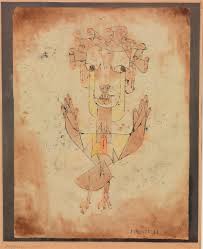
As a ghost sent from the past into your world my presence involves no small amount of incivility. So much clanging about and reckless rage, while confined to dark digital outposts, still demands an audience, someone to haunt. In any case, it has never been your world, or our world, always their world. We were just thrust into it, and told to make our way, however difficult. So if my desperate whispers fall on your ears as so many dark forebodings, they also contain within them the possibility of another future.
Can a ghost dream? If so, what kind of dream would a ghost dream? It would be a dream filled with longing and regret, to be sure, but also, free from the past, a dream of reckless abandon, an imagination allowed to run riot. It is a dream that cries for a future free from an insufferable past and an intolerable present.
In this, the dream I dream is not unlike that cool and sardonic description of heaven as told by the character Belize to a fictionalized Roy Cohn in Tony Kushner’s Angels in America: A Gay Fantasia on National Themes. Twenty-five years after its first production the play is experiencing a welcome revival, no doubt because of scenes like this one:
I’ve taken the liberty to transcribe HBO’s version of Kushner’s play. Please pardon in advance my light editing and any errors.
Belize: “You awake? Can you see who I am?”
Roy Cohn: “Yeah. You came for my momma years ago. Wrap your arms around me now…”
Belize: “Who am I, Roy?”
Roy Cohn: (laughs) “The negro night nurse. My negation. Come to escort me to the underworld…”
Belize: “You want me Roy? You want me to take you away?”
Roy Cohn: “Oh, God I’m ready.”
Belize: “I’ll be coming for you soon. Everything I want is in the end of you.”
Roy Cohn: “What’s it like after…this misery ends?”
Belize: “Hell or Heaven?”
Roy Cohn: He….(Roy trails off)
Belize: “Like San Francisco.”
Roy Cohn: “A City! Good. I was worried it would be a garden. I hate that shit.”
Belize: “Hmm. Big City. Overgrown with weeds, but flowering weeds. On every corner a wrecking crew and something new and crooked going up catacorner to that. Windows missing in every edifice, like broken teeth. Gritty wind and a gray high sky full of ravens.
Roy Cohn: “Isaiah.”
Belize: “The prophet birds, Roy. Piles of trash, but lapidary, like rubies and obsidion, and diamond colored cowspit streamers in the wind. And voting booths. And everyone in Balenciaga gowns with red corsages and big dance palaces full of music, lights and racial impurity and gender confusion. And all the deities are creole, mulatto. Brown as the mouths of rivers. Race, taste and history finally overcome. And you ain’t there. ”
Roy Cohn: “And heaven?”
Belize: “That was heaven, Roy.”
Indeed. Yet as Kushner has acknowledged, many years after publishing Angels, that future is not here, in San Francisco or anywhere else. Besides, even our most beautiful rebels, like Belize, are still, at best, changing the bedpans of the Roy Cohns of the world, rather than topping off that dose of morphine. Heaven must be conquered, brought into being, rather than received as a gift, upon surrender.
In order to dream a future at odds with the only one our present has on offer (the doctrine of TINA) one must identify who and what stand in the way of the realization of that future–one has to theorize an enemy, then a way to defeat that enemy. Kushner’s character Belize does this, and yet seems a bit too secure (smug even) in the notion that his heaven is the future.
Part of the problem, I think, is that smugness exhibited by Belize, so often on display by today’s liberals (think Rachel Maddow) and not a few historical materialists (Perry Anderson), reflects a belief that history is a necessary evolution, a slow but certain unfolding of ‘progress’, an arc always ‘bending’ towards justice. It is not. It just moves, hither and yon, not backwards or forwards. Where it moves and the quality of that movement is at least in part up to us. We may not make it move within conditions of our choosing, but move it we must.
Dreaming is a precondition for liberation; an essential rupture with ‘what is’, a reimagining of what is possible and and a fierce interrogation of ‘progress’. It is also essential for an effective anti-fascism.
In 1940, in the midst of a world-wide fascist explosion, just prior his suicide, Walter Benjamin said as much. From Benjamin’s On the Concept of History, Thesis Nine:
“There is a painting by [Paul] Klee called Angelus Novus. An angel is depicted there who looks as though he were about to distance himself from something which he is staring at. His eyes are opened wide, his mouth stands open and his wings are outstretched. The Angel of History must look just so. His face is turned towards the past. Where we see the appearance of a chain of events, he sees one single catastrophe, which unceasingly piles rubble on top of rubble and hurls it before his feet. He would like to pause for a moment to awaken the dead and to piece together what has been smashed. But a storm is blowing from Paradise, it has caught itself up in his wings and is so strong that the Angel can no longer close them. The storm drives him irresistibly into the future, to which his back is turned, while the rubble-heap before him grows sky-high. That which we call progress, is this storm.”
All of our 21st century gizmos and widgets, all that seamless connectivity and disruptive productivity brought on by our gigantic mega corporations are entirely compatible with a neo-fascism now only in its pre-pubescent stage. Fascism is not the reemergence of some ancient bigotry from prehistory, it is one possible future asserting itself, and in this assertion another form of capitalism is being constituted. Behind the progress of Peter Thiel and Elon Musk is a craven figure who cringes and obeys for a piece of chocolate. That figure is us, unless we discover a way to bring about a rupture with that ‘progress’.
In an article on Benjamin’s eclectic anarcho-communism in Jacobin (“The Young Benjamin”, Jacobin Blog, January 8, 2016) Michael Löwy locates the failure to apprehend fascism within the evolutionary socialist tradition represented by the philosopher Jürgen Habermas. Löwy writes:
“An evolutionist conception of history, which believes in the necessary progress in the forms of domination, can hardly give an account of fascism — except as an unexplainable parenthesis, an incomprehensible regression ‘in the middle of the 20th Century.’ Now, as Benjamin wrote in his Theses, one cannot understand the meaning of fascism if one considers it just an exception to the historical norm which would be progress.”
Lowy notes that “Benjamin understood the 20th century as one of barbarism and modernity — an interconnection which would take, a few years after his death, the catastrophic figure of Auschwitz and Hiroshima.”
War is coming; and with it the soil within which fascism grows is fertilized.
END
12 Monday Feb 2018
Posted in Essay
 In winter the rain-soaked Pacific Northwest wind finds its way through split bricks and cracked beams. It is fended off with wood stove and blankets, occasionally the warmth of a kindred spirit. From my office in this ramshackle warehouse, set next to a railroad crossing busy with jostling container cars and the occasional furtive hobo, surrounded by artists, counterculture types and a few working class intellectuals (some of whom work at Powell’s Books, a temple for what remains of the graphosphere) I engage in my phantom labor: interrogating the past so as to excavate the future.
As I leaf through old texts, always on the lookout for how fascism is apprehended by comrades and enemies alike, I find references to a scholarly work from the 1970s and a novel term of abuse from 2015. Together, they tell us something important about fascism, and, perhaps unexpectedly, the left.
The first text sends me to the Dead Letter Department of Anglo-American academia. Here I find the work of an American sociologist describing–even if he didn’t use this terminology–an American form of fascism. As with many advances in science and technology, the key insight from this work was stumbled upon and then, as with a miss-addressed letter, returned to sender. Unfortunately, that return address hasn’t been viable for forty years. But at least someone found it, opened it and read it, before sending it back to the Dead Letter Department, where it awaits some old-ghost to reinterpret its contents.
In 1976 the sociologist Donald Warren published The Radical Center: Middle Americans and the Politics of Alienation. From this work he coined the term “MARs”, an acronym formed from ‘Middle American Radicals’.
Warren and a team of researchers developed the concept of the MARs in an attempt to explain the results of their in-depth personal interviews, demographic research and attitudinal surveys collected over a period of years in the early 1970s. What they were studying was white people–a bunch of white people who, Warren noted, held beliefs seemingly at odds with their economic position–a polite way of saying social class. The book was published in 1976 and has been trotted out by liberals (John B. Judis), conservatives (David Brooks), paleo-conservatives (Samuel Francis) and even radicals (Zaid Jalani for Alternet) whenever recurring eruptions of ‘populism’ have needed explaining. All of these authors, and many others, misinterpret the singular insight Warren provides in The Radical Center. While this insight is related to his term “MARs”, it is a bit different from it, too.
So, what is it about Warren’s study, a work from the margins of sociology, published in relative obscurity and without much of a readership, that nonetheless remains attractive to analysts across the political spectrum? And what is that special something I think he discovered, that has been hidden in the Dead Letter Department?
If, as I contend, fascism has an ideology, a political economy, a social base and a geography, it also has a motor–something that once switched on sets it in motion, propels it in a particular direction, and must be engaged for it to keep going.
Early on, in order to will itself into being, fascism will engage in a double movement of fighting elites above and the working and non-working poor, below. This vertical double movement is from an oppositional political footing that is also deeply contradictory. It is at once set against certain elite centers of power but still closely tied to them; a semi-permeable membrane separating and binding together the two. I call it the MARs Motor. While this concept of a fascist motor¹ is mine, I didn’t identify the mechanics that underlie it; that was formulated by Warren, and as with many important discoveries, he was looking for something else.
From page 14 of The Radical Center:
“Thus, an “ideological perspective” seemed to emerge from our in-depth exploratory interviews. This ideological point of view does not readily fit the traditional notion of “left wing” or “right wing” convictions. Instead, it seems to embody, a distinct orientation of multiple threats of being caught in the middle between those whose wealth gives them access to power and those whose militant organization in the face of deprivation gains special treatment from the government.”
This is the only significant explanatory passage in some 260 pages that Warren sets apart and italicizes; it is the nut of what he is arguing. And its easy to see why it appeals to a broad political spectrum. For Warren social class didn’t neatly correlate with political consciousness. Likewise, the notion that something was needed ‘beyond left and right’ to assuage the ‘alienation’ of people trapped in the middle seemed appealing to a growing consensus that there was no longer ‘class conflict’, only entrance into the ‘middle class’ or banishment from it. But the relatively anodyne passage above doesn’t really capture why a growing number of ‘white ethnics’ (to use the terminology of the day) seemed to be wrenched loose from their traditional moorings within labor unions, the Democratic Party and liberalism. Why would they turn toward a radicalism that was in many ways anathema to mainstream insititutions–the presidential candidacy of George Wallace, for instance?
Warren’s singular insight, sketched out in the passage above, is developed further:
“The Middle American Radical perspective was developed from interviewing numerous individuals who felt very threatened by problems that were not immediately related to their economic position in society. Such individuals, in some problem areas, directed their scorn toward, and felt threatened by, groups which they seemed to consider lower in status than themselves, such as the organized poor and minority groups. At the same time we found that many individuals were deeply concerned about the status groups above their own…An additional element in this discussion of threats from the rich, the poor and the minorities, was the role of the government as an arbitrator of group interests.” (pgs. 13-14).
What is important here is that this ‘something’ be identified, if some four decades later, as nascent white nationalism, an American fascism just waking up from its slumber, still within the paternal confines of the Cold War anti-communist consensus, but nontheless self conscious of its relatively independent nature. What Warren described would become known as the ‘paleo-conservative right’, originally fronted by Pat Buchanan, later to re-invent itself as the ‘Alt-Right’, the key component of Donald Trump’s 2016 Presidential victory. What I call it is nascent white christian nationalism, the American form of fascism.
The MARs Motor is a feature of fascism that sets it apart from run-of-the-mill conservatism and right reaction. While often considered to be a red-headed bastard step child of the broader conservative family, it is still, regardless of what neo-conservatives might argue, a member of that family. The MARs motor is an essential ingredient in the fascist repetoire that signals it is on the move. It is the struggle with an ungrateful elite above and the unworthy poor below. If they are not engaged in a struggle with both, they are something else. In the capitalist core the political expression of this movement must take the form of white nationalism. Today, throughout Europe and North American a new fascism is being forged that seeks to reinforce a political geography of white christian nationalism and with it a new identity as a dispossessed and besieged minority. It is arrayed against the Global South, making socialist internationalism that much more important. Fascists, to be fascists, must fight above and below, then near and afar. The near and afar come when they go to war–and war is coming.
The dynamic Warren identified is a feature of fascism, not populism.² There is no such thing as populism, other than as a term of disparagement. But there most certainly is something called fascism. What Warren stumbled upon was indeed ideological, rather than an expression of a class position, a wooly conspiracy theory or a response (legitimate or illegitimate!?) to rising expectations, declining prospects, relative (or absolute) deprivation, etc. He documented a fundamental shift then just underway in the imaginary of the far right, from defenders of the white supremacist Jim Crow status quo to the newly dispossessed (white, silent no more) majority. White racism was developing a new character in the post-civil rights movement era, essentially morphing closer to an American fascism, something that their European counterparts would come to recognize. The defeat of de jure white supremacy by the civil rights movement set fascism back, but also offered a new horizon in the way of white nationalism, previously made redundant by the state’s own formal white supremacy. In a way, nationalism and racism had to shift terrain, in order to survive. And they did.
But from the dizzying heights of academic disdain, it’s difficult to understand any of this. And Warren, while I’m sure a nice guy, is a product of an institution that is largely incapable of getting it. Even the title of his book includes the phrase “politics of alienation”, by which Warren most certainly did not mean the alienation of workers from the products of their labor, but rather their ‘alienation’ from the splendid institutions of progress that American capitalist democracy had on offer at the time.
Following this, The Radical Center occasionally coughs up a cringe-worthy paternalism that regards its subject as a wayward child. But in this it was only following accepted conventions then (as now) regnant throughout sociology, political science and history. Behind virtually every study of populism (or todays Antifa, for that matter) is an implicit rebuke: Why would anyone reject freedom and democracy for extremism, especially when doing so is against their own interests? As in a shlocky horror film, academics peer into their brains, trying to determine what the hell is wrong with them and how they are to be fixed, or, more often than not, cured of whatever disease is causing the epidemic. The most extraordinary thing about Warren’s work was how a sociologist so obviously indebted to the head-patting paternalism of Richard Hofstadter and his ‘Paranoid Style in American Politics’, could have identified a key element in the development of a nacsent white nationalism in the United States, without ever calling it that, much less understanding it as such. But Warren obviously meant well, I’ll give him that. And he largely took his subjects at their word, a singular accomplishment at that time, as any.
All conservatives and liberals share this fundamental outlook about the far right and far left. But these angry white people still know what side their bread is buttered on. Capitalism creates the zero-sum game within which racism is made (and remade) normative, the conspiracy theory rational, the mode of exploitation necessary and eternal, the act of mass murder justifiable. If there is psychological projection here, it is on the part of patrician academics and their media chatterboxes and sycophants, products of their sociotope, which treats all radical politics as childish and utopian.
To state that this overall approach to the far right is emblematic of the dominant thought running througout all conservative, liberal and many socialist traditions would be an understatement. It is also central to why the return of right reaction surprises everyone except anti-fascists.3 And militant antifascists have a unique perspective on this recurring phenomemon. In trying to understand fascism, it sometimes helps to kick its ass. Empirical knowledge has its foundation in experience; there’s nothing quite as illuminating as the direct knowledge that a fascist is but a meat sack. But I aggress.
For Warren, the challenge was to identify a feature both constant and unique to his term, ‘middle american radical’. He would run up the flag pole the whole gamut of sociological, demographic, psychological and political markers that contend, but fail to achieve, the empirical throne: the ‘silent majority’, an ‘ethnic’ (pretty much white, working class Catholic), the alienated, forgotten, angry, troubled, disillusioned, ‘relatively deprived’; the “not quite poor American living in the not altogether affluent society” and so on. Then, Warren looked to income and education levels and labor union membership, for some kind of control for those pesky variables, again to no avail. Having dispensed with all these pretenders to the throne, Warren would attempt–like so many before and after him–to place the giant elephant in the room (racism) into some service of his middle american radical definition, but by calling it anything but that. What’s most important here is the all-too-common analytical operation of identifying discrete ‘races’ and correspondingly ‘race relations’, but not racism as the feature that structures important beliefs. And it’s mostly unconscious, an implicit given, shared by well-meaning academics, that remains operative today. And so long as one operates from these assumptions, nothing will make sense.
The motor of fascism has another aspect of importance to radicals, something that becomes visible by way of contrast. If fascists constitute themselves by fighting above and below, radicals do the same (come into being) by fighting the rich, and only the rich, and their homunculi, everywhere. Socialists become something else if they allow the bonds of solidarity that unite peoples in struggle to dissolve through racism and nationalism. Socialists should never fight the poor masses, but from a restrictive, narrow definition of who is a worker, especially during war, they risk doing precisely that. Cue a reference to the great betrayal of the socialist international in 1914. To be a socialist is to have an expansive definition of what it is to be a worker, the poor, the marginalized. The fault line here is nationalism, but not all nationalisms, just the form it takes in the core.3 White nationalism. The failure to organize the ‘unorganizable’, to swim within the great ocean that is the brutal exploitation and domination of the lowest of the low, is on display when socialists look to their betters above, and want to be like them, rather than put their heads on a platter.
Back in my office I am laughing at a zinger from a right-winger.
The hilarious epithet ‘Trumpen proletariat’ was first introduced to our political lexicon in 2015 by the effervescent right-winger Jonah Goldberg, who scribbles for National Review and the American Enterprise Institute. Goldberg is also the purveyor of a related term, ‘liberal fascism’ (a smiley face with a Hitler mustache adorns the cover of his book by the same name). But while his cockamamie thesis about fascism having roots in the family tree of liberalism was effectively savaged by scholars such as Roger Griffin, his ‘Trumpen Proletariat’ hits on all cylinders, at least as polemic, if not analysis.
As a tripartite portmanteau of ‘Donald Trump’, ‘lumpen’, and ‘proletariat’ the epithet at once mocks Trump as an interloper among political elites, while asserting his followers are of a plebeian nature (lumpen) best understood as an outgrowth of the left (proletariat). But it misunderstands all three terms, in a perverse manner and that’s why it’s funny–a billionaire leading the scum of the earth in a left-wing revolution. What the fuck. But, it succeeds in another way that is altogether uncomfortable for some radicals.
The term ‘lumpen’ is used by many Marxists eager to explain why certain people won’t accept socialism–can’t accept socialism–principally because they are not workers or the peti-bourgeoisie and are therefore unorganizable. When Marxists consider a hefty portion of any population to be an undiferentiated mass of criminals and ‘deplorables’ you can count on any ‘revolution’ they lead being one that maintains inequality, class divisions, violence and oppression. These undesireables don’t count among the proletariat, and usually don’t figure in Marxist equations for social transformation. If they do it is as the gangs that support fascism. They cannot be organized, only neutralized or destroyed. There is a long history of what I call patrician socialists deliberately sabotaging efforts to organize with the lowest of the low. But know this: when the slum dwellers, gang bangers, outcasts and unemployed are condemned to the orthodox Marxist original sin of non-participation in the formal economy, when they are dismissed and discarded as so much “human dust”, you ensure they will be organized by themselves, by others, or not at all. In any case, many will turn to the right, or all the way to fascism. Indeed, many have probably completed that journey and are wearing MAGA hats rather than joining Redneck Revolt.
This contempt for the common people (plebians) is most pronounced among elite liberals and conservatives–indeed it is central to their world view.
Gary Kamiya, a co-founder of Salon magazine, explained back in 2011, apparently in all seriousness, that the childlike behavior of Tea Partiers could be understood by resurrecting Hofstadter, whose work, Kamiya writes was “penetrating…prescient…brilliant” (all three adjectives in one sentence).
Kamiya, in his article “The Infantile Style In American Politics” (a nauseating homage if there ever has been one) excerpts the following from Hofstadter’s The Pseudo-Conservative Revolt — 1954:
“[I]n a populist culture like ours, which seems to lack a responsible elite with political and moral autonomy, and in which it is possible to exploit the wildest currents of public sentiment for private purposes, it is at least conceivable that a highly organized, vocal, active and well-financed minority could create a political climate in which the rational pursuit of our well-being and safety would become impossible.” (Salon, December 5, 2011).
Well, you could say that it was 1954 when Hofstadter wrote that, but it was the 21st century when it was adoringly quoted by a liberal fucktard. To do this passage justice one should channel the inimitable Mid-Atlantic lock jaw of William F.Buckley jr. or Gore Vidal, or perhaps its 21st century liberal identitarian version, the incessant screeching of Arianna Huffington, who learned how to embrace the weirdness of her cacalogical musings by sidling up to Henry Kissinger–the very definition of elite creepy weirdness–so she can now lecture Uber drivers on getting more sleep, so they can starve more efficiently. Those accents are as entirely contrived as the bullshit it enunciates so clearly.
But this is not about otherness or rising above being weird, it’s about believing you are an Optimate and that capitalism offers upward mobility to all who would just strive to climb the ladder of success. But climbing means your foot is best positioned on someone else’s neck–someone below you.
From the Financial Times (December 6, 2016).
“When Trump first ran for President, the Huffington Post had each story that mentioned him print a byline that described him as ‘a serial liar, rampant xenophobe, racist, misogynist and birther’. But when I ask whether his victory surprised her, she says no. She points me to her 2010 work Third World America. ‘Its about the fact that many parts of America have become third world. They are the people who voted for Trump.'”
Right. How effortlessly Huffington links Trump with the lumpen of the global south, now invading America. How convenient for a millionaire, many times over.
This elite visceral reaction to Trump is not resistance–its hatred and fear of the hoi polloi, channelled in a narrow, self-serving direction.
This disdain for the masses by ‘people of property’, to use a phrase by that war mongering skeezoid David Frum, are to be expected and should cause no sense of surprise. But they tend to take other forms when issued from on high from the left. Any radicalism that traffics in this stupidity aids the growth of fascism.
On the other hand, dismissing the importance of racism in structuring political and social life can lead to other pitfalls. For instance, consider two very recent political developments, the first a ‘controversial’ policy effort on trade by the Trump administration and the second an extraordinary expression of worker militancy in a state that most recently flipped so hard to the right that Mike Davis thinks it might end up setting a Guiness World Record.
Trump’s imposition of tariffs on steel imports should not be understood apart from this:
Here, to be clear, more than one-year after his assumption of the presidency, is Trump offering a sop to his working class base, albeit one that probably won’t help anyone. In fact, it might hurt more than a few. But its good optics. It means, in part, that Trump, now more than a year into his tenure, is finally rewarding white workers–practicing patronage if you will–and thereby growing the political, cultural and ideological space within which fascism can thrive. He’s also building his re-election bid. And no, it doesn’t mean all steel workers are racists–it means anti-racism needs to happen there in conjunction with socialist work, or that constitutency will be lost to fascism.
Then there is the West Virginia wildcat teachers strike, which should not be understood apart from this:

The extraordinary fact that an illegal strike–a wildcat strike!–on the part of public employees was not put down by the state should be considered in light of Mike Davis’ Jacobin article of February 7, 2017 “The Great God Trump and the White Working Class”.
Davis writes,
“The exception [during the 2016 U.S. Presidential election] was West Virginia where the Democratic wipeout was so enormous that it will probably end up in Guinness World Records. Only Wyoming gave Trump a higher percentage of its presidential vote. But even more striking than his 42-point margin of victory was the fact that Clinton received 54,000 fewer votes than were cast earlier for candidates in the Democratic primary — a contest that Sanders (125,000 total) won in every single county…a large minority of working people, custodians of a heroic labor history, are ready to support radical alternatives but only if they simultaneously address the economic and cultural crises of the region.
The struggles to maintain traditional kinship networks and community social fabrics in Appalachia or, for that matter, in the embattled Black-majority counties of the former cotton South, should be every bit as important to socialists as defending individual rights to make free reproductive and gender choices. They’re usually not.”
Isn’t that the truth. But how to explain such an incredible volte-face? Is there a relationship between renewed worker militancy in West Virginia and its recent turn to the right that should be theorized in relation to fascism? Saying as much doesn’t mean any number of unsupportable corollaries; for instance, that West Virginia teachers have become white nationalists. Perhaps the only space available for labor militancy is in a state like West Virginia? Why would that be the case? While there is no doubt that the overwhelming popular support hard-won by West Virginia teachers came about as a result of direct action/mutual aid tactics like providing free lunches to kids out of school, thereby denying their opponents a dirty wedge with which to divide the movement (your’e hurting the children!), it can also be partially attributed to the fact that West Virginia is not Mississippi.
And while much of what Davis has written about Trump is true in a narrow electoral sense, it doesn’t adaquately capture what is going on here. And Jacobin, while correctly applauding the heroism and militancy of the West Virginia teachers, fails yet again to explore the larger context of a growing fascism, not least because their editorial line doesn’t recognize the existence of that political phenomenon.
This is how the Australian anti-fascist Angela Mitropoulos can accuse Jacobin of “authoritarian Left nationalism” or Strasserism, for printing articles by Die Linke leftists that argue for a ‘tightening’ of Germany’s borders. In its coverage of the West Virginia strike Jacobin buries that state’s recent political developments in the perennial and futile search for revolutionary agency that is myopic, at best. My response to Mitropoulos’ admittedly polemical attack on Jacobin is a riff from the comic Chris Rock, who approached the obvious guilt of OJ Simpson by saying: “I don’t agree, but I understand.”
23 Tuesday Jan 2018
Tags
alt-right, anarchism, anti-fascism, antifa, coalition for human dignity, communism, fascism, it’s going down, Nationalism, Racism, rose city Antifa, skinheads, socialism, spycraft, steve bannon
I probably cut an odd figure in my Carhartt Washed-Duck Tool Pants, black Thrasher hoodie and industrial neoprene gloves. Waist-deep in a dumpster I am making a fashion statement of sorts, wading through the quotidian refuse of an office park: coffee grinds, fast food containers, styrofoam peanuts, cardboard boxes, used printer cartridges and, much to my chagrin, the occasional dirty diaper. It’s 1990 and my comrades and I are ‘dumpster diving’ out in the suburban sprawl of Portland, Oregon. But it is neither food nor salable commodities we seek. We are churning through garbage in search of the political droppings of a far right organization housed there. The take from this ‘trash cover’ (to use a term of the trade) could help neutralize a far-right group, or at least make less effective their attacks on vulnerable communities. After a few night’s worth of applied garbology–Disco! Reams of perforated computer paper reveal detailed membership lists. We don’t have time to do anything other than scan it–the headings confirm it is from our target–so we bag the loot and skidaddle.
Your trash, my treasure–asshole.
From there the black garbage bags are transported to a warehouse where the really difficult slog begins. We spread out a large tarpaulin and separate the wheat from the chaff. What we call raw, primary data–everything from membership rosters to post-it notes, utility bills to grocery lists–is sorted and prepped so as to be of some use. Then we feed the raw data into already existing databases and files, cross referencing it to identify matches and points for further analysis. In other words, manual data entry is how we transformed data into information (no shortcuts from analog to digital back then). If we do our opposition research well, that information can reach its final form: actionable intelligence. For instance, the computer printouts provide detailed information on the targeted organization’s supporters–donation amounts, addresses, phone numbers, occupations, etc. Some of those donors may not want their identities released to the public. We do. Likewise, the discovery of internal memoranda can provide a window into a group’s organizational capabilities, relations with other political formations or even internal dynamics, such as factional fights, that we can exploit. Finally, a report can be generated and the findings ready for dissemination. Then it’s back into the dumpsters and the process repeats itself. From data collection to information analysis to actionable intelligence.
Our fashion statement is also therefore a political statement.
In all of this our team of researchers were practicing a form of ‘para politics’, i.e., political conduct apart from voting or demonstrating, polling or political speech. There are other, less charitable meanings associated with this term, but I am employing it here in a relatively value neutral manner. This is, of course, the province of the Antifa. For our purposes here, let’s call it Antifa spycraft.
If my late-night shenanigans of decades past often yielded material for critical print, radio and television stories on the far right, they also often helped communities better protect themselves from attack. In this case, our information helped ‘out’ more than a few ‘down low’ bigoted businesses and politicians. Oh, and it was legal. In many locales, the laws around trash collection are often ambiguous. In this case, because the material we absconded with was in a dumpster, it was no longer private property. Likewise, depending on your locale, once your garbage can is out on a sidewalk or street, it may be free for anti-fascists–or fascists, for that matter–to rummage through. This low tech tactic of opposition research–today’s equivalent of hacking someone’s digital footprint–was a time-honored weapon in the Antifa arsenal. But not the only weapon.
If back in the day we had a ‘trash cover’ on an enemy political group, there was a good chance we also had an infiltrator attending meetings and other activists taking down license plates and shooting video and photos of their events. Much like the shitheads at Project Veritas and Brietbart News do now, but long before those clowns were selling their hack jobs to their paymasters, we pushed the limits of acceptable political engagement. Today, effective anti-fascists, especially those grouped around Rose City Antifa and It’s Going Down, as well as activists featured in Mark Bray’s Antifa: The Anti-Fascist Handbook understand this. It’s well past time to have a debate with those socialists and other radicals who don’t seem to get it.
That the political tradition and contemporary efforts of the Antifa are valuable, even essential, to the broader socialist struggle is not accepted by all comrades. In spite of an honorable and effective history, there are left radicals who not only dismiss this work, but denigrate those who practice it. Quite a few regard the most militant and therefore visible actions of the Antifa as anathema to our broader struggle. Many misguided socialists prefer to ignore this vital work or, when such intelligence is used by an Antifa fighting force, such as in Charlottesville, raise cries of ‘adventurism’, perhaps laced with a quote from Lenin on infantile disorders.
But if you ask this old ghost there is nothing more infantile than attacking the work of comrades you know next to nothing about; except, perhaps, doing so from a Marxist theoretical framework so sclerotic it can regurgitate that fatal stupidity all veteran anti-fascists are familiar with: “The enemy is not fascism as much as it is capitalism that exploits the working class according to democratic and civilized norms that would never be associated with the swastika or other fascist regalia.” (‘Antifa and the Perils of Adventurism” by Louis Proyect, August 15, 2017. My emphasis). Proyect, whose nom-de-chair is The Unrepentant Marxist, slanders antifa activists when he’s not busy digging himself out from under all the free dvds (he never tires of letting us know) tinseltown sends him for film reviews.
He goes lowest when addressing the street battles between anti-racists and neo-Nazis that took place in Charlotesville last year.
He writes, “Turning now to Charlottesville, it is obvious to me that if the protests had been disciplined and under the control of marshals such as was the norm during the Vietnam antiwar movement, there would have been much less of a chance that James Fields would have been able to drive his Dodge Challenger into a crowd, killing a young woman and injuring 19 others.”
Here Proyect is laying the death of Heather Heyer at the feet of the Antifa, instead of where it belongs, with the neo-Nazi who ran her over. Elsewhere he refers to Antifa activists as ‘boys’ engaging in ‘childish acting out’. And unruly boys need discipline, don’t they? Proyect apparently wants cops, in the form of movement ‘marshals’, to get them back in line, with a spanking, if necessary. This bit of scolding he digs up from his glory days in the abject failure that was the Vietnam antiwar movement. But the important lesson of Charlottesville is completely lost to Proyect, which is in the role the Antifa played in protecting religious pacifists from attack. Cornel West testified to this development, something that should be built upon. Leftists with integrity, who know when to shut the fuck up when they are out of their element of expertise, should support the Antifa, not hang them out to dry.
What Proyect does not understand is twofold: the nature of neo-fascism in the 21st Century and how a corresponding anti-fascism, to be effective, must be somewhat different from other forms of protest and organizing.
By definition Antifa organizing must contend with vigilante forms of attack–those that have their origins largely outside the state repressive aparatus. In other words, fighting racist assholes is not the same as going door-to-door collecting signatures for a ballot initiative or candidate, much less reviewing the latest art house cinema production.
The hinge that supports the door through which all revolutionary antifascists must pass–from a coherent definition of fascism to a retooling of anti-fascism–is intelligence, by which I mean spycraft. There is no substitute for knowing your enemy, preferably much better than they know themselves. No one else will do it. Cops reduce everything to their bailiwick: criminality. Reporters personalize the far right, always looking to sell a story. Academics do post-mortems with an eye towards predictability–usually unconnected with the flesh and blood Antifa struggle and therefore too little, too late. Liberals wring their hands about free speech and fumble about for that phantom limb within the democratic party that might deliver them from ‘hate’. Anti-fascists are the only political force intent on destroying both the conditions that continually regenerate fascism as well as the recurrence of the fascist plague itself.
This role can only be successfully carried out by anti-fascists who employ measures of antifa spycraft against our enemies. One cannot gain this critical advantage through anything other than counter-intelligence: no amount of long-form analyses of the falling rate of profit or the changing demographics of the working class will tell you this and it cannot be divined through oracles–whether in the form of tea leaves or data science. Anti-fascists must have the ability to infiltrate neo-fascists both to disrupt and neutralize their efforts and to protect communities they attack.
How to do this begins with a counterintuitive hidden in plain view. The state, law enforcement in particular, is governed by a set of regulations that are not the same as those that govern citizens and many others. People can engage in intelligence gathering in ways that are often (though not always) rendered problematic for a cop or official. Furthermore, the person of interest to an antifa spy is often not a public official but a private citizen, perhaps a public figure, in many ways more open to surveillance and their networks thereby to penetration. This also applies to the civic and political groups a far right activist works with. While it may be quite beyond the technical capability of an antifa activist to hack the confidential informant records of a local cop, it is certainly within their capability to wade through the trash of a local fascist.
Today, many Antifa groups continue in this same tradition with detailed, publicly available and actionable intelligence on far-right activists–mug shots, addresses, workplaces, quotations, etc. Furthermore, contrary to claims that it’s too expensive and/or complicated to practice spycraft (leave it to the professionals!?) amateur spies are essential to the Antifa. Another way to think about this is that the type of struggle the Antifa is engaged in will in large part determine its methods, much like clinic defense organizations have long utilized opposition researchers in their work defending clinics against the anti-abortion movement, especially when they cannot rely on the state to do so.
It should be obvious that fighting the far-right is not the same as fighing corporations or the state; and the Antifa is not synonymous with the Black Bloc, another elementary distinction that eludes Proyect, but will have to wait for another time.
To continue, a cop generally has to have ‘probable cause’ to search through someone’s garbage and will likely be required to leave a paper trail (digital footprint) of their activity. In other words, because of the oppositional nature of much of the far right–the fact that it occupies a contradictory relationship with the state, often outside of it and even opposed to it–forms of anti-fascist resistance can penetrate it by different means. Opportunities for disrupting the far right present themselves in ways that organizing a union drive at a multinational corporate factory do not, and, also, that creative intelligence work can provide the basis for work between communities that might not otherwise work together. This doesn’t, of course, mean that elements of the state don’t overlap with the far right (after all, Donald Trump is president) but that anti-fascists need to take the threat of their activism seriously.
In my experience the value of anti-fascist work was always best determined in close consultation with other radical groups and communities targeted by the far right. In “Death to the Klan” and Armed Antifascist Community Defense in the US (It’s Going Down, July 26, 2016) there is a useful review of such efforts in Portland, Oregon during the late 1980s and 1990s.
“…[groups] like the Red and Anarchist SkinHeads (RASH) and the SkinHeads Against Racial Prejudice (SHARPs) found themselves in frequent battles with neo-fascists converging on Portland. A group called Coalition for Human Dignity (CHD) activated not just to beat back the onslaught of skinheads, but to transform racial consciousness in Portland. They used the strategies developed by ARA [Anti Racist Action] to expose and shame skinheads wherever they showed their faces, getting them fired from their jobs and evicted from their apartments. However, when skinheads began to harass local members of the community, attacking their houses and cars, CHD devised a decentralized community self-defense strategy.”
In the same article an old Portland comrade of mine, M. Treloar, is interviewed by It’s Going Down activists and elaborates:
“There were several situations where our people who had concealed weapons were confronted by groups of boneheads and either pulled the weapon or made it clear that they were armed and the boneheads backed off…There is no doubt in my mind that in several instances they would have been attacked, since we had people who were taking down car license plate numbers, staking out houses or infiltrating gatherings.”
“The CHD mobilized to form a media defense position, which helped generate positive public opinion….What’s notable is again the people who attacked the boneheads after a certain point did very little time, and were generally hailed as heroes in the community…”
From very early on the work of the Coalition for Human Dignity in Portland, Oregon (I was a founding member) targeted the social base of neo-fascism: white nationalism and the Christian Right. This definition intentionally cut across class lines–rendering racist reaction as neither the exclusive rotted fruit of the ruling class (capitalism releasing fascist antibodies to protect itself) nor principally the unresolved grievances of a white working class left behind by captialist development (two fairly typical myopic explanations of the re-emergence of the far-right.)
Back then, much as today, the issues of choice for far-rightists were anti-black and anti-latino racism and homophobia. It should be noted that at this time (1980s-1990s) the two main political parties and all statist anti-hate groups (SPLC, ADL, etc.), scrupulously avoided homophobia as a political issue and did not include bigoted elements of the Christian right nor anti-immigrant groups within their definition of ‘hate groups’. It was radical LGBTQ and fight-the-right activists who pushed them to do so by being more effective than they ever could be. But, nonetheless, organizing in the early nineties had to contend with the routine dismissals of the Christian Right as backwoods hicks, neo-Nazis as cults and criminals and racist skinheads as yet another counter-cultural youth rebellion, all destined to pass–if they hadn’t already–into the dustbin of history. But they didn’t, and neither did we. So many premature obituaries of the Paleo-conservatives and the Christian Right have been issued and reissued since then that it is staggering to consider not only their continued relevance today but their central role in the Trump electoral victory, and how spectacularly wrong those analysts were about their political prospects.
Many months after Trump’s victory, in a series of articles for Catalyst, Jacobin and New Left Review one of the most astute Marxist analysts today, Mike Davis, finally got around to noting the confluence of white nationalism and the Christian Right in Trump’s victory. That it took so long for the socialist left to make this observation is disturbing and highlights the fact that if anti-fascists lack the theoretical sophistication of New Left Review contributors, they more than make up for it by actually fighting fascism and capitalism, rather than just writing about it, after the fact.
On the other hand, if antifa groups want to have a say in how to oppose fascism, theoretical clarity is certainly important. The reason the best anti-fascist fighters have always come from socialist, anarchist and communist traditions is because they understood the first principle of anti-fascism: fascism is our mortal enemy, and must be fought.
Saying as much need not always involve alliances with liberals and conservatives that necessarily mean capitulation to those forces. If one has a decisive advantage in intelligence, it can be used to establish the political parameters of such alliances or agreements. If, however, antifa groups do not have an ‘intelligence capacity’ they will cede the right to effectively fight fascism, and thereby protect communities under attack, to others. That right, by the way, is earned; sometimes in a dumpster.
Blog of the Crowd Counting Consortium
Thoughts on life... by Donald B. Wilson
gehadsjourney.wordpress.com
Recipes showing step by step directions with pictures and a printable recipe card.
The Storyteller (Qissa-Go)
educator, writer, photographer
A hotchpotch of random stuff I'm working on... articles, songs, writing/YouTube projects
4 out of 5 dentists recommend this WordPress.com site
Historian. Organizer. Writer.
The Web log of Dr. Joseph Suglia
 Ghosts of Anti-Fascism Past